
A damaged pack is a stop condition, not a discount
A swollen cracked battery is crossed out beside a three-line identity and inspection record.
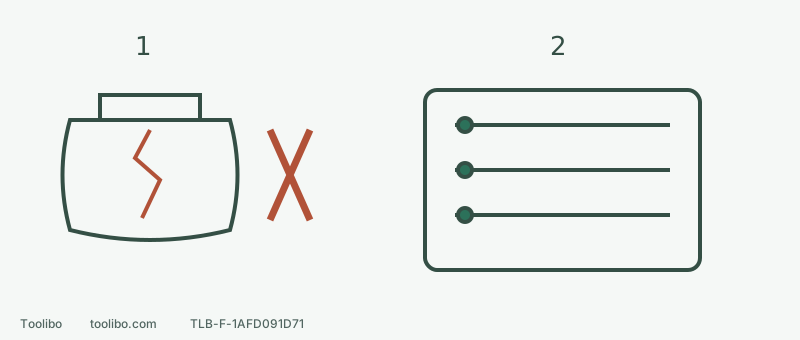
1 · Do not power a damaged pack
Smoke, leaks or abnormal heat: do not approach to touch or remove it; move away and follow emergency arrangements.
2 · Record the unresolved checks
Record exact tool, battery and charger identities, then inspection and trial limits. An unchecked item is not a pass.
Symbolic damage and record layout, not a handling procedure. Observe dangerous batteries from a safe distance.
Establish identity and missing items before meeting
Ask for clear pictures of the tool model and label, battery and charger models, and everything included. Pictures help screen a listing but do not replace inspection. A shared brand, similar voltage or physical fit does not establish battery and charger compatibility.
Find the applicable instructions and compatibility information beforehand. List required safety accessories such as a side handle. A running tool missing required equipment may still be unsuitable for your work. Ask about drops, water exposure, intermittent faults, repairs and modifications; the seller’s answers are clues, not verified facts.
Pause if the label cannot be identified, the account of the tool’s origin is inconsistent, or the seller refuses a reasonable unpowered inspection. A low price does not resolve uncertain identity or repair support.
Begin with an unpowered visual inspection
First observe from a safe distance. If the battery is smoking, leaking, abnormally hot or otherwise obviously dangerous, do not approach to operate switches, touch it or remove it. Move away and follow the site’s emergency arrangements. Only after ruling out these warning signs should you confirm switch release and isolate power as instructed; ordinary inspection takes place with the battery removed.
Swipe or scroll horizontally to see all columns.
| Area | What to inspect | What rules out a powered trial |
|---|---|---|
| Housing and handles | Cracks, looseness, missing screws, abnormal joints | Damage affecting grip or guarding; suspected improper modification |
| Switches and controls | Intact exterior and normal return/selection as instructed | Sticking, breakage or clearly faulty locking/selection |
| Battery case and terminals | Swelling, cracks, corrosion, scorching and contact damage | Any obvious damage; do not validate it by charging or running |
| Charger and cord | Case, plug and insulation integrity | Damaged insulation, scorching, exposed conductors or abnormal repairs |
| Chuck and accessories | Visible jaw damage, missing parts and applicable holding range | Damaged jaws or inability to grip normally as instructed |
Do not scrape terminals with metal, open housings or replace safety judgment with a quick power test. Passing a visual inspection only means those visible defects were not found; it is not proof of internal condition.
Decide whether a safe trial is possible
Consider a controlled trial only when identity, compatibility, appearance and required accessories are established and the seller agrees. Follow that model’s instructions. Prepare a sound suitable short bit, suitable scrap, secure workholding and required protection. Do not spin a long bit unsupported at high speed or test on walls or unknown material.
With the battery removed, install the accessory and set gears/modes as instructed. Recheck clamping and operating space, then connect a verified compatible, sound battery. Perform a small amount of permitted ordinary work, observing control, secure accessory holding and abnormal behavior. Before changing gears, adjusting or replacing accessories, stop completely and isolate power again as instructed.
Do not deliberately stall, overload or exhaust the battery as a stress test. Stop for unusual smells, sounds, obvious wobble, repeated protection stops or loosening, and seek qualified inspection. A brief trial cannot establish remaining life, every clutch setting or battery capacity.
Record buy, wait or reject
Fill in: exact tool/revision____; battery____; charger____; required safety accessories____; instructions and compatibility checked____; unpowered findings____; permitted trial findings____; unresolved items____.
Swipe or scroll horizontally to see all columns.
| Decision | Conditions | Next step |
|---|---|---|
| Continue considering purchase | Clear identity, confirmed compatibility, no visible defects and normal permitted trial | Weigh complete cost and return terms; not a new-tool lifetime guarantee |
| Wait for verification | Missing compatibility, uncertain required equipment or no suitable trial conditions | Do not pay yet; obtain information or qualified inspection |
| Reject this transaction | Dangerous battery, electrical/control defects, improper modifications or refusal of reasonable inspection | Do not attempt a roadside repair or substitute a discount for safety |
No opportunity to test differs from a failed test, but neither should be marked passed. Leave blanks visible so you do not later mistake unverified essentials for checks you completed.
Include the cost of an uncertain battery
Suppose the used package costs 200 fictional budget units, a new explicitly compatible battery and charger cost 240, and missing accessories cost 60. The conservative complete budget is 500. These are arithmetic examples, not current quotations. If a suitable new package for the same jobs totals 520, a saving of only 20 calls for careful consideration of warranty, returns and remaining uncertainty, not fixation on 200.
Remove a cost item only when the existing battery and charger are confirmed usable and compatible. Brief rotation or a full indicator does not establish rated remaining capacity. A visibly damaged or dangerous battery also creates handling risks; intending to replace it later does not make taking it away safe. Have the seller arrange lawful safe handling first.
You are buying a system for safe, defined work, not a favorable moment of powered operation. Clear identity, inspection, trial limits and complete budget give you a sound basis for negotiating.