
One bit, three different measurements
A side view distinguishes a plain holding shank from a fluted working section, with overall, working and diameter dimensions.
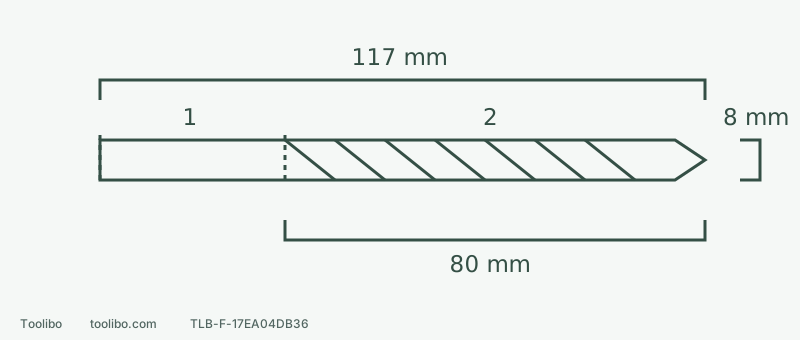
1 · Holding section
Match the cylindrical shank to the chuck range; do not grip cutting flutes to hide a mismatch.
2 · Working section
Working length does not authorize one-pass full-depth drilling; check chip clearance, work thickness and rear clearance.
Bosch GB 2608577711: 8 mm cutting and shank diameters, 117 mm overall, 80 mm working length. Shape is schematic, not an installation or depth limit.
Separate the work material from the bit material
HSS means high-speed steel, a material used to make the bit, not the name of your workpiece. Colour is unreliable: gold or silver-looking bits can have different purposes. Identify wood, mild steel, stainless steel or the actual masonry before checking the exact accessory’s intended use.
Pause at material identification for unknown coatings, walls or composites. Do not drill an exploratory hole to discover what is inside a wall. Selecting a bit does not complete checks for concealed services, dust or safe workholding.
Narrow the choice with intended-use labels
Swipe or scroll horizontally to see all columns.
| Work material | Product category illustrating a label | Unsupported conclusion |
|---|---|---|
| Wood | Bosch PRO Wood Brad Point lists softwood and hardwood, with a centring point and cutting spurs | A wood bit also suits metal or masonry |
| Ordinary metals | HSS PointTeQ, subject to the exact listed metals | All metals, including stainless, are interchangeable |
| Stainless steel | Bosch HSS-Co lists stainless; Co denotes cobalt-alloy high-speed steel | Every cobalt bit suits every task |
| Applicable masonry | CYL-3 lists uses including concrete and solid brick | Fitting it gives any drill a hammer mechanism |
These are label-reading examples, not interchangeable accessories. Also check whether ordinary rotation, rotational impact or axial hammering is permitted. A hex shank alone does not establish impact-driver suitability.
Complete a real matching example
This example uses British-market information: an 8 mm hole in an ordinary solid-wood test board, Bosch PRO Wood Brad Point 2608577711 and GSR 12V-35. It is not the HX or FC variant or a similarly named US model.
Swipe or scroll horizontally to see all columns.
| Check | Verified information | Result |
|---|---|---|
| Work material | Bit lists softwood/hardwood; drill permits wood drilling | Wood use matches, not a transferable metal approval |
| Cutting diameter | 8 mm | Matches the intended hole, not inferred from the shank |
| Shank and holder | 8 mm cylindrical shank; 0.8–10 mm chuck range | Shape and holding range match |
| Tool wood capacity | Applicable manual lists 32 mm maximum | 8 mm is within that dimensional limit, not approval for every species, depth or technique |
| Action | Bit intended for rotary drills/drivers; drill set to drilling | No hammering and no substitution of an impact driver |
The bit is 117 mm overall with 80 mm working length. Working length is not a promise to drill that deep in one pass: holding length, chip clearance, work thickness and rear clearance still matter. This is a selection check, not a fixed-speed or full-depth instruction.
The tool document is 1 609 92A 9UK, November 2024; its GSR 12V-35 column identifies article family 3 601 JH8 0… Check the full physical identifier and applicable edition, not merely 12V.
Inspect the actual items on arrival
- Match accessory code, cutting diameter and shank diameter; exclude an accidentally supplied long, reduced-shank or different-interface version.
- Inspect safely for bends, cracks, damaged edges or severe corrosion. Do not fit a damaged accessory for a trial.
- Stop completely and remove the battery as instructed before checking the chuck and installation space. Jaws belong on the designated shank, not cutting flutes used to compensate for poor fit.
- Install and secure by hand as the chuck instructions require. Do not hold the chuck and use trigger power to tighten it.
- Reconnect a battery for ordinary operation only after accessory, clamping, protection and operating conditions are ready. Leave the tool unpowered if essential identity or capacity is unresolved.
A bit can suit the material yet fail the shank, size or mode check. Keeping these separate tells you whether to change the accessory, change the tool or identify the workpiece, rather than hiding a mismatch with an adapter or extra pressure.