
Recognize the point before comparing the length
Three conceptual bits show a central point with outer spurs, a threaded spade paddle and a screw-tipped auger with spiral flutes; arrows mark self-feed and a bracket marks working length.
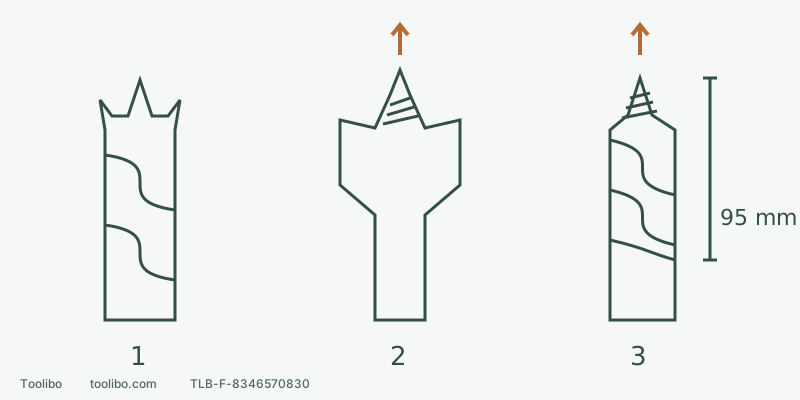
1 · Centring point and edge spurs
Brad-point 2608577711 is an 8 mm softwood/hardwood candidate; support and a trial still determine the exit result.
2 · Threaded spade pulls itself in
2608900315 is the stated softwood rough-hole example, not a hardwood choice; its 6.35 mm shank does not establish tool capacity.
3 · Working length is not overall length
The 95 mm working length of 2608585703 rules out the example 110 mm depth, despite its 160 mm overall length.
Original identification sketch, not a grinding pattern or a scale comparison. The 95 mm label refers only to auger 2608585703; exact dimensions remain in the table.
Filter by the job, not an overall winner
Swipe or scroll horizontally to see all columns.
| Your task | First candidate | What still needs attention |
|---|---|---|
| A small, accurately positioned hole with important edges in softwood or hardwood | Correct-size brad-point bit | Exit support, depth, grain and trial result |
| A rough through-hole in softwood where appearance is secondary | A spade explicitly approved for softwood, including a suitable self-feeding type | Control of pull-in, permitted cutting diameter and exit clearance |
| A deeper timber bore | An auger with sufficient working length | Long-bit starting rules, reaction, chip removal and full withdrawal path |
This is not a speed ranking. Without a matched material, hole and tool test, no category is universally faster or cleaner. Spade bits include ordinary points and threaded self-feeding points; the flat paddle shape alone does not establish identical feed behaviour.
Read the full dimensions of three real products
These examples are from Bosch UK product information and its catalogue; dimensions apply only to the listed variants.
Swipe or scroll horizontally to see all columns.
| Accessory | Cutting diameter | Working / overall length | Shank details |
|---|---|---|---|
| PRO Wood brad-point 2608577711 | 8 mm | 80 / 117 mm | 8 mm cylindrical |
| EXPERT Self Cut Speed spade 2608900315 | 16 mm | 100 / 152 mm | 6.35 mm, 1/4-inch hex |
| PRO Wood auger 2608585703 | 16 mm | 95 / 160 mm | Listed shank diameter 11.11 mm; hex width across flats 11.10 mm |
The first uses a centring point, edge-cutting spurs and two chip flutes; the range is for softwood and hardwood. The second has a threaded pulling tip and a wave-shaped paddle. The UK 2026 catalogue specifies fast, rough softwood holes and expressly excludes hardwood; do not borrow another wood bit’s material range. The third has a pulling screw tip and a chip-removing spiral, with softwood and hardwood applications. This particular auger nevertheless has only 95 mm working length; its name does not make every deep hole possible.
There is another trap: the auger family page’s generic connection wording mentions a 1/4-inch internal hex holder, but this exact 2608585703 variant lists an 11.11 mm shank. Match the actual variant dimensions to the holder rather than forcing it into a 6.35 mm hex opening. Hexagonal is a shape, not a single size.
Turn the choice into three practical decisions
For an accurately positioned 8 mm hole in a small hardwood board, start with an 8 mm brad-point candidate, not a 16 mm spade that you hope to control into a smaller hole. If the exit is on a visible finished face, include backing support and a same-material trial. Good centring alone cannot guarantee a splinter-free back face.
For a 16 mm rough through-hole in identified softwood free of hidden hardware, 2608900315 becomes a candidate. Its 6.35 mm shank fitting the chuck does not establish that the drill permits a 16 mm self-feeding spade. Check whether the tool distinguishes spade, auger, self-feed and hole-saw capacities; a hole-saw limit cannot be transferred to a spade. A flat-bottom blind hole or a high-quality finished surface is not automatically served by this rough-work example.
For a 16 mm hole 110 mm deep, reject the listed auger’s 95 mm working length. Its 160 mm overall length does not make up the difference. A longer version requires a fresh check of exact model, shank, tool limits and withdrawal route, not simply an instruction to buy something longer.
Five checks before fitting the bit
- Write down material, diameter, effective depth, through or blind hole, and the face that must remain clean. Resolve hidden nails or metal first; a robust-looking bit does not authorize drilling them.
- Read cutting diameter, working length, overall length and shank size from the exact product number. Compare cutting diameter with the tool’s limit for that bit type, and shank size with its chuck range as two separate checks.
- Draw the hole axis, feed endpoint, withdrawal and external bit-changing position. Keep clamps and hands outside the bit path. Secure the work rather than holding a small piece by hand.
- Identify a threaded self-feeding tip. If the setup, grip or tool cannot control its feed, change the combination instead of pushing harder or grinding the tip to compensate.
- If the battery is dangerously hot, swollen, leaking or smoking, do not approach or handle it; stop use and contact the manufacturer. For normal equipment, release the trigger, wait for a stop and disconnect power before fitting the bit and setting the controls by the exact tool procedure. For normal reassembly keep your finger off the trigger, confirm battery latching, then unlock the selector and choose forward. Only then verify edge quality and controllability in matching scrap. Drill wood in rotary mode, without masonry hammering. Follow the exact tool/bit starting and speed rules for long bits; do not spin one unsupported at high speed.
For every later fitting, removal or adjustment, stop fully and disconnect power again. Stop if the bit grabs, control is lost or abnormal heat or smell appears; wait and isolate power before dealing with it. Self-feeding does not mean relaxing your grip.