
Choose a connection route
One route connects DCW210 to the appropriate hose end of a DEWALT DWV010 or DWV012 extractor. This is a named direct combination; do not add unidentified fittings because it appears to be missing a part.
The other uses a suitable 1-1/4-inch hose on another vacuum system with the DWV9000 universal quick connector. Diameter must be checked alongside the actual end construction. A fixed hard cuff, bare spiral hose and an end already equipped with AirLock are not identical assemblies. A universal label is not proof that every arrangement fits.
Identify tool and Type, extractor, hose end and existing accessories. Resolve the whole combination before fitting. Do not shave the port, build a taped adapter or force an unsuitable hard tube into it.
Distinguish the bag collar from the vacuum connector
The supplied bag fits over the port and locks by turning its collar clockwise; counterclockwise releases it. Remove the bag assembly for external extraction rather than inserting a hose into the bag.
Identify DWV9000’s own unlocked and locked positions. Do not transfer a bag-collar rotation description to a connector viewed from another direction, or twist the complete hose instead of operating the locking collar.
Fit the external system without power
- Switch off, wait for the pad to stop and remove the battery. Unlock and remove the bag, then inspect the port for cracks, debris or distortion.
- With DWV9000, first secure its hose-side attachment using the arrangement appropriate to the actual hose. Not every hose simply pushes into the same shape. Verify uncertain ends rather than cutting an unidentified hose.
- Set the quick-connector collar to unlocked, then push it onto the compatible tool-port connection.
- Rotate the collar to locked. Support both sides and check gently that normal hose movement does not release it. Do not lift the tool to test it; neither connector nor hose is a carrying handle.
- With a direct compatible DWV010/012 end, likewise verify its locking mechanism is engaged rather than resting on the port.
Rehearse the real travel
Keep the battery removed and the work secured. Move from start to farthest point, then return and turn as planned. The hose should not tilt the connector, hit clamps or drop a loop beneath the abrasive. Do not continuously support it with one hand to hide a routing problem.
A pull at full reach calls for moving the extractor, rerouting or reorienting work. A return-stroke snag calls for fixing the return route, not simply adding length. After fit and travel are satisfactory, confirm O and securely fit the compatible battery for a short trial.
Secure fit does not establish suitable filtration
Confirm extraction and filtration suit the material and that abrasive holes and visible passages are open. Watch for leaking joints, loosening or hose drag during the trial. Stop, wait and remove the battery before inspecting; do not retighten while running. No visible cloud does not prove control of every fine particle.
Assess unknown old coatings before sanding rather than using a trial to identify safety. DCW210 is not for drywall, even with a powerful extractor.
Keep collection complete after removal
Switch off, wait and remove the battery. Hold the connector, unlock the tool end and separate it from the port without dragging the whole hose. If returning to the bag, inspect fabric and collar, refit and lock clockwise, then recheck clearance. Do not leave the port open for a last small patch. A secure connector replaces neither collection equipment nor material-specific protection.
DCW210: two documented vacuum routes
The upper route uses the compatible DWV010 or DWV012 hose end; the lower route adds DWV9000 to a suitable 1-1/4-inch hose.
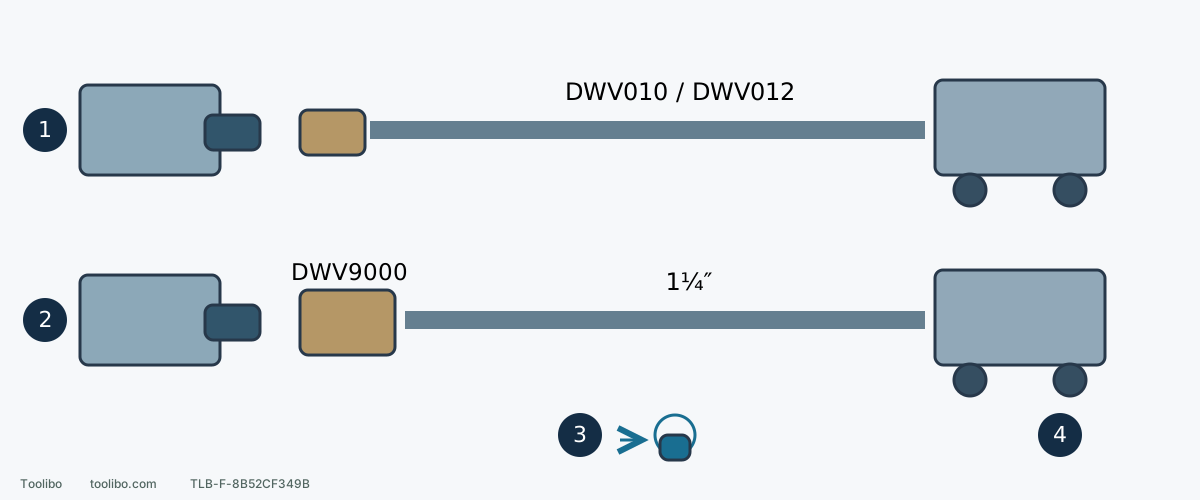
1. Direct extractor route
Use the compatible hose end on the named DWV010 or DWV012 system.
2. DWV9000 route
The other-vacuum route requires a suitable 1-1/4-inch hose and matching hose-end arrangement.
3. Unlock, insert, lock
Remove the battery, operate the connector collar and check seating gently; never lift the tool by the hose.
4. Check the whole system
Verify filtration for the material and rehearse the complete hose route before a powered trial.
Exploded connection paths, not exact part shapes or a universal hose-fit chart.
Models referenced