
EasyAquatak 120: reach and attachment choice
A compact carry-style machine feeds a 5 m high-pressure hose; fan, rotary and detergent attachments are drawn separately.
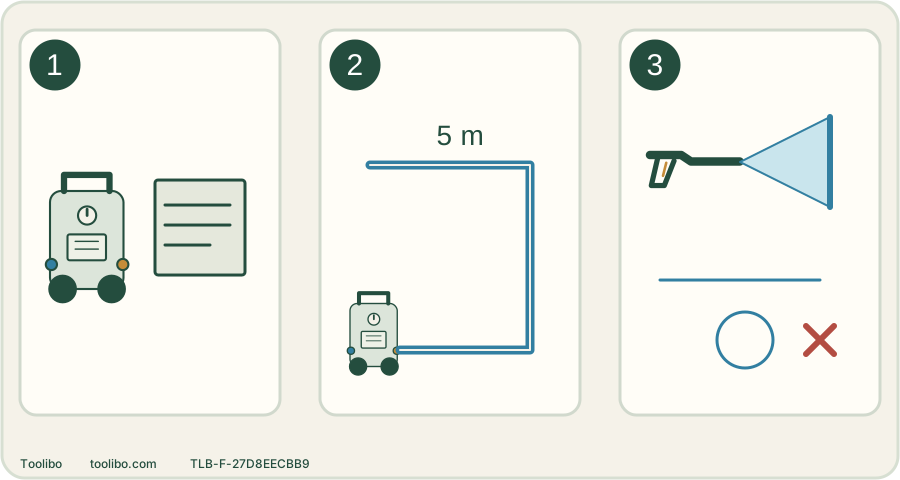
Identity
Match UK 06008A7971 and the actual rating plate.
Reach
Lay out the 5 m hose route without pulling the machine.
Attachment
Choose by surface; never use the rotary jet on a motor vehicle.
The diagram shows the verified kit arrangement, not a universal EasyAquatak package or a measured cleaning-performance test. Conceptual schematic, not a product image or scale drawing.
Identify the machine before using a number
The retail product code covered here is 06008A7971. The matched EasyAquatak manual identifies the 120 within type family 3 600 HA7 9… Check the rating plate and supplied manual on the actual machine; a similar name on an import listing is insufficient. Electrical data and kit contents must match your market.
The current UK page and older manual do not present weight on an identical basis. This guide therefore does not use weight to claim a carrying advantage over another model. Evaluate the real storage space and lifting route instead of comparing unlike weight labels.
What the supplied reach means
The verified package includes a 5 m high-pressure hose. Trace it from the proposed machine position around the object. A few pressure-washable chairs near the supply may fit; reaching the far side of a car around obstructions is different. A bicycle is not an automatic suitable example: Trek prohibits high-pressure washing. Follow the actual bicycle maker and use its approved gentle hand-cleaning method instead where pressure is forbidden.
The compact layout and accessory storage are useful only if the machine can remain stable without hose tension. Do not drag it by the hose. If the route is too short, compare a suitable longer factory configuration or a specifically approved accessory rather than assume all replacement hoses extend the original.
Select an attachment for the surface
The package offers a variable fan nozzle, rotary nozzle and detergent attachment. They are different tools, not three interchangeable power levels. Start by deciding what the surface permits. A broad controlled spray is a different action from a concentrated rotary jet.
The matched manual excludes rotary and pencil jets for motor vehicles. Do not choose the rotary attachment merely because road dirt is stubborn. Detergent needs the correct attachment and product instructions; the detergent bottle is not permission to mix chemicals or put an arbitrary cleaner into the machine’s water supply.
Read the water and performance columns
The UK product page gives maximum pressure 120 bar and maximum flow 5.8 L/min. The matched manual lists rated pressure 8 MPa, rated flow 5.4 L/min and minimum inlet supply 5.9 L/min. Keep these labels intact:80 bar is the documented rated-pressure value, not a second model name or a fault threshold.
The manual limits inlet water temperature to 40°C and inlet pressure to 1 MPa. Confirm the actual water supply, hose arrangement and required backflow protection before starting. Self-priming capability is not permission to use an unfiltered bucket or an arbitrary suction layout; use the specified kit and procedure.
Decide whether its limitations fit your routine
Choose it when the work is compact, the supply is adequate and the included attachments match your task. Consider another configuration if the hose route requires constant repositioning, broad paving dominates, or a needed surface-cleaning accessory substantially changes the complete cost.
Do not judge the purchase by maximum pressure alone. A correctly controlled tool used regularly is more useful than a higher-specification machine that is inconvenient to deploy. Conversely, compact storage does not make this kit a substitute for a larger site-oriented arrangement when that is the actual job.
A small-job setup you can actually check
For a hypothetical supply check, a 5 L container filled in 60 seconds gives 5 L/min, below this model’s 5.9 L/min minimum. The same volume in 50 seconds gives 6 L/min, only a small margin; repeat under actual water-use conditions rather than treating one measurement as a guarantee. These are example calculations, not new pump ratings.
- Off and unplugged, inspect the hose and gun, secure the matching connections and choose the appropriate fan or detergent attachment. Have the rinse parts ready before applying any product.
- Establish the approved water supply with the motor off. Release the gun lock and purge until the water is steady. If it will not settle, correct the inlet rather than start a dry or starved pump.
- Connect the protected electrical supply with the switch off, then start and test a small permitted surface. Inspect coating and joints after the first pass. Do not jump to the rotary nozzle to correct material damage.
- Before switching between detergent and rinsing, stop, unplug, close water, release pressure and lock the trigger. Use the attachment’s proper detergent route and label dilution; finish a manageable section before it dries.
At the end, complete shutdown and pressure release before draining and packing. If the 5 m route becomes taut, stop and reposition safely; do not pull the compact body toward you.
Models referenced