
Keep cleaning outside the bearing and electrical boundaries
A bicycle profile marks hubs, motor, battery contacts and disc brake; a sponge works on the frame while jets toward protected interfaces are crossed out.
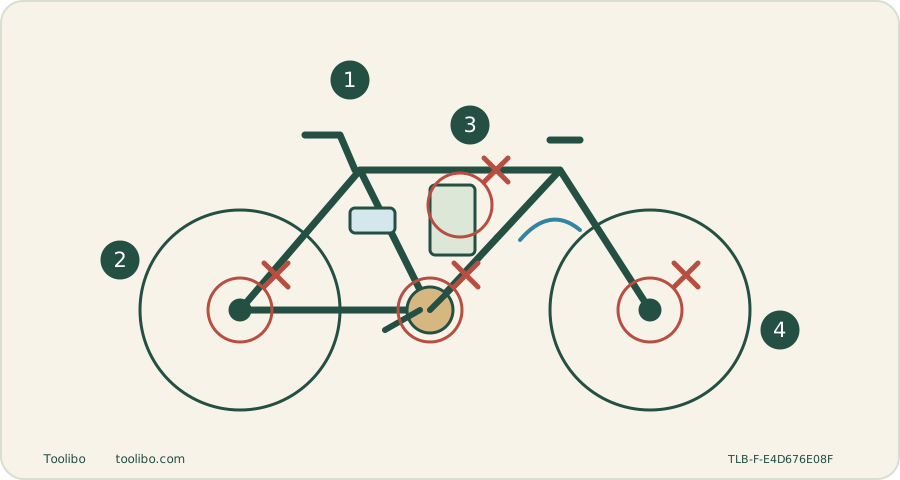
Prepare
Switch off and follow owner-removable component instructions.
Separate
Keep drivetrain tools away from braking surfaces.
Clean
Use a soft sponge and controlled gentle rinse.
Check
Dry, reassemble and verify function before use.
Accessible dirt can be removed without directing water into sealed assemblies.
Choose the method before moving the bike
Trek’s care instructions reject high-pressure washing, and Bosch eBike guidance explains the risk of water entering motor, hub and frame bearings. Moving a powerful nozzle farther away is not a substitute for that prohibition. Nor does a cordless pressure cleaner automatically become suitable because it is portable.
Set the bike on stable ground with enough room to work without leaning it against delicate controls. Identify the frame finish and the bike’s particular electrical system. A removable battery and a permanently integrated unit require different preparation. Follow the bike’s instructions; do not dismantle a fixed battery to imitate a photograph of another model.
Prepare electrical and braking areas
Switch the system off. Remove owner-removable battery and display components only as instructed, and protect fixed controls where the maker specifies it. Keep detached components and charging equipment away from the wet work area. Do not wash an exposed battery or direct a stream into its contacts.
Use separate cloths for the greasy drivetrain and the frame. Set aside any brush carrying chain lubricant so it cannot contaminate brake discs or pads. Check for obvious damage, loose parts or abnormal play before washing; record those findings rather than hoping cleaning will resolve them.
The absence of visible corrosion does not prove a wet connector is ready for use. Leave electrical reassembly and charging until the required interfaces are clean and dry under the manufacturer’s instructions.
Work through a gentle cleaning sequence
- Remove loose grit gently. Soften adherent mud with controlled low-pressure water where permitted; do not force a concentrated hose jet under seals or use a thumb over the hose to create one.
- Use a soft sponge or suitable brush with an approved mild bicycle cleaner. Work around the frame and accessible surfaces rather than inserting tools into bearings or motor openings.
- Clean greasy drivetrain areas with their separate tools and compatible products. Protect braking surfaces from cleaner and lubricant overspray.
- Rinse gently without repeatedly flooding electrical mounts, suspension seals or hubs. Remove visible cleaner residue instead of chasing maximum foam.
- Dry accessible surfaces with a clean cloth and allow trapped moisture to escape as directed. Do not use compressed air to drive moisture farther inside components.
For a bike carrying dried mud behind the crank, rotate or reposition it only by a permitted stable method. A longer-handled soft brush may reach the exposed dirt; the answer is not to aim a pressure lance into the motor gap.
Inspect before riding or charging
Swipe or scroll horizontally to see all columns.
| Observation | Next action |
|---|---|
| Frame is clean and contact areas are dry | Reassemble only the components the owner is permitted to remove. |
| Dirt remains at a bearing or seal boundary | Use the permitted external method or ask a cycle technician; do not force a jet inward. |
| Brake surface may have oil or cleaner contamination | Do not ride to “burn it off”; use brake-specific service advice. |
| Display errors, poor battery engagement or abnormal drive behaviour | Stop use and seek model-specific help rather than repeated wet restarts. |
After reassembly, check correct battery engagement and normal response of the system. Check braking safely before normal riding. Cleaning does not replace an inspection after a crash or a mechanical service when there is play, grinding or leakage.
Make the next wash simpler
Keep the approved cleaner and separate drivetrain tools together. Remove salt and mud promptly with the permitted gentle routine rather than allowing thick deposits to create pressure to use a more aggressive tool. Record any repeated wet-contact issue for service.
A useful success criterion is not merely a shiny frame: the bike is dry where required, controls behave normally, the battery is correctly secured and braking surfaces remain uncontaminated. If one of these conditions is missing, the cleaning job is not finished.