
Two water checks before ON
Two water checks before ON — numbered controls and physical routes explained by the legend.
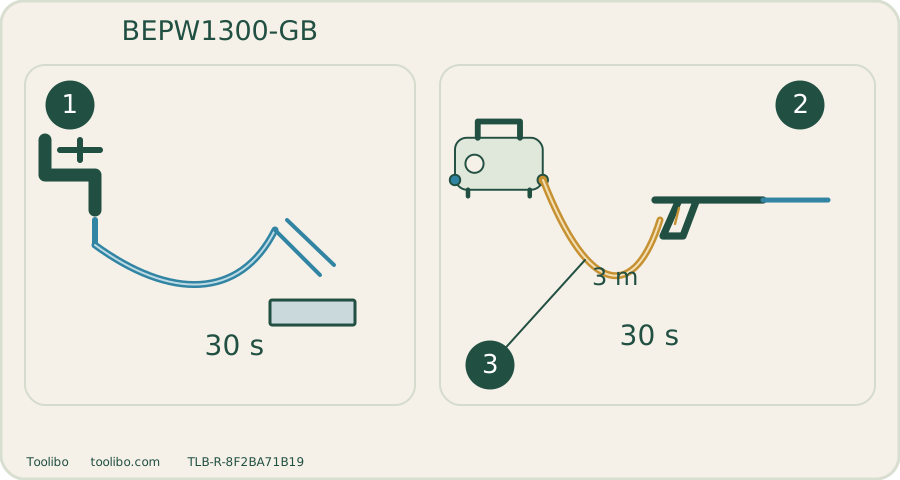
Flush
Disconnected supply hose 30 seconds
Purge
Connected system 30 seconds, longer if air remains
Reach
Keep 3 m gun route free of tension
Original explanatory diagram; not a dimensioned service drawing.
The compact GB model is a short-route machine
BEPW1300-GB Type 1 is the compact 1300 W version, supplied with a 3 m pressure hose, adjustable fan/pencil nozzle, 0.5 L soap bottle, inlet filter, hose adaptor and cleaning pin. Do not assume the BEPW1300L package or a US machine with a similar number contains the same attachments. The verified BEPW1300 kit does not include the BEPW2000’s turbo nozzle.
A short route can be a benefit when cleaning robust nonpowered garden tools whose maker explicitly permits pressure washing near a tap: there is less hose to handle. It becomes a limitation when you must walk around a large object. Before purchase, measure from a stable machine position to the farthest point, including obstacles. If 3 m cannot reach without pulling the body, choose a different arrangement rather than dragging it by the hose.
What 110 bar does—and does not—tell you
The European Type 1 manual separates maximum pressure 110 bar from rated pressure 74 bar. Rated flow is 5.2 L/min, while maximum flow is 6.6 L/min, or 396 L/h. The lower rated values are not evidence of a fault. None of these output figures independently states the required minimum tap supply.
Match the electrical rating plate and use cold, clean water. The technical table lists a 10 bar maximum inlet pressure and 50 °C water limit, but that is not an instruction to connect a hot-water supply. A safe supply arrangement and surface suitability matter more than chasing the maximum pressure number.
Two flushing checks before the motor runs
- Start with the washer off and unplugged. Run water through the disconnected garden hose for 30 seconds to flush debris before attaching it to the machine.
- Fit the inlet filter and supply connection, using a reinforced hose at least 12.7 mm diameter and the necessary drinking-water backflow protection. Connect the pressure hose and lock the gun/lance joints.
- Open the tap. With the motor still off, unlock the trigger and run water through the gun for 30 seconds; continue if air remains. This second check clears the assembled machine, not just the garden hose.
- Check the protected electrical connection, insert the plug with the switch off, then switch on. Hold the gun with both hands and begin a small test with the broad fan.
A sputtering stream means investigate the supply and trapped air before concentrating the jet. If water never arrives, keep the motor off. A clear continuous stream is a useful observation; it does not prove the entire electrical or mechanical system is fault-free.
Soap application is an attachment change
The soap bottle and normal wand cannot be fitted together. For a change, switch off and unplug, stop the water supply and squeeze the trigger to release pressure, then lock the trigger. Replace the wand with the bottle attachment, positioning the bottle beneath the gun barrel, not above it. Use a pressure-washer detergent at its labelled dilution and test compatibility.
For garden furniture, first inspect the finish and choose a discreet test patch. A narrow pencil jet concentrates impact; do not use it merely because the wider pass leaves dirt. If the finish changes or fibers lift, stop and use a gentler permitted method. Do not hold the item in your hand while spraying it.
Short jobs still need a full shutdown
Turn off and unplug, stop the water, discharge remaining pressure until the gun stops emitting water, and engage its lock before disconnecting. Drain the hose and attachments and store indoors at no less than 4 °C (40 °F); operation must also not be below 4 °C (40 °F). Inspect the inlet filter before each use.
For pulsation, isolate and depressurize before cleaning an obstructed nozzle with the supplied tool and rinsing it. Check accessible hose bends and air leaks. A damaged cord, leaking gun seal or persistent fault needs qualified service, not improvised electrical or pump work. The optional BZOSPK1-XJ suction kit is a separate setup; do not improvise it by dropping the ordinary garden hose into dirty water.
Models referenced