
A clamp does not create a bench machine
The crossed inverted tool is not an approved conversion; the alternatives show supported hand work and a purpose-designed bench machine, not a specific approved product.
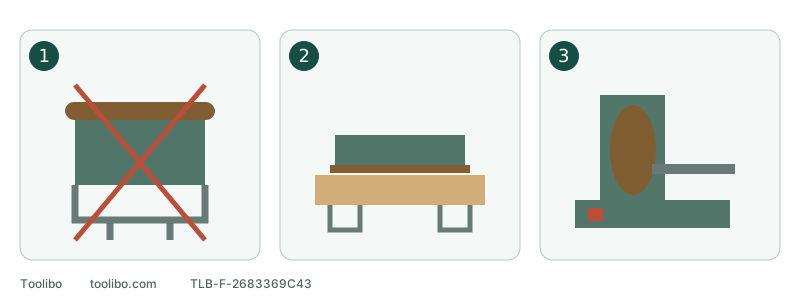
1. Unsupported conversion
Clamping a housing does not establish guards, work support or safe stopping.
2. Supported hand work
A secured piece and suitable hand block avoid an exposed powered belt.
3. Purpose-designed equipment
Its own support, guarding and instructions still need checking.
The crossed inverted tool is not an approved conversion; the alternatives show supported hand work and a purpose-designed bench machine, not a specific approved product.
You change who controls what, not just orientation
In normal handheld work, the operator controls the tool and the workpiece needs suitable restraint and support. Clamped upside down, the tool stays still while the operator feeds material into the moving belt. Hands approach exposed abrasive and roller areas, while small-part support, feed direction, trapping points and possible ejection all need reconsideration.
“It is clamped firmly” only addresses temporary tool movement. It does not answer safe work support, hand access to danger or stopping during a jam. A video successfully sanding one piece does not establish a suitable machine configuration.
Three control conditions cannot be improvised away
Swipe or scroll horizontally to see all columns.
| Condition | What stationary conversion needs to establish | Not a substitute |
|---|---|---|
| Work support and feed | Attachment-specified support, limits and feed method | Fingers holding a tiny part or a temporary block on the bench edge |
| Guarding and exposure | Treatment of moving belt, rollers and trapping points | Flipping the tool and assuming its housing covers every new risk |
| Controlled stopping | Safe stopping from the actual working position and prevention of unintended restart | Treating handheld lock-on as a stationary stop system or taping the switch on |
This is not a jig-dimension, tie-down or switch-bypass guide. Clamp strength alone is not the question: the complete changed use and controls must be covered by the exact manufacturer’s instructions.
Makita 9403: lock-on is not conversion approval
9403 is the handheld belt-sander example discussed here. Its handheld switch or lock-on control does not independently authorize inverted bench use. Keeping the motor running does not add a work table, guards or a suitable stationary stopping arrangement.
That does not mean no brand or belt-sander model ever has a manufacturer stationary attachment. If you find one, verify exact model and accessory numbers rather than borrowing permission from another machine in the range. Similar names, identical belt dimensions or a clamp gripping the housing do not establish applicability.
What information would support further consideration?
- The attachment maker explicitly identifies your exact model and applicable version, not merely “universal belt-sander stand.”
- Complete tool and attachment instructions allow that working position and material; a base pictured in a parts drawing is insufficient.
- Executable requirements cover mounting, support, guarding, feed, starting, stopping and post-stop handling, and you can meet the restrictions.
- The actual attachment is intact and complete and the work area and dust controls suit the task. Missing parts or unclear steps mean no trial run.
Verify this with the tool off, completely stopped and isolated. Without explicit permission, stop there; absence of a discovered prohibition is not approval. A distant photograph sent to support should not be treated as their assumed authorization of a homemade system.
Better options when a small part is difficult to hold
For light marks or burrs on a small solid-wood component, first consider stable restraint in a suitable fixture or support and a hand block suited to the shape. Hand work still has pinch, flying-particle and dust hazards. Do not aggressively sand a tiny finger-held part at a hazardous edge. If secure support is impossible, reconsider the production sequence, perhaps doing suitable surface preparation while the part remains in a larger blank.
If stationary sanding is genuinely needed, choose equipment designed for it with instructions covering the task, and follow its table, guard, clearance and feeding requirements. A purpose-built machine still needs setup; it is not operated as if it were an inverted handheld tool.
Another option is having someone with suitable equipment process a difficult small part. The decision rests on reliable work control and dangerous contact, not whether you already own an idle handheld belt sander.
If you have already clamped it upside down, return to a safe state
Do not restart for a photograph or to demonstrate clamp strength. If stable and safely accessible, use available normal controls to switch off, wait for the belt to stop completely and isolate power before arranging safe removal of the improvised restraint. An active jam, smoke or imminent danger means move away and seek help, not reach toward a moving belt.
Before returning to handheld use, inspect housing, controls, cord and belt for clamping damage; suspected damage means continued non-use. Removing clamps does not establish that the machine is sound. Prepare for its original authorized use or choose another explicitly approved stationary setup, rather than trying again with a larger clamp.
Models referenced