
Identify the machine
Three original side-by-side silhouettes: collection bucket, floor rollers with two tanks, and spray/extraction dual path.
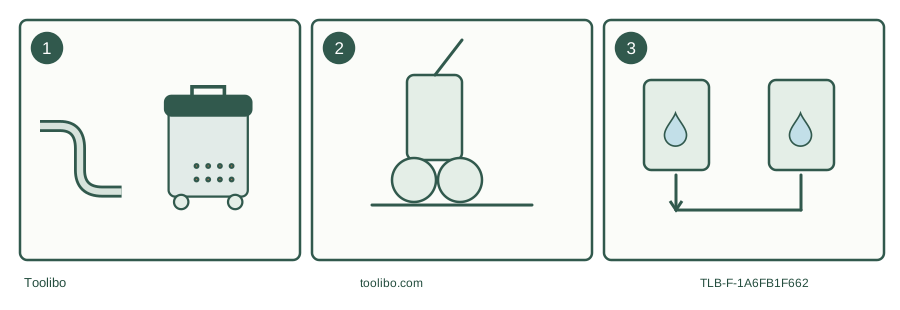
Collect
Hose to collection tank.
Wash floor
Rollers and approved hard floor.
Spray extract
Solution delivery plus recovery.
Model-specific decision path; isolate power before opening or changing the collection system.
Look for what the machine does to the surface
A bucket-style wet/dry vacuum pulls permitted material through a hose into a collection container. A roller floor washer applies controlled moisture and works a floor through its cleaning head. A spray extractor delivers cleaning solution and then recovers it from suitable textiles. These are useful starting descriptions, not permission to operate an unidentified product.
Some machines combine functions. The classification question is therefore not simply “Does it have a water tank?” Ask which operating mode the actual manual provides, what parts that mode requires and which surfaces it permits. A handle trigger, small liquid tube or separate fresh-water tank offers a clue; only the matched instructions confirm the function.
Use three documented examples
Kärcher’s WD 4 family in manual 59510240 is a household wet/dry vacuum. Its collection system includes a hose, container and flat pleated filter. The wet-mode instructions describe collecting liquid; they do not turn the hose into a detergent-spray circuit. Do not add solution to an arbitrary opening to create a washing mode.
The FC 7 Cordless and Premium in manual 59698290 are hard-floor cleaners with cleaning rollers and separate fresh and dirty water containers. Their intended use is waterproof hard flooring, and the manual excludes carpets and water-sensitive coverings. That is a different surface boundary from “can pick up water.” A floor material’s familiar name alone does not prove that its coating, seams or current condition are waterproof.
Kärcher’s SE 4 international listing, product 1.081-150.0, describes spray extraction with a fresh-water tank and integrated spray/suction hose. It also lists wet and dry vacuum functions with appropriate accessories. This combination is exactly why labels alone mislead: the same body can have several modes, but each has its own assembly and care requirements.
Swipe or scroll horizontally to see all columns.
| Visible clue | Question to verify | Wrong assumption to avoid |
|---|---|---|
| Large bucket and plain suction hose | Does the manual permit wet collection? | Every canister vacuum can collect water |
| Rollers, fresh tank and dirty tank | Which waterproof floors are permitted? | It is a workshop-debris vacuum |
| Spray control and liquid delivery path | Which extraction accessories and textiles are approved? | Any vacuum can wash carpets |
| Several modes in the manual | What changes between those modes? | One filter setup fits all functions |
Match the task before the accessory
For known dry crumbs inside a car, look for an approved dry vacuum mode and a suitable upholstery or car nozzle. For a small clean-water spill, verify wet collection and its filter/bag configuration. For a stained seat, the task may require a surface-approved washing method; suction alone does not establish that method or remove the need to follow the seat manufacturer’s care instructions.
Do not improvise an extractor by spraying large amounts of cleaner and hoping a bucket vacuum will recover everything. The surface may retain moisture, foam may reach the collection system, and chemical suitability remains unresolved. Nor should a roller cleaner be used to swallow garage screws, sharp fragments or unknown powder simply because its box mentions dry dirt.
Resolve uncertainty without switching on
Find the full model and regional rating plate, then compare the controls and parts with the illustrated manual. Identify the collection inlet separately from any blower outlet, spray connection, clean-water filler or drain. Check whether the hose contains an approved liquid-delivery line rather than assuming a visible tube is interchangeable.
If a second-hand machine is missing its water tank, filter, float or mode-specific nozzle, do not treat the missing part as optional. Ask the manufacturer to identify the configuration. A photograph can help locate a component, but it cannot establish internal seals, electrical condition or safety classification.
Keep hazardous work outside all three categories
Neither “wet/dry,” “professional,” nor a replacement HEPA filter is proof of whole-machine certification for hazardous dust. Ordinary routines here exclude silica, asbestos, lead contamination, hot ash, flammable liquids and combustible dust. A specialist dust extractor may also resemble a bucket vacuum, yet its suitability depends on its complete specification and the assessed task.
Once the machine and mode are established, keep the appropriate setup guide with it. Record the required filter, bag, hose and nozzle for each mode. That small identification record is more useful than memorizing a rule such as “remove the filter for water,” which is wrong for some documented wet/dry designs.