
Check the working state
Capacity: Buddy12L and Multi22L gross, with space reserved for filter and float.; Feedback: Buddy owner checks versus Multi filter indicator; no Push&Clean on base18451550.; Shared wet state: Bag out, matching wet filter in, float checked; dry before dry pickup.
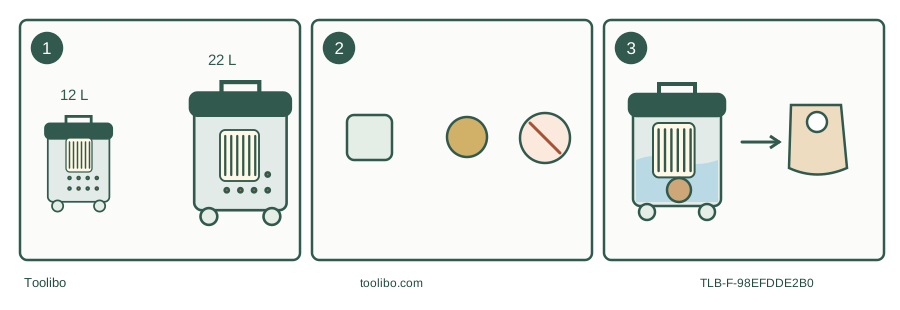
Buddy II 12 EU
- 12 L gross plastic container.
- Wet-appropriate filter stays fitted and the bag is removed; this is not the 18 T tool-socket version.
Multi II 22 EU
- 22 L gross polypropylene container.
- Filter-clean indicator fitted; no Push&Clean system and no power-tool socket on this base model.
Capacity
Buddy12L and Multi22L gross, with space reserved for filter and float.
Feedback
Buddy owner checks versus Multi filter indicator; no Push&Clean on base18451550.
Shared wet state
Bag out, matching wet filter in, float checked; dry before dry pickup.
An original decision aid. Isolate power before opening, changing filters or emptying.
Compare the base EU versions
Buddy II 12 EU product 18451119 and Multi II 22 EU product 18451550 are the exact models in this comparison. Both are domestic wet/dry vacuums with plastic containers, and both have a blower function. Do not substitute UK product numbers, special car kits, Buddy 18 T or Multi 22 T/Inox features. A regional plug, tool socket or extra accessory does not automatically follow from the family name.
The most obvious difference is 12 versus 22 litres of gross container space. The more easily missed difference is the Multi II 22’s filter-clean indicator. The exact base-model matrix does not give 18451550 the Push&Clean button or a power-tool socket. A larger Multi II pictured beside another variant is not proof that all those features come together.
Choose capacity around emptying and storage
The Buddy’s smaller bucket can suit short permitted cleanup jobs when you can empty nearby and need a compact storage position. The Multi provides more room for ordinary collected material. Neither statement predicts durability or independently measured cleaning speed; it is a comparison of layouts and capacities.
Think through a real route: from a dry outlet to the car or hobby bench, then to the appropriate waste point. A larger container can mean a less convenient wet load to lift or pour. Gross tank volume is not usable water capacity, and there is no need to wait for a maximum-fill response before emptying. Leave room for the filter, float and air movement.
Verify the hose actually supplied with the exact package. Manufacturer pages and older family sheets can describe different hose lengths or accessory options. A long hose that must bend around a doorway may give less useful reach than expected. Neither machine should be dragged by its hose or power cable to recover that distance.
The indicator helps only if you respond correctly
On the Multi II 22, a filter indicator can prompt attention when dirty filtration reduces suction. It is not an automatic cleaner and not a measurement of whether the dust is safe. Stop and unplug before checking the bag, nozzle, tubes, hose and filter. A clogged hose can also make pickup feel weak, so do not assume every symptom means buying a new filter.
The Buddy II 12 relies on the owner noticing pickup changes and inspecting its filter arrangement. That is simpler, but it makes a before-use check particularly useful. With either machine, inspect filter condition and seals, fit the matching bag correctly and never run with a missing or damaged filter merely to test the motor.
Bags and filters are different purchases
Buddy II and Multi II do not use interchangeable filtering parts simply because both are Nilfisk bucket vacuums. Match the product number and current accessory listing. The verified Multi II listing names filter kit 107417194, while the Buddy’s matching official shop listing names 81943047. Keep the bag family separate too; tank volume alone is not a compatibility guide.
A dust bag collects permitted dry debris at the inlet. The filter beneath the head remains essential to the air path. A correctly installed bag can make disposal more controlled, but it cannot upgrade an ordinary household vacuum into a certified hazardous-dust system. Do not confuse the ease of changing a bag with protection against every fine particle.
Both need deliberate wet preparation
Before liquid pickup, switch off, unplug, remove the dust bag and empty dry debris. Fit or retain the correct filter suitable for wet suction and check the float. Close the head correctly, keep electrical connections dry and remain with the machine. Do not remove all filtration because another vacuum uses a different wet arrangement.
Foam or liquid escaping means stop immediately and empty safely. At a full-tank response or sudden wet-pickup loss, stop yourself rather than assuming automatic electrical isolation. Never immobilise the float or keep restarting to gain more capacity. A water spill in an electrically unsafe area is not an ordinary wet-vac task.
Afterward, drain hose residue without spilling it, disconnect power before opening and empty into an appropriate disposal route. The Multi’s family instructions describe rear or side pouring to avoid the front hose connection. Clean permitted parts, protect the electrical head from water and dry the filter and tank before restoring dry collection.
Stay inside the common safety boundary
Both models are intended for non-hazardous dust and suitable non-flammable liquids. Exclude hot material, hazardous dust, combustible or explosive powders, petrol, solvents, acids and alkalis. This comparison does not authorize ash, cement, flour, asbestos, lead or unknown powder cleanup. The larger tank and indicator do not change that boundary.
Motor input watts and a pressure value in mbar are not interchangeable with airflow or a cleaning-speed test. Choose by manageable size, maintenance access and the indicator you will actually use. For persistent faults, damaged cables, leaks into the head or abnormal heating, stop and seek qualified service rather than modifying electrical, thermal or float protection.
Models referenced