
Check pad support and body clearance separately
Conceptual top view, not actual dimensions or a minimum-clearance template. A circle leaves an inside-corner area; a detail point reaches closer, but housing, hand and canister may stop travel first. Check the complete route unplugged.
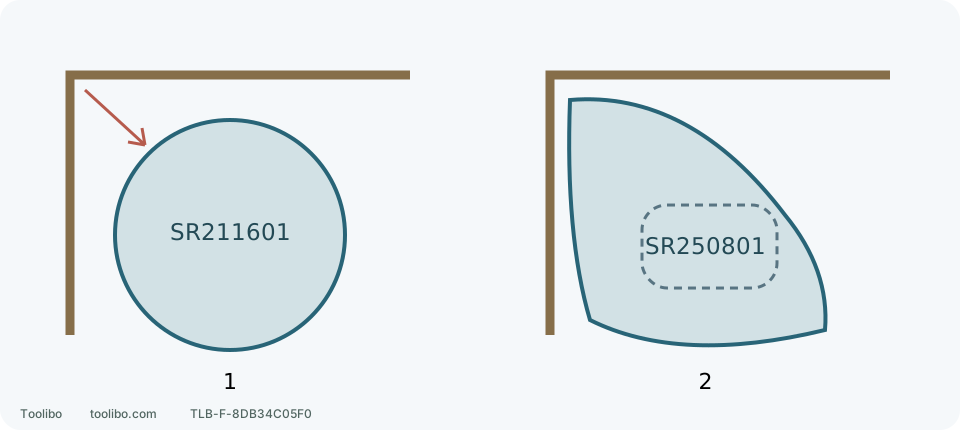
SR211601Round-pad random-orbit sander
- Nominal 5-inch pad; 125/128 mm conflict retained.
- 7,000–13,000 OPM with a numbered dial.
- External vacuum-hose fit not verified here.
SR250801Pointed-pad detail sander
- Conflicting product and catalog pad dimensions.
- 12,000 OPM; no speed dial documented.
- Catalog names 1-1/4-inch hose fit for this model.
1 · Broad supported surface
Do not tilt the round edge into the corner. SR211601 remains unplugged until its applicable stopping sequence is clarified.
2 · Point access is not whole-tool access
Keep the pad flat and supported; change method where body clearance prevents a controlled outward and return stroke.
Conceptual top view, not actual dimensions or a minimum-clearance template. A circle leaves an inside-corner area; a detail point reaches closer, but housing, hand and canister may stop travel first. Check the complete route unplugged.
Compare the same dimensions
Both specified US tools are corded, so battery platforms are irrelevant. SR211601 is a round random-orbit sander; SR250801 is a pointed detail sander. Start with surface, boundary and support rather than amperage or OPM alone.
Swipe or scroll horizontally to see all columns.
| Dimension | SR211601 | SR250801 |
|---|---|---|
| Working shape | Nominal 5-inch round pad | Pointed detail pad |
| Published speed | Variable 7,000–13,000 OPM | 12,000 OPM; no speed dial specified |
| Control | Dial 1–6, no exact OPM table per position | On/off; do not borrow the other model’s six settings |
| Input | 120V, 60Hz, 2.8A | 120V, 60Hz, 1A |
| Abrasives | Hook-and-loop discs with aligned dust holes | Matching shaped hook-and-loop sheets and holes |
| Extraction | Removable canister; no equivalent hose fit promised here | Removable canister; catalog lists 1-1/4-inch vacuum connection |
2.8A does not guarantee a better finish, and 12,000 OPM does not establish equivalence with a particular setting on the other tool. No matched-condition weight, time or finish test supports a ranking here. Actual label and local supply must agree; changing plug shape does not change voltage.
A tabletop and a cabinet-frame corner are different jobs
On an open tabletop or flat door, a round pad can remain supported over continuous passes. SR211601’s adjustable speed adds control for an established material/abrasive combination. That is an access/control reason to consider it, not a guarantee against swirl marks. Narrow edges, veneer and raised local defects remain vulnerable to over-removal; do not tilt the round edge to work a tiny spot.
At a visible bare-wood inside corner or cabinet frame, SR250801’s point approaches the corner more closely than a circle. It can refine smaller accessible areas, but it is not a finger extension. Housing, hand or rear canister can hit the wall first. If the point reaches while the back of the pad hangs unsupported, stop machine access there. Leave the deepest strip for a suitable hand block; do not power into unseen or unsupported gaps.
Check the complete route while unplugged
Only handle normal, stable equipment safe to approach. Set O, wait for complete stop and unplug; keep it unplugged. Damaged cord, plug or switch, or scorching, means pause without a powered test. Do not touch equipment actively smoking or presenting electrical danger.
- Identify the surface to sand and edges that must remain sharp. Secure the work without clamps obstructing the route.
- Lay the actual pad flat, with the complete intended extraction fitted and room for cord and hand.
- Approach and retreat slowly in a normal grip. Identify whether pad, housing or canister obstructs first, not merely whether the tip reaches.
- If advancing requires tipping the pad or loading only its point, reduce machine coverage, change assembly order or finish by hand. Do not remove necessary extraction to create an artificial fit.
This check does not select grit or resolve material hazards. Unknown coatings or suspected lead/asbestos need qualified assessment before deciding to sand.
Use exact accessory identity alongside dimensions
SR211601’s manual gives 5 inches (125 mm) for pad and disc, while the product specification says 128 mm for pad. Do not treat these as interchangeable cutting diameters. SR250801’s page says 6 × 4-1/8 inches; the 2026 catalog says 4 × 5-3/4 inches (102 × 146 mm). Neither unresolved size is a cutting template: check fitted outline, backing, holes and model applicability.
For SR250801 there is a concrete abrasive lead: SKIL explicitly lists it for CDA9004. The 20-piece package contains five each of 60,80,120 and 240 grit. It helps identify the right shape, not dictate starting every job at 60 or jumping straight from 120 to 240. Add intermediate grades as the finish process requires.
For a damaged pad, the SR250801 parts list for Body 0560161002, Version A, 2018/11/10 identifies item 2 as Soft Pad 3706706001. Use that identity with service to verify applicability; it is not universal interchange or permission to disassemble. The product orbit field 1.6 lacks a unit, so it is not repeated as a confirmed orbit diameter.
Extraction and operating limits affect the decision
Both canisters need emptying and correct abrasive dust paths. SR250801’s microfilter must not be washed with soap and water: this can embed dust and damage the filter. Unplug before maintenance; another model’s washing method does not transfer. A connected hose does not certify the extractor for the dust involved.
SR211601’s 04/19 manual printed 13 has an unresolved stopping conflict: one passage says lift clear before switching off, another describes releasing the switch and lifting together. Until clear requirements applicable to the actual tool are obtained, only unplugged fit and purchase assessment are appropriate; do not trial-sand, choose a sequence yourself or borrow SR250801’s instructions.
Broad-surface work can make SR211601 a candidate, subject to resolving that operating prerequisite. Accessible corner work with full pad support can favor SR250801. A project containing both areas may need two methods or machine plus hand work rather than one tool forced into every corner.
Models referenced