
Compare the changeover, not just the PSI
Compact handle-mounted soap applicator beside upright tank-and-soap-tip route, with 20 ft and 25 ft hose lengths.
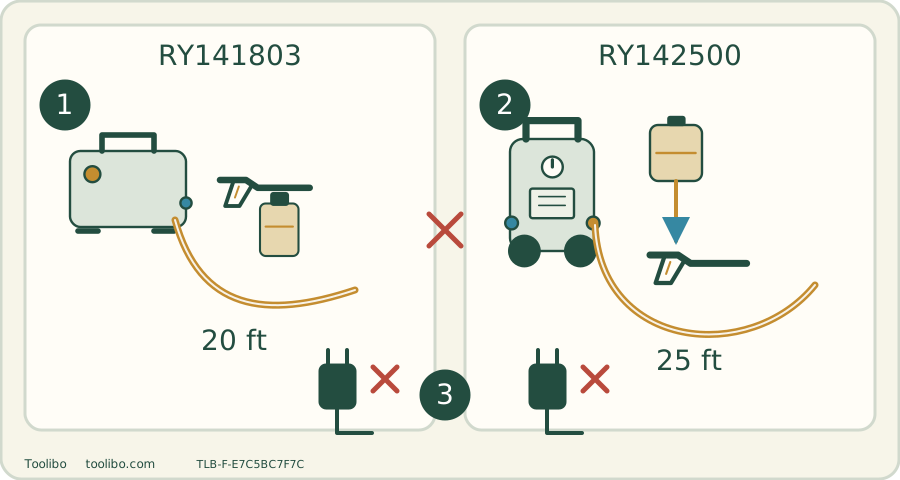
RY141803
- 1800 PSI maximum pressure.
- 20 ft high-pressure hose; 15° and turbo tips; a separate soap applicator replaces the wand.
RY142500
- 2500 PSI maximum pressure.
- 25 ft high-pressure hose, 12-inch flat-free wheels, onboard soap tank and 15°, turbo and soap tips.
Compact
20 ft hose; soap applicator replaces wand.
Upright
25 ft hose; tank draws with soap tip.
Electrical limit
Use each exact model’s extension rules, not a shared brand table.
Both mode changes require stopping, isolation and pressure release.
Compare exact US models
This comparison is RY141803 versus RY142500 in their verified US configurations. Both are corded 120 V AC, 60 Hz, 13 A machines. The compact RY141803 lists 1800 PSI maximum and 1.2 GPM maximum; the upright RY142500 lists 2500 PSI maximum and 1.2 GPM maximum. Keep those labels intact: neither flow figure is being presented here as an independently verified same-condition performance test.
The difference that is easiest to experience before any spraying is the setup. One machine is carried; the other has 12-inch flat-free wheels and an upright handle. A higher maximum pressure will not make an awkward stair carry easier or keep a poorly routed hose from pulling the machine.
Carrying versus rolling
RY141803 suits a routine where the washer must be lifted from a shelf or carried between small work positions. That is a layout advantage, not a claim of a verified weight difference. Inspect the real lifting route, including thresholds and steps, rather than assuming every compact machine is comfortable for every person.
RY142500’s wheels help on a route that can be rolled. They do not eliminate the need to lift across steps or protect the machine from tipping when a hose catches. Check the assembled wheel retainers and handle before transport. Shut down, isolate and depressurize either model before moving it; never pull the hose to drag it into reach.
What the extra hose actually changes
The compact package has 20 ft of high-pressure hose; the upright has 25 ft. The difference is 5 ft, about 1.5 m—not a second driveway of reach. Lay out the route around the far side of the intended object and leave slack at both ends before deciding whether that increment matters.
For a small patio with a tap nearby, both may reach the work without a move. For a car parked beside a wall, the longer hose may help route around one end, but a hose stretched taut around a tyre or corner is still a poor setup. Neither stated length authorizes an arbitrary aftermarket extension or proves matching replacement fittings.
The two detergent paths change your routine
RY141803 uses a separate soap applicator at the trigger handle in place of the wand. To change from rinsing to soap, you stop, isolate electricity and water, release pressure and change the assembly. After applying detergent, you repeat that safe changeover to reinstall the wand for rinsing.
RY142500 has an onboard tank and a soap tip that activates the injector. Switching involves a nozzle change rather than replacing the wand, but it still requires stopping, isolation and depressurization. A tank is convenient when the work suits repeated detergent application; it also leaves a tank to empty and clean afterward.
Both matched quick guides describe 20:1 injection. That does not mean every detergent should be premixed 20:1: follow the chemical label and account for the machine’s injection stage. If soap does not appear, check the correct applicator/tip before adding more concentrate. Neither system permits bleach or solvent-based detergent.
Do not swap electrical advice between them
The compact guide permits 25 ft 14 AWG or 50 ft 12 AWG extension leads, with 100 ft prohibited. RY142500’s guide does not recommend an extension; its listed allowance is only 25 ft 12 AWG and 50 ft is prohibited. These are materially different constraints despite the shared 13 A nameplate figure.
Prefer a suitable nearby outlet, keep electrical connections dry and test GFCI protection before use. If the only workable layout needs a lead beyond the exact model’s limit, choose neither configuration until the electrical arrangement is resolved. Do not buy the more powerful-looking model and hope a thinner existing extension will work.
A worked choice for a recurring job
Imagine cleaning a few outdoor chairs stored down a short flight of steps. Frequent carrying and a small work area favor evaluating the compact layout first; the extra 5 ft of hose may provide little benefit. Its separate soap attachment is an acceptable tradeoff only if you can safely change modes before detergent dries.
Now imagine a flat route from garage to paved walkway with repeated soap-and-rinse sections. The upright’s wheels, tank and additional hose may reduce handling inconvenience. That is a workflow judgment, not proof it cleans faster or that 2500 PSI is safe for every paving surface. Check material restrictions, choose an appropriate nozzle and inspect a test patch.
Choose neither if the water supply is inadequate, the surface cannot tolerate pressure washing or the required accessories are not positively matched. Both guides still require air-free water before the motor runs and proper protection against freezing afterward. The useful comparison is the total setup you can use correctly—not a pressure ranking divorced from the work.
Models referenced