
A body length is not the complete access space
Schematic only: PSBDD02 is listed at 6.1 inches. Add bit projection and hand/battery clearance; no unsupported PBLDD01 length difference is implied.
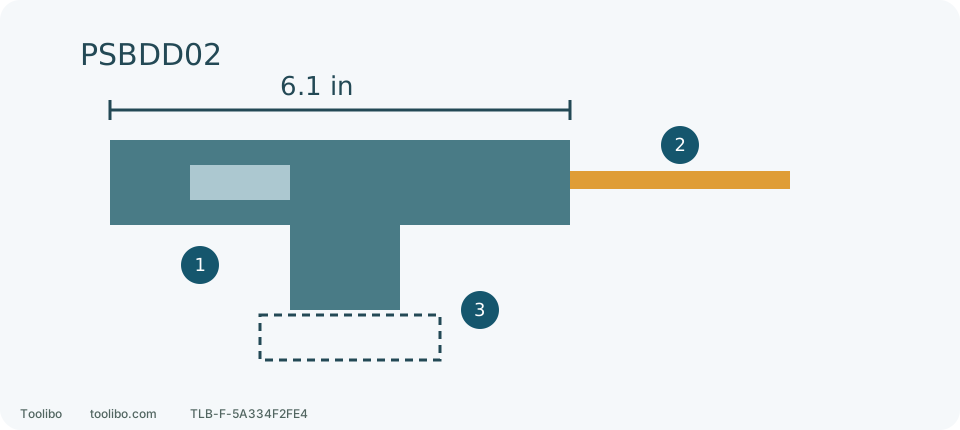
1
Body envelope
2
Actual bit projection
3
Grip and battery clearance; keep battery removed during fit checks
Schematic only: PSBDD02 is listed at 6.1 inches. Add bit projection and hand/battery clearance; no unsupported PBLDD01 length difference is implied.
Start with the differences you can establish
Both US models are brushless ONE+ 18V drill/drivers with two gears, 24 published ring positions and a 1/2-inch chuck. Neither has hammer drilling. Turning the clutch to its highest setting does not add that function.
Swipe or scroll horizontally to see all columns.
| Item | PSBDD02 | PBLDD01 |
|---|---|---|
| Published maximum torque | 450 in-lb | 750 in-lb |
| Low no-load speed | 0–450 rpm | 0–500 rpm |
| Published high speed | Introduction: 1,700; specification field: 1,750 rpm | 0–2,100 rpm |
| Published body length | 6.1 inches, about 155 mm | No numerical comparison here |
| Chuck | 1/2-inch keyless | 1/2-inch metal ratcheting |
| Rotary drilling / screwdriving | Yes / yes | Yes / yes |
| Hammer drilling | No | No |
The PSBDD02 US page disagrees with itself on high speed. Ask for the exact tool version and applicable instructions rather than silently treating either number as universal. A 50 rpm difference would not establish working speed anyway. PBLDD01 has a higher published top speed, but many accessories should not run at maximum speed.
The published 24-position figure includes mode positions, not 24 numbered clutch settings. PSBDD02 and PBLDD01 manuals show numbers 1–23 plus drilling; PBLHM101 shows 1–22 plus drilling and hammer drilling. Follow the actual ring and matching manual.
Measure the cabinet opening, not the compact label
Only handle stable equipment that is safe to approach. If a battery smokes, leaks or remains abnormally hot, do not approach, touch or remove it for a fit check; keep away and seek local emergency guidance.
PSBDD02’s 6.1 inches is a starting measurement, not space for the projecting bit, hand and battery. Without a matching PBLDD01 measurement, there is no defensible length difference or promise that one fits a particular corner. The PSBDD02 specification lists 2.1 lb without identifying the battery condition there; it does not establish a comparable operating-weight advantage.
- Measure from the hole centre to rear, side and overhead obstacles, including a straight entry and withdrawal route.
- Establish how far the actual bit must project beyond the chuck.
- Ask for dimensions of the exact other tool; use the intended battery’s outline to check space below and around the grip.
- Before a physical fit check, release the trigger, wait for a complete stop and remove the battery. Keep it removed; never power the tool into a narrow gap to explore it.
If the complete arrangement cannot enter straight, change the hole position or drilling method. Angled clamping of the bit is not a solution.
Match the tool to your regular work
For hinges, small screws and wood pilot holes, grip and controllable clutch adjustment matter first. Start low on representative scrap and increase only enough to seat the screw appropriately. The settings are not in-lb values and do not transfer directly between tools.
For heavier rotary drilling, PBLDD01’s 750 in-lb rating and metal ratcheting chuck are relevant equipment differences. Still check the bit’s material, diameter, speed and tool requirements. A 1/2-inch chuck is not permission to drill that diameter in every material, nor a maximum wood-hole rating. Unconfirmed capacity cannot be replaced by a larger torque number when choosing a large hole saw or self-feed bit.
Binding, abnormal resistance or loss of control calls for releasing the trigger, waiting for a stop, disconnecting the battery and checking the bit, workholding and task. Changing to a higher-output tool does not replace that diagnosis.
Compare the package you will receive
The current US PSBDD02K2 list contains two PBP002 1.5Ah batteries and a PCG002 charger. PSBDD02K is different: one PBP003 2Ah battery. Existing ONE+ owners can also price the PSBDD02B bare tool rather than duplicate a usable charger.
PBLDD01K lists two 2Ah HIGH PERFORMANCE batteries, a charger and bag. Do not borrow exact battery or charger codes from a different combo kit. On 23 October 2026, both PBLDD01B and PBLDD01K US entries were marked discontinued. That is neither a recall nor proof that retailers have no stock. Confirm the actual tool, battery count, accessories, returns and applicable warranty before comparing the total delivered cost.
For cabinet assembly, decide on complete access and grip; for drilling, decide on the actual accessory requirements; then decide whether the included batteries solve a real need. A peak torque number cannot answer those questions for you.
Models referenced