
Rotation alone versus rotation with axial impacts
Both models drill and drive screws. Only PBLHM101 adds axial hammer action and requires its auxiliary handle; this is not a claim of higher rotary output.
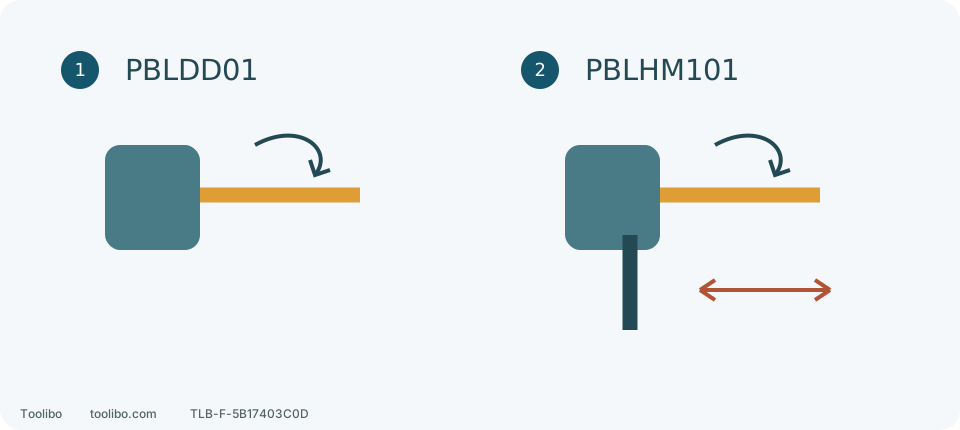
1 · PBLDD01
0–500 / 0–2,100 rpm
2 · PBLHM101
Same rotary speeds; hammer 0–5,400 / 0–31,000 per minute
Both models drill and drive screws. Only PBLHM101 adds axial hammer action and requires its auxiliary handle; this is not a claim of higher rotary output.
The same output figures, different modes
PBLDD01 is a drill/driver; PBLHM101 is a hammer drill/driver. Both US models use ONE+ 18V batteries and have a 1/2-inch chuck, 24 published ring positions and 0–500 / 0–2,100 rpm no-load gears. Both advertise up to 750 in-lb. PBLHM101 therefore is not automatically a faster wood drill or more precise screwdriver.
Swipe or scroll horizontally to see all columns.
| Work or equipment | PBLDD01 | PBLHM101 |
|---|---|---|
| Clutch-controlled screwdriving | Yes | Yes |
| Rotary drilling | Yes | Yes |
| Axial hammer drilling | No | Yes |
| Low / high impact rate | None | 0–5,400 / 0–31,000 per minute |
| Included auxiliary handle | Not a comparison basis here | Yes; instructions require its use |
The impact rates are from English printed page 5 of the PBLCK02K manual containing PBLHM101. They describe a mode, not guaranteed drilling time. There is no verified like-for-like length and weight table here, so neither tool is declared lighter or guaranteed to fit a tighter space.
The published 24-position figure includes mode positions, not 24 numbered clutch settings. PSBDD02 and PBLDD01 manuals show numbers 1–23 plus drilling; PBLHM101 shows 1–22 plus drilling and hammer drilling. Follow the actual ring and matching manual.
For wood and metal, check the accessory and control
Only handle stable equipment that is safe to approach. If a battery smokes, leaks or remains abnormally hot, do not approach, touch or remove it for a fit check; keep away and seek local emergency guidance.
Furniture brackets, wood pilot holes and suitable metal bits call for rotary drilling. Hammer mode does not improve these jobs automatically and can damage the work or accessory. Start screwdriving at a low clutch setting on representative scrap; 750 in-lb is not a screw’s target torque.
If an existing PBLDD01 slips at the bit, leaves rough holes or binds, check sharpness, correct seating, workholding, speed and feed. A hammer symbol on a replacement will not fix those rotary-drilling problems.
A shank fitting the chuck does not authorize an arbitrarily large hole saw. Follow the applicable tool and accessory requirements. Do not substitute chuck size for maximum holes in wood, steel or masonry.
When masonry work justifies PBLHM101
Begin with the anchor requirements, not the hammer switch. For a small bracket, first establish that the brick or block suits the intended anchor, then confirm hole diameter, depth and masonry bit. Do not drill exploratory holes while hidden services, dust control or stable footing remain unresolved.
When the material, tool and bit all permit hammer drilling, PBLHM101 supplies the axial impacts that PBLDD01 lacks. Tile faces, brittle materials and accessories requiring rotation only must not be hammered just because masonry may lie underneath. Regular hard-concrete work, large holes or deep holes may call for a suitable rotary hammer rather than forcing this choice.
Install and use PBLHM101’s required auxiliary handle for stable two-handed control. It is not decoration used only in hammer mode. Include its envelope when planning a cabinet corner; change the setup if you cannot hold the tool reliably.
Price bare tools and kits separately
Neither bare tool includes a battery or charger; PBLHM101B includes the auxiliary handle. The current US PBLDD01K list has two 2Ah HIGH PERFORMANCE batteries, charger and bag. PBLHM101K has one 4Ah HIGH PERFORMANCE battery, charger, bag and the tool’s auxiliary handle. Two 2Ah packs allow rotation; one 4Ah pack is a different arrangement. Adding Ah does not make the packages equivalent.
On 23 October 2026, all four B/K product entries were marked discontinued. Retail stock can still exist. Confirm the actual unit and full contents rather than relying on an old promotional picture. A first-time ONE+ buyer must also match charger input voltage; an existing owner should price the bare tool plus genuine missing equipment.
Without suitable masonry work, choose for rotary drilling rather than imagined hammer-model superiority. PBLHM101 adds clear value when axial hammer action is genuinely needed and its handle and accessories can be used safely. Before changing bits, adjusting or measuring access, release the trigger, wait for a complete stop and remove the battery.
Models referenced