
Shared rotation, one hammer option
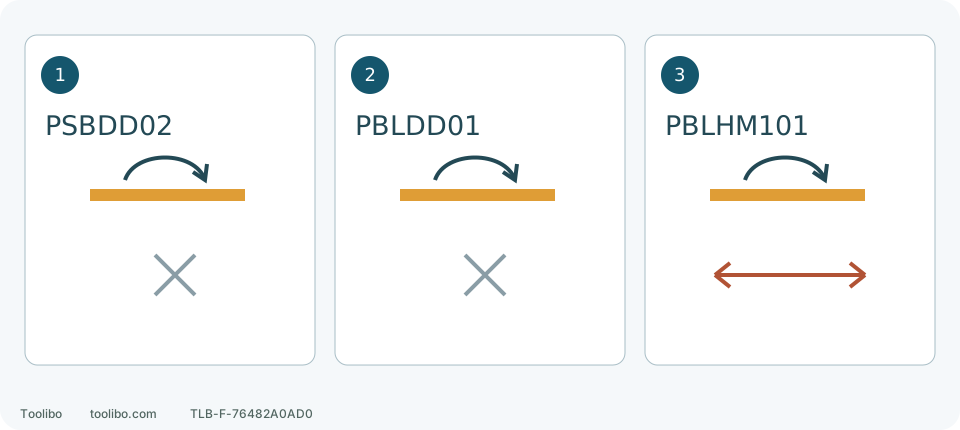
PSBDD02 and PBLDD01 drill and drive without hammer. PBLHM101 adds axial impacts; all share ONE+ 18V, but working clearance and the required handle still matter.
PSBDD02Compact cordless drill/driver
- RYOBI 18V ONE+
- HP Compact drill/driver with a 24-position clutch.
- PSBDD02B — US listing
PBLDD01Cordless drill/driver
- RYOBI 18V ONE+
- HP drill/driver with a ratcheting metal chuck.
- PBLDD01B — US listing
PBLHM101Cordless hammer drill/driver
- RYOBI 18V ONE+
- Selectable hammer action; follow the PBLHM101 sections of the shared manual.
- PBLHM101B — US listing
1 · PSBDD02
Drill / drive
2 · PBLDD01
Drill / drive
3 · PBLHM101
Drill / drive / hammer
PSBDD02 and PBLDD01 drill and drive without hammer. PBLHM101 adds axial impacts; all share ONE+ 18V, but working clearance and the required handle still matter.
Put the three models on comparable terms
These US ONE+ HP brushless tools share a battery platform, not an identical purpose. PSBDD02 and PBLDD01 are drill/drivers; PBLHM101 adds hammer drilling. Existing compatible batteries can help, but the individual tool, battery and charger requirements still apply.
Swipe or scroll horizontally to see all columns.
| Item | PSBDD02 | PBLDD01 | PBLHM101 |
|---|---|---|---|
| Rotary drilling / screwdriving | Yes / yes | Yes / yes | Yes / yes |
| Hammer drilling | No | No | Yes |
| Chuck | 1/2 inch | 1/2 inch | 1/2 inch |
| Published ring positions | 24 | 24 | 24 |
| Published maximum torque | 450 in-lb | 750 in-lb | 750 in-lb |
| Low no-load speed | 0–450 rpm | 0–500 rpm | 0–500 rpm |
| Published high speed | Introduction 1,700; specification field 1,750 rpm | 0–2,100 rpm | 0–2,100 rpm |
| Low / high impact rate | None | None | 0–5,400 / 0–31,000 per minute |
| Body length | 6.1 inches | No numerical comparison here | No numerical comparison here |
PSBDD02’s page has conflicting high-speed values. Ask for confirmation against the actual version instead of making fine speed rankings. The 750 in-lb figures do not specify each clutch step or output in every task. A 1/2-inch chuck is not a universal material-capacity limit.
The published 24-position figure includes mode positions, not 24 numbered clutch settings. PSBDD02 and PBLDD01 manuals show numbers 1–23 plus drilling; PBLHM101 shows 1–22 plus drilling and hammer drilling. Follow the actual ring and matching manual.
Furniture and cabinets: solve access and grip first
Only handle stable equipment that is safe to approach. If a battery smokes, leaks or remains abnormally hot, do not approach, touch or remove it for a fit check; keep away and seek local emergency guidance.
For hinges, pilot holes and small screws, check whether the tool and bit can enter straight with room for the hand and battery. PSBDD02’s 6.1 inches is about 155 mm, useful for initial planning. Without equivalent dimensions for the other two here, the compact label does not establish a numerical length advantage.
Measure from hole centre to obstacles, add actual bit projection, then use the intended battery dimensions to check space below. For physical checks, release the trigger, wait for a complete stop and remove the battery. Keep it removed; do not power into a tight gap. Without reliable grip and withdrawal, change the hole, work sequence or tool arrangement.
Both ordinary drill/drivers provide clutch-controlled screwdriving. Start low on representative scrap and adjust gradually. A PSBDD02 setting does not directly transfer to PBLDD01, and maximum torque does not replace trial fitting.
Heavier rotary drilling: check the bit, not just 750
PBLDD01’s 750 in-lb rating, top 2,100 rpm and metal ratcheting chuck are relevant features. A large accessory still needs appropriate material, diameter, shank, permitted speed and tool compatibility. Do not use a large hole saw or self-feed bit merely because its shank fits or the torque looks high.
For binding, abnormal resistance or poor control, stop, wait until rotation ceases and disconnect the battery before examining the accessory, workholding and task. Pushing harder or fitting a bigger battery is not diagnosis. PBLHM101 has the same published rotary speeds and torque as PBLDD01; without masonry work it is not automatically an all-round upgrade.
Masonry installation: only PBLHM101 supplies hammer action
For anchors in suitable brick or block, confirm the substrate, hole diameter/depth and masonry bit, then locate hidden services and arrange dust control and stable footing. Only when all conditions allow it does axial hammer action help. Tile faces, brittle material or rotation-only accessories must not simply be hammered.
PBLHM101 requires its auxiliary handle, not only when hammer mode is selected. Install and hold it as instructed, and include its space when buying or measuring access. Frequent hard-concrete work or large/deep holes may call for a suitable rotary hammer rather than forcing a choice among these three.
Finish with the exact kit and stock condition
PSBDD02K2 lists two PBP002 1.5Ah packs and PCG002; PSBDD02K lists one PBP003 2Ah and PCG002. PBLDD01K lists two 2Ah HIGH PERFORMANCE packs, charger and bag. PBLHM101K lists one 4Ah HIGH PERFORMANCE pack, charger, bag and auxiliary handle.
On 23 October 2026, the corresponding US PBLDD01B/K and PBLHM101B/K entries all showed discontinued. This does not mean recall or no retail stock. Verify actual identity, accessories, battery condition, returns and applicable warranty. Existing ONE+ owners may prefer a bare tool plus missing items; newcomers should compare the complete cost of starting work, not just battery count.
Eliminate unsuitable modes first, unsafe or impractical access second, then compare equipment you can actually use.
Models referenced