
Four checks before selecting a system
A separates WX429L and CR5435B-00 records. B distinguishes disconnected cord and detached battery supply. C shows two separate required extraction arrangements, not cross-fit. D shows a six-row evidence sheet without an automatic approval tick.
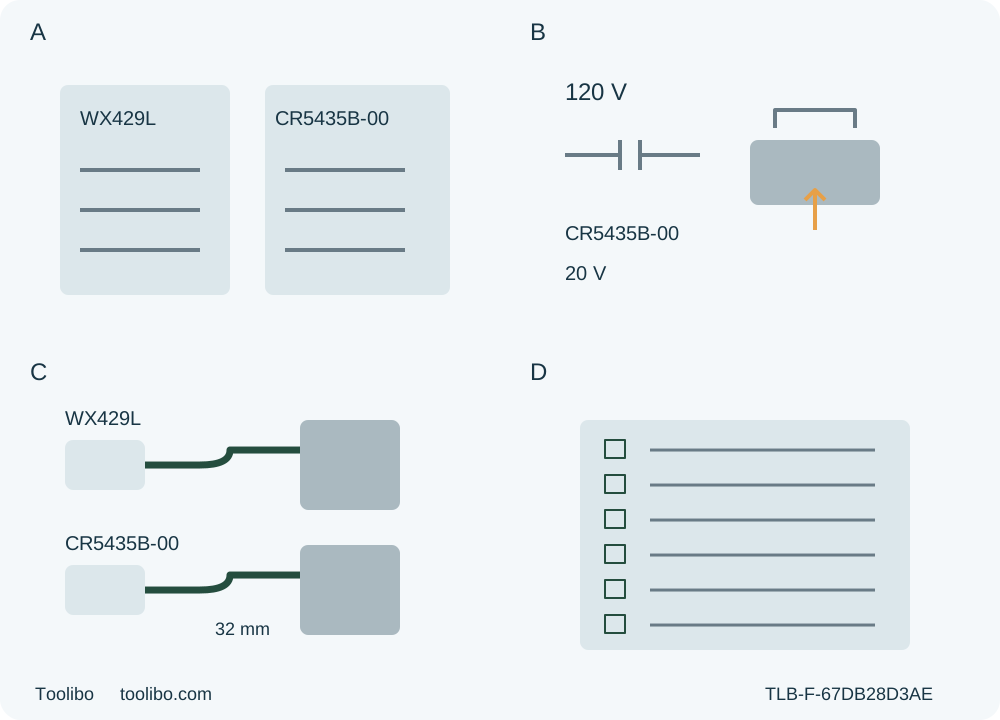
A · Keep identities separate
Match actual model, document and original approved wood assembly; equal nominal diameter and bore do not authorize interchange.
B · Qualify actual supply
WORX needs its real 120 V/60 Hz supply and safe cord route; SKIL needs the actual commissioned BY519702/QC536001 system and own instructions.
C · Require both dust systems
Each candidate needs its own complete native connection and active suitable extraction; SKIL 32 mm is not a WORX adapter specification.
D · Decide from six evidence rows
Close identity, power, dust, grip, full path and condition/acceptance. A grip-marking conflict or unsafe setup is HOLD, not a lower score.
Original conceptual decision aids, not operating instructions or scaled tool drawings. Separate lines in C require each model’s own complete qualified native arrangement and active suitable extractor; the graphic gives no adapter equivalence or hose-fitting recipe. D is an evidence checklist, not a safety score or certification. Actual physical grip markings and supplied instructions must agree before either system is eligible.
Choose a complete compact system, not a motor number
A homeowner has a known loose wood board, a modest square cut and two compact saws available: a US WORX WX429L and an actual SKIL CR5435B-00. Both use a nominal 115 mm blade envelope and a 3/8-inch, 9.5 mm mounting hole. That similarity does not establish interchangeable blades, washers, guides, extraction adapters or operating instructions. The useful decision is which complete, documented system can safely reach and finish this particular cut—not which tool wins a voltage, speed or one-hand convenience contest.
The result of this guide is a written eligible / conditional / HOLD decision for each saw and one selected owner workflow, or a decision to use neither. It is not a pair of operating tutorials or permission to energize an unfamiliar tool. The exact scopes are WX429L with the matched AR01295003 manual and CR5435B-00 with its matched 01/22 manual. Read each complete supplied document before deciding. A different body, conflicting actual marking or unidentified revision is not covered by a familiar brand name.
1. Define the job before comparing the tools
Write down the material, actual thickness, required finished dimension, trustworthy reference edge and which face matters. For this comparison, keep the job to clean, dry, known wood approved for each candidate’s existing original wood blade, with no nails or other foreign material in the proposed route. An interior opening, unknown coated panel, installed wall, metal or tile is outside the decision. The fact that a manual contains additional material sections does not expand this bounded wood task.
Then draw the retained and waste portions, clamp locations, independent supports, clear exit and operator position. Each candidate needs enough actual shoe support, stable reach and clearance for its own grip, guard, guide and hose throughout the route. The retained work must be clamped securely; both portions need support outside the blade path, while the waste remains free to separate without closing the kerf. Neither a compact handle nor a cordless battery makes it acceptable to hold the board or offcut with the other hand.
If the job cannot be supported without a loose small-piece recut, reaching under the work or relocating a clamp while cutting, reject that plan before choosing a saw. A different saw is not a substitute for a sound fixture. Do not assume a maximum-depth table proves that the particular thickness is eligible: the real setup must cut through while exposing less than a full tooth, retain clearance from supports and allow safe entry and exit.
2. Give each candidate its own identity and assembly row
For the WORX row, record actual WX429L identity, matched instructions, original approved 115 mm, 24-tooth wood blade with a 9.5 mm hole, and correct existing washers and bolt. The manual requires a blade marked for at least the speed on the tool; its table lists 3500/min. Verify actual blade approval and markings rather than treating this motor figure as proof. Keep the 9.5 mm identification: “nearly 10 mm” is not an assembly specification.
For the SKIL row, record actual CR5435B-00 and 01/22 match, original approved 115 mm/9.5 mm wood assembly, correct washers and blade safe speed at least 6000 rpm. Its higher motor speed is not evidence of better finish, more usable torque or permission to transplant a WORX blade. An apparently matching diameter and bore do not establish tooth geometry, plate thickness, clamp engagement, direction or manufacturer approval.
Both rows require an actually sharp, undamaged blade and sound accessible hardware, shoe, handles, switch and guard. Missing approval, uncertain mounting, a bent shoe, abnormal vibration or unexplained contamination is a HOLD for qualified assessment, not an invitation to test which saw cuts better. These owner systems were qualified with an already correct original assembly; this comparison does not supply a fitting, torque, sharpening or cleaning recipe.
The WORX manual includes conflicting abrasive-related material while also prohibiting abrasive wheels and excluding plastics in its working hints. The SKIL document has a separate ceramic-tile scope but excludes metal and masonry in its intended-use notes. Neither observation is permission to broaden this wood comparison. Do not use another material as a trial of the selected blade or guard.
3. Compare the real power and hose paths
The WX429L is the documented 120 V, 60 Hz, 4 A corded system. Eligibility means the actual nameplate, sound plug and cable, suitable supply and any required correctly selected extension arrangement have been verified. Include the entire cord path in the fixture drawing: no cutting, pinching, hot surfaces, sharp edges or pull that could disturb the saw near the exit. A nearby outlet alone does not complete that qualification. A damaged cord or unreliable switch requires qualified service, not a taped repair or powered fault reproduction.
The bounded SKIL candidate is an already commissioned BY519702 battery / QC536001 charger system under their own matching complete instructions. The tool manual lists these identities, but the list is not a charging tutorial, a carton guarantee or approval to pool every SKIL pack and charger. Record actual labels, condition and the owner’s established operating arrangements. If those instructions or compatibility evidence are missing, classify this candidate as conditional pending evidence, or HOLD when a conflict or unsafe condition is known. Do not cure a missing mains arrangement by inventing a new battery system.
Cordless does not mean hose-free. Both candidates require connected dust collection for the selected wood workflow. WORX’s operating table says to keep the dust adapter connected to a collecting device while using the tool. Its later “consider connecting a vacuum” troubleshooting wording does not make that optional. SKIL specifies its supplied adapter and a 32 mm hose connection, with an extractor suitable for the actual dust and no hose interference with the lower guard or cut.
Require each complete, already qualified native arrangement and an active suitable extractor operated under its own instructions. Do not transfer SKIL’s 32 mm dimension to WORX, infer a universal adapter or count an idle hose as working control. Connection and clearance checks require the saw off, fully stopped and unplugged or battery removed, with the extractor isolated as its instructions require. In the decision sheet record how the hose reaches the entire cut without obstructing the grip, guard, clamps or waste. Add the applicable ventilation, eye, hearing and respiratory protection and a dry, well-lit, nonexplosive workplace with bystanders clear. Extraction does not cancel those requirements.
4. Resolve grip evidence before calling either candidate eligible
The actual WORX ordinary crosscut/rip figures show its original rear grip. Do not invent an auxiliary handle, hold a guard or put the other hand on the work to imitate a larger saw. The selected owner route must match the physical tool and its complete instructions; the free hand remains clear of blade, underside, waste and guard movement.
For SKIL, the model-specific ordinary-operation Figures 11–13 and the manufacturer’s “One-hand” designation support the actual main-handle route used by its bounded owner guide. However, the same manual’s general symbol table includes an “always operate with two hands” symbol and introduces the table as symbols that may appear on the tool. This is not a universal declaration that the symbol does not apply. Inspect the actual physical markings and supplied instructions. If they impose a conflicting grip requirement, hold for manufacturer clarification before use. Do not solve that conflict by improvising a second gripping surface, discounting the marking or assuming a web photograph overrides the tool in hand.
This question changes eligibility, not the ranking. If the SKIL’s actual grip instructions remain unresolved, it cannot be the selected system just because the task would be easier without a cord. Conversely, a qualified SKIL grip does not prove that the operator can safely support and reach this particular work. Neither candidate grants permission to hold stock with the free hand.
5. Check control and stopping obligations without rehearsing live
Write a short control-recognition row for the chosen system, then use only that model’s complete owner workflow for the actual setup and cut. WORX has the rear safety-slider/trigger sequence, rear depth lever 16 and front bevel lever 11. SKIL has its own thumb lock-off/trigger, depth-lock knob by the motor and front bevel-lock knob. SKIL’s left zero-degree notch is an approximate reference that needs a supported sample; do not import its notch or guide offset into WORX merely because both bodies are compact.
For both candidates, isolation precedes settings and inspection: switch off, wait for actual complete standstill, then unplug WORX or remove the SKIL battery. Before use the guard must close instantly and move freely without contacting blade or other parts at all angles and depths of cut, with its spring sound. Ordinary edge-entry uses automatic lower-guard operation, not manual holding open. A successful zero-setting check does not replace the full documented range check.
Both require full blade speed before contact, a stable supported path and a controlled feed. Their manuals do not turn an LED, released trigger or elapsed countdown into proof of a safe blade. Normal completion requires trigger release, actual standstill and guard coverage before safe setdown and physical isolation for acceptance. Binding or interruption instead requires immediate trigger release and holding the saw motionless until stopped—not withdrawing a moving blade or attempting a comparison restart. Do not perform powered fault, brake or protective-function tests to settle the choice.
6. Finish the decision sheet and its acceptance handoff
Use a separate row for each of these six questions, with the actual evidence and a reason when unresolved:
- Identity and assembly: Does the physical tool match the exact document, original wood assembly and blade rating, without borrowing the other model’s parts?
- Power: Is the actual corded supply or designated commissioned battery system complete and sound?
- Dust and environment: Is the correct native connection complete, with active suitable extraction and the required workplace/PPE controls?
- Grip and instructions: Can the documented grip be used, with no unresolved physical-marking conflict and no hand holding stock?
- Whole path: Are shoe support, clamping, independent waste, guide relationship, cord/hose clearance and safe reach qualified through the exit?
- Condition and acceptance: Are full-range guard checks and controls sound, and can the owner safely stop, isolate and inspect a representative sample?
Mark eligible only when every row is positively established for that actual job. Mark conditional when a specific missing documentary or planning item can be closed before use; state who must supply it and what evidence will close it. “Probably compatible” is not a closing condition. Mark HOLD for damage, a conflicting marking, unknown assembly, unsuitable exposure controls or an infeasible fixture. If both are eligible, choose the already complete arrangement that fits the work and operator; this is a practical ownership choice, not an unsupported speed or finish ranking. If neither is eligible, choose neither.
The handoff is to the selected model’s complete supported-sample workflow, not directly to the final workpiece. Define acceptance before that sample: full separation, required retained dimension and square relationship, acceptable damage on both faces, unchanged support/locks and normal guard return. Measure only after actual stop and physical isolation. Unexpected burning, drift, vibration, stalling or guard behavior stops the process for qualified investigation; it is not a reason to force the cut or swap a blade between systems. Keep the completed sheet with the exact documents so a changed blade, pack, adapter, stock or fixture triggers a new qualification rather than inheriting an old checkmark.
Models referenced