
Compare the whole documented system
A keeps two rail/document systems separate; B contrasts 165 mm and 168 mm blades with the same 20 mm bore; C distinguishes a 2–3 mm scoring option from lift-sensing obligations; D records a whole-system decision.
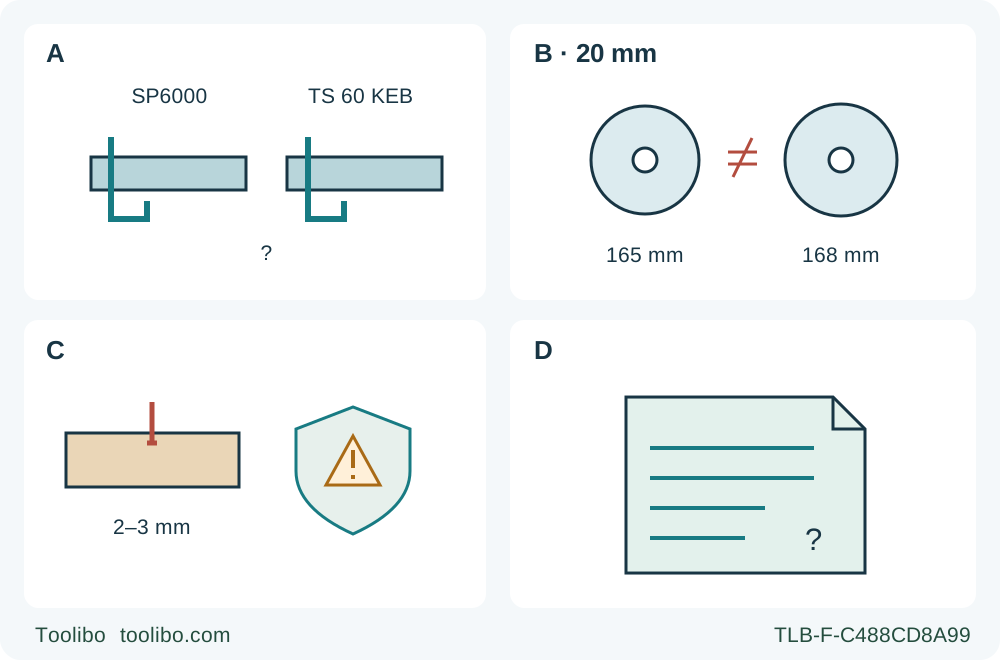
A · Match the actual rail system
Confirm exact approved rail, clamps, complete instructions, fit and splinter-edge condition. Compare actual depth with the selected rail; do not transfer a guessed offset or capacity.
B · Qualify the original assemblies separately
SP6000 uses its approved 165 mm / 20 mm assembly and at least 5200 rpm blade rating; TS60 specifies 168 mm / 20 mm, 1.8 mm kerf, 1.2 mm body and suitability for 9500 rpm. A common bore is not interchange approval.
C · Include the attached obligations
The SP6000 2–3 mm rail scoring method and TS60 lift-sensing/braking are different functions. Finish trials, guarding, support, extraction and prescribed checks remain necessary.
D · Choose, resolve or defer
Record the complete verified system and missing essentials. Unknown accessory identity or an unmet required check keeps the proposal on hold regardless of a favourable bare-tool price.
These are conceptual comparison symbols, not physical assembly or running-cut drawings. A means each actual rail and its complete instructions must match; no cross-brand compatibility is asserted. B does not authorize blade interchange. C pairs different documented functions, not a performance or safety score: the SP6000 scoring option is not the TS60 KickbackStop function. D represents a documented choose-or-hold result, not certification that a pictured system is ready to run.
A guided saw is a system purchase, not just a motor-and-blade choice. For a planned run of straight, supported wood-panel cuts, compare the saw, original blade assembly, rail, clamps, splinter reference, extraction and owner’s inspection obligations together. This worksheet ends with one of three decisions: a documented system fits the task; essential evidence or equipment is still missing; or neither proposed system is appropriate yet. It is not a cutting tutorial or a hands-on performance ranking.
The examples are the US Makita SP6000 under 884683E949 and the North American Festool TS 60 KEB under 10472370_G dated 17 April 2024. The Makita’s exact current US product and listed accessories are part of its admitted evidence. The Festool is an exact manufacturer-document reference, not a claim that this is the latest supplied revision for every current carton. Verify the actual regional nameplate, supplied instructions and accessory identities before making a buying or reuse decision.
Start with one real task rather than the largest number
Write the material, actual thickness, finished dimensions, required visible edges and whether the intended cuts start at an open edge. Record how the loose panel will be clamped and supported through separation, including the waste. A rail does not hold a sagging panel flat, guarantee that a small offcut cannot pinch the blade or provide stable footing at the far end.
This comparison concerns ordinary straight wood-panel work with a qualified original assembly. It does not make either system ready for internal cut-outs, metal, mineral boards or an angle-cutting accessory. If the actual job requires those operations, put them on a separate evidence-needed list instead of treating the word “plunge” or a catalogue image as a complete method.
Then list what is already owned, with exact identities and condition. Mark each item as verified reusable, required but missing, optional or unresolved. An unidentified rail or a blade with an apparently matching centre hole belongs in unresolved, not in the reusable column. This is often more useful than comparing bare-tool prices while assuming all accessories transfer.
Do not let the shared 20 mm bore hide different blade systems
The admitted SP6000 US assembly uses a 165 mm blade and 20 mm arbor. Its manual requires every blade to be rated for at least 5200 rpm even when the speed dial is set lower. This owner scope retains the correctly installed approved wood assembly; it does not teach fitting or qualify a generic replacement through the bore dimension alone.
The TS 60 KEB document specifies 168 mm diameter, 20 mm locating bore, 1.8 mm cutting width and 1.2 mm standard blade thickness, with suitability for 9500 rpm and EN 847-1. Its operating speed range is 3000–6800 rpm. The blade requirement is not replaced by the smaller motor-speed number. Nor does the shared nominal 20 mm bore make the two blades interchangeable.
Put blade identity and the intended material in separate cells on the worksheet. If a seller’s proposed blade cannot be matched to the complete model-specific requirements, stop that configuration rather than assuming a thicker, thinner or slightly different-diameter blade will merely change the kerf. Original assembly qualification is a precondition for this comparison, not a modification project.
Compare depth references, not an unqualified maximum
The SP6000 manual describes its depth scale as a rough setting and requires actual blade projection to be measured for accurate depth. The selected rail changes the real relationship between saw base and work. A capacity figure without identifying whether a rail is present is not enough to decide whether a particular panel can be cut correctly. The existing SP6000 owner workflow therefore qualifies actual projection with the real rail and retains the documented tooth-exposure limit.
The TS 60 document explicitly separates its depth references: up to 62 mm without a guide rail and up to 57 mm with an FS guide rail. The +FS scale is a distinct reference, not an instruction to add a guessed rail correction to an already rail-adjusted reading. These numbers describe the cited document’s limits; they do not justify a more deeply projected blade than the task requires.
Write the actual stock thickness beside the usable depth under the chosen, documented configuration. If margin is unclear, hold the choice for exact confirmation. Do not infer that a slightly larger blade diameter automatically produces a better finished cut or compensates for incomplete support. Capacity and process qualification answer different questions.
Treat each rail and splinter edge as a matched reference
The SP6000 instructions use two base adjusting screws to establish smooth travel without clatter on its guide rail. Its full-length splinterguard trim creates the cutting-edge reference. The current exact US product identifies genuine rail and clamp accessories, but that evidence is not blanket approval of a rail with a similar-looking profile. A previously trimmed strip also needs to agree with the actual blade and setup that will use it.
The TS 60 document likewise specifies two adjustable jaws for guide play and a full-length bedding-in of the rail splinter guard. It requires approved accessories and describes its FS guide system. The separate FSK cross-cutting rail has its own operating manual; its mention does not make a complete angle-cutting setup part of this worksheet.
For either proposal, require the exact rail and clamps, their complete instructions, sound condition and an established reference edge. Do not mix one brand’s blade, another rail’s depth assumption and a third source’s clamp layout into a supposed universal system. A rail that can slide under a saw is not thereby a qualified combination.
Keep initial commissioning costs and obligations visible. A worn strip, uncertain fit, missing clamps or incomplete accessory instructions can make an otherwise attractive saw an unresolved purchase. The correct decision may be to complete an existing documented system instead of adding a second bare tool.
Separate scoring from the other finish controls
The SP6000 has a documented quick-stop button for a 2–3 mm first pass when using a guide rail, followed by the usual-depth pass. That is a particular two-pass method with its own isolated transition and repeatable fixed rail. It is not an invitation to pull a running saw backwards, and it does not guarantee a perfect edge in every plywood. Choose it only if the complete supported two-pass workflow fits the task and its trial meets the finish requirement.
The TS 60 document describes a separate green splinter guard that improves the upper cut edge of the sawn-off piece at 0°, in addition to the rail’s splinter strip. It has its own fitting and bedding-in instructions. This comparison identifies that ownership requirement without reproducing a partial installation procedure. Do not invent a matching 2–3 mm scoring control for the TS 60 or treat every anti-splinter feature as the same operation.
If a visible edge is decisive, include a comparable-material trial and a defined damage limit in the eventual owner plan. A feature list cannot replace actual finish acceptance. We have not tested the two machines against each other, so neither “cleaner” nor “faster” is awarded here.
Account for protection and extraction as obligations
The TS 60 KEB’s feeler wedge detects unintended lifting from the workpiece or rail and triggers rapid blade braking. The manual expressly says KickbackStop does not guarantee complete protection against kickback. Its prescribed function checks, condition of the feeler unit and post-trigger assessment are ownership responsibilities. A green indicator means the function is active; it is not certification of the entire workpiece setup, blade assembly or operator position.
The SP6000’s documented overload protection, speed control and soft start are not described as the same lift-sensing function. Do not turn absence of that named feature in this comparison into a universal unsafe/safe ranking. Both systems still require their complete guarding, support, grip, direction-of-feed and stopping rules. A brake or electronics never substitutes for disconnecting power before work on the tool.
Extraction belongs in the system ledger as well. The Makita manual describes connecting a suitable Makita vacuum arrangement for clean cutting. The TS 60’s dust section requires extraction and describes the actual connector arrangements, recommending the larger 36 mm hose to reduce clogging and requiring attention to static charge and antistatic equipment. Qualify the actual hose and extractor for the dust rather than transferring an airflow threshold from an unrelated Bosch guide. Neither a visible bag nor a hose photograph certifies exposure control.
Close the decision with evidence, not a score
A defensible SP6000 choice might be an owner whose exact genuine rail, clamps, original assembly and extraction are already qualified, and whose intended finish benefits from its documented two-pass option. That is a fit-to-task reason, not a claim that the Makita always costs less or cuts better.
A defensible TS 60 choice might be an owner who needs its documented system functions and is prepared to meet the exact blade, rail, extraction and protective-function obligations. The decision remains held if the actual revision, rail or required checks cannot be established. Choosing a feature also means accepting the instructions attached to it.
For the final record, name the actual model and document, material and thickness, approved original blade, rail/clamps and reference condition, depth reference, extraction arrangement, required checks and the still-missing items. Use current quotations only after identities are settled; this article makes no live price or kit-content claim. If either column contains an essential unresolved item, do not erase it with a total score. Choose a complete supported system, resolve the missing evidence, or defer both—and move to the corresponding complete owner instructions only after that decision is closed.
Models referenced