
Four stages of a documented decision
A shows a disconnected cord and pause symbol; B an observation sheet; C four separate assessment boxes; D separate hold and documented-eligibility outcomes.
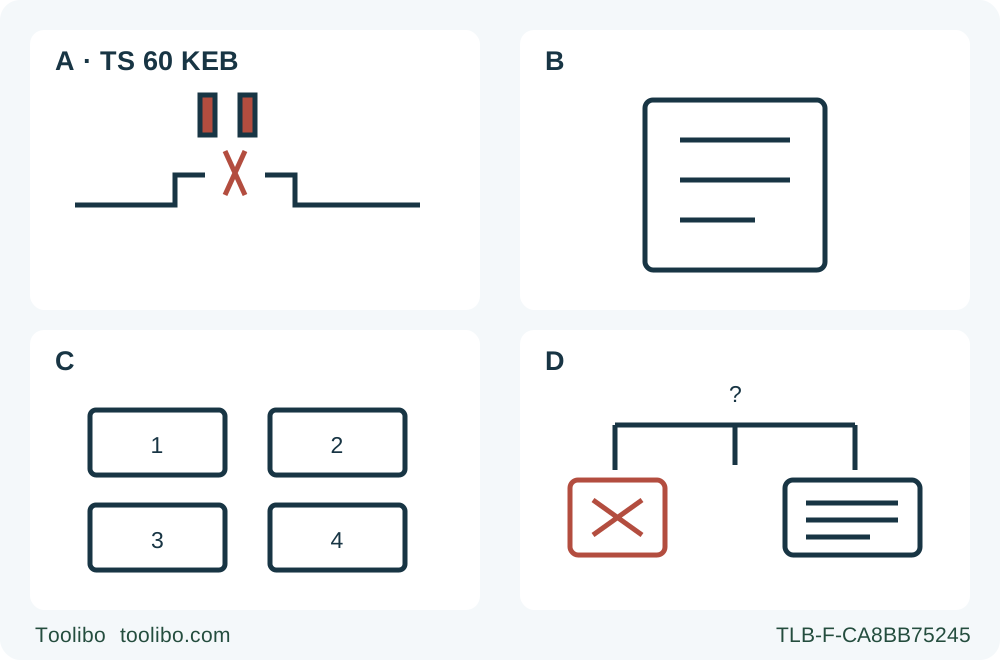
A · Stop and isolate
Maintain control until complete standstill, then disconnect before assessment; do not recreate the event.
B · Record what is known
Distinguish observed lift, a supported surface-related explanation and an unknown cause; do not convert missing evidence into clearance.
C · Complete the required checks
For an actual lift-triggered event, retain separate cause, machine, feeler-wedge and exact function-check requirements. Use complete instructions, not a partial live test.
D · Decide and document
Unresolved or failed conditions keep the saw out of use. Satisfied requirements permit return only to the established full workflow, not an improvised restart.
This is a conceptual decision aid, not a switching or mechanical procedure. A means standstill and disconnection before inspection. B records existing observations without reproducing the event. C keeps cause correction, machine condition, feeler-wedge condition and the prescribed function check separate. D permits only a documented decision: keep out of use or return to the complete established instructions after all prerequisites are met. No green indicator alone authorizes work.
A TS 60 KEB that has stopped after a KickbackStop event needs an explanation, not merely another press of the switch. The useful outcome of this guide is a written decision: keep the saw out of use, obtain further assessment, or return to the owner’s established operating workflow after the required conditions have been satisfied. It is not a reset sequence, a function-test tutorial or permission to complete an interrupted cut.
The reference is the North American TS 60 KEB instruction manual 10472370_G, dated 2024-04-17. Match the actual saw, regional identification and supplied instructions before using this decision sheet. This is a document-scoped interpretation, not a claim that this is every owner’s latest manual. The machine must already have a correctly qualified blade assembly and an established operating setup. Blade removal, fitting, rail commissioning, plunge cutting and protective-function deactivation are outside this workflow.
First secure the interruption, then assess it
If the blade binds or cutting is interrupted, release the switch and keep the saw stationary in the material until the blade stops completely. Do not pull a moving blade backwards through the kerf or lift it out while it is still turning. Retain control of the tool and supported work; a protective stop does not make an unstable offcut safe to catch. After standstill, disconnect the power before inspection or adjustment. Use the complete owner instructions to leave the tool in its protected condition; do not improvise removal from a trapped cut.
A trigger released to OFF is not electrical isolation. Neither a brake response nor a changed indicator makes the blade safe to touch. If damaged or unstable material prevents safe access to the plug or removal of the tool, keep people clear and obtain suitable assistance rather than reaching beneath the work. Stop the job, not just the motor.
Record what was already visible when the event occurred: the cut location, whether the base lifted or rocked, whether the work or guide moved, any binding, the observed indicator and any unusual noise. Do not reconnect the saw merely to recreate the event, recover an indicator colour or demonstrate that the protection still works. An observation that was missed should be marked unknown.
Identify what the system actually detects
Section 9.7 describes a feeler wedge that detects unintended lifting of the saw from the workpiece or rail and triggers rapid braking. That reduces risk; the manual explicitly does not promise complete protection against kickback. This is not a general sensor for every poor support arrangement, hidden fastener, damaged blade or incorrect feed decision.
The status descriptions are useful evidence, but they are not a clearance checklist. Green means the KickbackStop function is active. Orange means it is deactivated. Flashing orange means it is not active, including the documented situation in which the saw was started before the feeler wedge was pressed against the work or rail and the plate was not completely level. Flashing red means the function has triggered. These meanings refer to this exact system, not another manufacturer’s LED vocabulary.
A green light does not establish that the work is stable, the blade is undamaged, the cause of lifting has been eliminated or a required function check has passed. Conversely, a motor stop without a remembered red indication is not proof that nothing went wrong. The manual also describes overload and temperature protection. Do not diagnose every stop as KickbackStop or repeatedly cycle the trigger to discover which protection intervened.
Separate a real lift from an unexplained or surface-related event
The manual distinguishes triggering caused by unintended lifting from unintentional triggering on an uneven workpiece without a rail. In the latter example, a recess allows the feeler wedge to occupy a position corresponding to a lifted saw. That explains a possible mechanism; it does not authorize calling every inconvenient stop a false alarm.
With power disconnected, examine the recorded circumstances and the supported work. Did a panel sag, an offcut rotate, a clamp shift, a guide become unstable or the base lose full contact? Was the saw twisted, forced or allowed to bind? Is the material known and free of concealed obstructions? These questions organize the assessment; they are not instructions to reproduce the failure. Review the complete safety and operating instructions for the actual cause.
Use three initial classifications on the decision sheet: observed lift or kickback; a documented surface-related explanation with no unresolved damage or lift concern; or cause unknown. If the evidence is incomplete, keep the third classification. In this conservative workflow an unknown cause is not cleared by a later green light or by obtaining one apparently good cut.
For a surface-related event, the manual says to try working with the function active first and describes a narrowly limited deactivation exception elsewhere. This article deliberately does not teach or authorize that exception. Change to a suitable, fully supported arrangement within the owner’s established instructions, or seek advice if active protection cannot be maintained. Repeated unexplained triggering is a reason to stop and resolve the setup, not a reason to bypass the system.
Apply the actual post-lift requirements
For triggering caused by unintended lifting, section 9.9 requires determining and eliminating the reasons for lifting, checking the machine for damage, checking the feeler wedge for damage and checking the KickbackStop function under section 9.11. Treat these as separate requirements. Correcting a clamp does not automatically clear damage, and an intact-looking housing does not establish that the feeler wedge or detection function is sound.
Record the cause found and the corrective action rather than writing “reset.” If support was implicated, document how both resulting pieces remain stable and how the base stays fully supported. If the blade or assembly is suspect, stop using the saw until the complete matched inspection or service requirements have been satisfied. This guide gives no partial blade-change or alignment recipe.
The feeler wedge is a protective component, not an ordinary fence or a piece to straighten by eye. The manual warns that even slight bending can delay braking, and contamination can impair detection. Do not bend it back, tape it out of the way, hold it in position or treat visual cleanliness as a passed function test. Damage or uncertainty must remain visible on the decision sheet until properly resolved.
Do not open the housing or protective cover to investigate electronics. The manual reserves work requiring the motor housing to be opened to an authorized service workshop. That is a specific service restriction, not a claim that every owner check must be performed by a technician. Owners who can safely carry out permitted work must still follow the complete matching instructions; this article does not replace them.
Do not turn the function check into a quick live experiment
Section 9.11 is a special procedure with its own preparation, including removal of the blade and use of the guide rail. It is not a test to perform with the normal cutting assembly while deliberately lifting a running saw. This guide intentionally omits its switching sequence, timings and movement instructions so that a partial summary cannot be mistaken for the complete procedure.
The manual also calls for checking the function before each use. The post-event requirement therefore does not disappear simply because the saw has previously behaved normally. A status light seen during ordinary operation is not a substitute for the prescribed check.
The decision sheet should record that the exact required check was completed under the full instructions, by whom, and its result. A competent owner following the complete permitted procedure is not automatically excluded by the manufacturer. However, if you lack the instructions, equipment, ability or confidence to complete every prerequisite, this guide’s conservative choice is to keep the saw out of service and ask Festool or a suitable authorized service provider for help. That referral choice is not a fabricated manufacturer rule that only a workshop may ever perform the check.
If the function still does not work correctly after the manual’s prescribed verification and corrective checks, the manual says not to use the machine and to contact their Festool service workshop. Do not accept intermittent success, substitute an ordinary green indication or keep testing by making cuts. Retain the failed or uncertain result in the record.
Make the return decision explicit
Use a short record with fields for saw identity and manual revision, event observations, cause classification, cause correction, machine condition, feeler-wedge condition, required function-check result and unresolved items. A separate field should state the decision and who made it. This is an owner planning aid, not a manufacturer inspection certificate.
Keep the saw out of use if the cause is unknown, damage is suspected, any required check is incomplete, the protective function is faulty, the exact instructions are unavailable or the proposed work would require defeating protection. Mark the unresolved item and the next action clearly. A service handoff should include the original observations and checks already attempted, without reconnecting the saw to produce a demonstration.
Eligibility to resume requires the cause to be understood and eliminated, the required condition checks to be satisfactory, the prescribed function verification to be complete and all other owner prerequisites to remain valid. It means returning to the complete ordinary operating instructions, not jumping back into the interrupted kerf. This article provides no interrupted-cut restart sequence, no internal plunge method and no new rail setup.
Before any later permitted work, re-establish the whole setup: suitable known material, support and restraint, a fully level base, unobstructed blade path, correct depth and locked adjustments, clear cord and hose, suitable dust extraction, eye and hearing protection and appropriate respiratory protection. The saw must still be in its correctly assembled, maintained condition. Protective sensing is one part of that system, not a substitute for the rest.
Close the record only when the decision is supportable. “Stopped, isolated, unresolved—service requested” is a valid completed outcome. So is a documented return to the established workflow after every required condition has been satisfied. “The light went green, so I continued” is not.
Models referenced