
From exact identity to a documented ownership decision
A separates the two exact model identifiers; B contrasts round and diamond original interfaces; C pairs different maintenance records; D shows a completed decision document rather than a safety score.
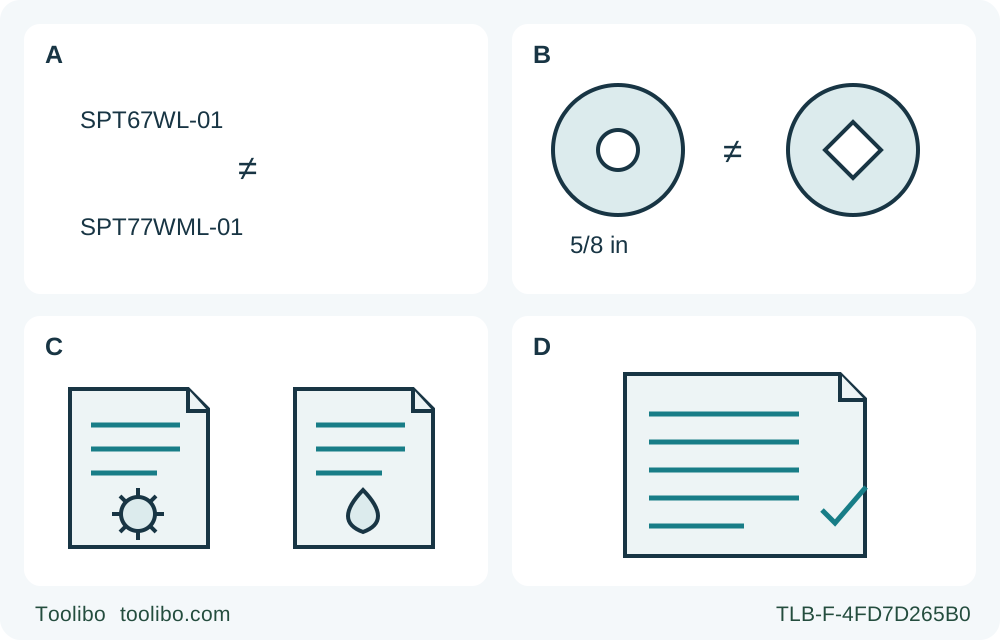
A · Match the exact manufacturer names
Record SPT67WL-01 Sidewinder and SPT77WML-01 Worm Drive with their actual documents; inspired wording does not change the first model’s classification.
B · Keep original assemblies separate
Round 5/8 in and diamond interfaces are distinct qualifications. Unknown blade, flange or clutch assembly means hold; do not convert or test it during comparison.
C · Compare real maintenance obligations
Keep SPT67 gear-service requirements separate from SPT77’s prescribed oil check before every use. This panel is a responsibility comparison, not an oil-opening or regreasing recipe.
D · Record consider, hold or reject
Write the model, documents, original assembly, maintenance evidence and unresolved conditions. A completed decision permits only the appropriate next qualification stage, not an immediate powered test.
This is a conceptual reading aid, not a gearbox drawing or a maintenance procedure. A requires exact manufacturer naming, not inference from handle shape or inspired technology. B shows that equal blade diameter does not make round and diamond interfaces interchangeable; no fitting is taught. C separates the SPT67 documented service obligation from the SPT77 prescribed pre-use oil prerequisite, without teaching either repair. D means the evidence sheet is complete, not that either tool is certified safe or ready to plug in.
A drive-system name is useful only when it belongs to an exact documented model. A rear handle, a long housing or a phrase about another product’s technology is not enough to identify the gears inside. This comparison turns the manufacturer’s names and two complete manuals into an ownership decision: which exact saw’s assembly, maintenance and operating prerequisites can you actually support?
The comparison is between the US SPT67WL-01, named Sidewinder on its current manufacturer page, and the US SPT77WML-01, named Worm Drive. It does not compare every sidewinder with every worm-drive saw. Both are corded circular saws, but their documented assemblies and lubrication obligations are not interchangeable. No timed cuts, measured torque, endurance tests or hands-on performance results are claimed here.
The intended result is a short decision sheet with an exact model, its controlling documents, the obligations you can meet and any unresolved reason to hold the purchase or use. A model can remain a reasonable candidate without being ready to plug in. Conversely, a drive label does not make an unidentified blade assembly or neglected maintenance acceptable.
Establish the names before interpreting the marketing
Record the full selected suffix, the actual nameplate and the appropriate manual. The SPT67WL-01 product page explicitly calls it a Sidewinder and also uses the phrase “Worm Drive-inspired technology.” Those statements do not convert the SPT67WL into a worm-drive model. The first is the manufacturer’s model classification; the second is a marketing description, not a gear drawing or a transfer of the other tool’s service instructions.
For SPT67WL, the reviewed manual is 1619X08870, with the 2014 layout date retained. For SPT77WML-01, the reviewed instructions are 1619X09207, marked 04/17, in a shared manual covering several configurations. These dated documents are linked by the exact manufacturer product pages; they are not evidence that every earlier or later saw supplied under a similar name has an identical instruction set.
The selected SPT77WML-01 is the standard-plug configuration. Do not import the shared manual’s twist-lock arrangement from the -72 configuration. Match the actual supply and cord requirements rather than assuming that a suffix is just a different carton. If the offered saw’s label, plug, controls or supplied documentation does not agree, stop the comparison at identity verification.
Do not settle uncertainty by housing shape or blade position. A manufacturer’s declared configuration is evidence; an attractive photograph of a rear handle is not a universal gearbox test. This article also does not extend either model’s name to another brand or infer a drive system from a retailer’s broad category.
Treat the blade interface as an ownership boundary
Both manuals cover 7-1/4-inch circular-saw assemblies, but equal outside diameter is not compatibility. The SPT67WL’s documented arbor arrangement is round 5/8 inch. The SPT77WML uses the specified diamond-arbor assembly. A blade that sits near a flange, or a package displaying the correct diameter, is not enough to qualify either assembly.
For this decision, require the existing correctly installed original approved wood-cutting assembly, with the correct flanges, fastening parts and blade markings already established under its complete manual. Do not remove a diamond knockout, add a reduction ring, swap washers or try a borrowed blade to find out whether a bargain saw works. A replacement need is a separate task requiring the complete matched instructions and competent correction, not an opportunity to improvise during a purchase inspection.
The manuals also describe a mechanical friction-clutch arrangement associated with the blade fastening system. Its correct assembly and condition matter, but it is not the definition of the drive system. The presence of a clutch does not make the SPT67WL a worm-drive saw, and it is not an electronic sensor that promises to stop every kickback.
Do not turn that feature into a test. Loosening a bolt to provoke slip, deliberately binding a blade, or judging clutch function by a seller’s powered demonstration would add hazards without establishing complete qualification. Record whether the original assembly and maintenance history are credible. If not, mark the candidate on hold for a qualified assessment rather than awarding it a safety point for having a named clutch.
Compare the real lubrication commitment
The clearest ownership difference in these sources is not a claim about cutting force. It is what the owner must establish before use and what maintenance belongs to service work.
The SPT77 instructions require an oil-level check before every use. The specified check condition is unplugged, horizontal and at maximum cutting depth. The oil must not be below the bottom threads of the housing; the manual specifies Skil 80111, warns against overfilling and requires the oil-plug and lock-button arrangement to be correctly restored. These are admission conditions for the already qualified owner workflow, not a shortened opening, filling or refitting procedure.
A seller saying “it has oil” does not prove the actual prescribed condition. Neither does a clean housing or an old receipt. If the level, oil identity, sealing condition or restored assembly cannot be established, the SPT77 candidate is not ready for the operating task. Use the complete matched instructions and competent help to resolve the uncertainty. Do not substitute engine oil, improvise an oil-change interval or invent a powered warm-up routine from this comparison.
The maximum-depth oil-check position is also not the cutting-depth setting. After oil qualification, the saw must be isolated and set for the actual stock using its own depth instructions. Leaving it at maximum depth merely because the oil check used that position would defeat the separate depth-setting step.
The SPT67 manual instead says the tool has been properly lubricated and describes regreasing the gears when the brushes are changed. That is not a declaration of lifetime, maintenance-free operation. It also does not authorize importing the SPT77 oil-check routine into the SPT67. Keep the documented service work with qualified personnel and retain a record of inspection or repair when condition is uncertain.
On the decision sheet, distinguish “I can meet the specified pre-use oil prerequisite” from “I can arrange documented service when needed.” Neither statement is a performance ranking. They describe the obligations you are prepared to maintain for the particular tool.
Keep common safety requirements outside the drive contest
Neither a drive name nor a clutch excuses basic qualification. Before considering either saw ready, its lower guard must operate correctly, the trigger must return as intended, the cord and plug must be sound, and all settings and fastenings must be secure. Assessment and adjustment require physical unplugging; a released trigger or a stationary blade is not electrical isolation.
For an eventual cut, both need suitable eye and hearing protection, appropriate respiratory protection and dust control, known clean wood, stable support and clamping, clear underside and exit space, and a cord route away from the blade. The broad base must remain on the supported retained piece. No purchase decision removes the need to plan the offcut so it cannot close the kerf or trap the saw.
This comparison does not teach a shared cutting sequence. Depth references, sight notches, guide contact and operating grip must come from the selected model’s instructions and complete owner workflow. Do not transfer an angle stop, a sight mark or a guide offset because the other saw has a familiar-looking base.
Do not assume an electric brake from the drive label. The reviewed SPT67 product specification does not grant an electric motor brake, and the SPT77 owner instructions do not supply a general immediate-stop promise. For either candidate, plan for actual complete standstill and lower-guard coverage before setting the tool down. Never treat a marketing name as permission to put a coasting saw on a bench.
Complete the decision sheet, then choose or hold
Write five entries for each candidate: exact model and suffix; matching manual; original assembly status; maintenance obligations and evidence; and unresolved conditions. Use specific observations such as “original diamond assembly documented, pre-use oil condition unresolved,” not broad scores such as “worm drive is safer.”
For a hypothetical owner with a fully documented SPT67 original assembly and access to qualified service, but no established SPT77 oil condition or assembly history, the SPT67 is the clearer candidate for the next model-specific qualification stage. That is a statement about the evidence in this example, not proof that sidewinders are universally easier or better. Reverse the evidence and the decision may change. If neither assembly is established, hold both rather than selecting a drive label as a substitute for verification.
A “consider” result means the exact model fits your documented obligations and can proceed to its complete owner preparation. It is not permission for an immediate powered test. A “hold” result means a named prerequisite remains unresolved and needs its proper documents or competent assessment. A “reject this offer” result is appropriate when identity cannot be established, dangerous modifications are evident or the seller will not allow meaningful isolated inspection; it is not a judgment against every tool with that drive system.
Finish with the reason for the choice in one sentence: for example, “I can support this exact original assembly and its maintenance requirements, and I will complete its isolated setup and supported sample before normal use.” If that sentence depends on guessed gears, borrowed parts, a drive-based torque claim or ignoring an oil prerequisite, the comparison is not complete yet.
Models referenced