
Compare obligations before selecting a saw
Paired model documents and SPT77 oil requirement, round versus diamond original openings, a conceptual supported task and a written decision.
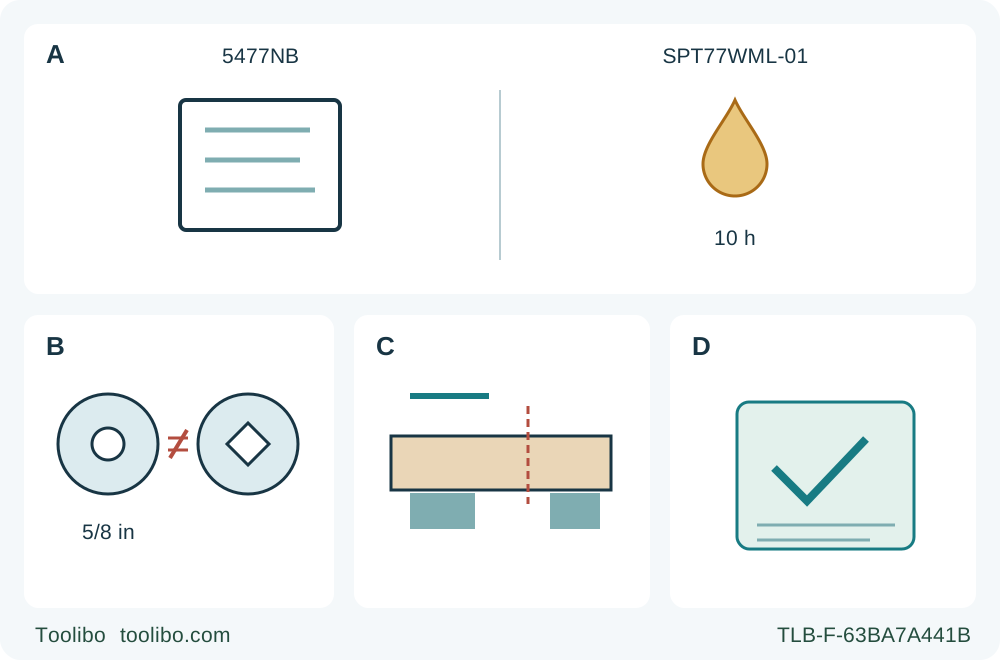
A · Different maintenance evidence
5477NB sealed-housing marketing does not mean maintenance-free. SPT77 requires documented pre-use oil qualification; 10 h identifies its first oil-change requirement, not a universal service interval.
B · Original assemblies differ
The selected US Makita 5/8 in round opening and SPT77 diamond opening are not interchangeable. No conversion, fitting or clutch adjustment is depicted.
C · Qualify the whole task
Both candidates require stable supported work and a qualified guide. This conceptual workpiece is not a complete clamping layout or live-cut instruction.
D · Write a decision
Record which exact owner system is qualified, what remains unresolved and the next action. A check on the document is not a universal winner or immediate purchase instruction.
A compares documentation and lubrication obligations, not maintenance-free certification; the 10 h note belongs only to the SPT77 first oil change. B rejects assembly interchange, not a blade-fitting recipe. C is a task-planning concept with independent supports, not a complete clamp map. D is a decision record, not a purchase or safety score. All inspection remains unplugged.
The useful difference between these two corded saws is not a promise that one drive layout wins every cut. It is the ownership system you must be able to maintain: the actual blade assembly, supply, controls, lubrication obligations and support plan. This comparison helps a household owner choose which documented system to investigate or retain for supported loose-wood work—and when neither candidate is ready.
The exact pair is the US Makita 5477NB under 884849A941 / 5477NB-1 and the US standard-plug SKILSAW SPT77WML-01 under 1619X09207 04/17. Makita explicitly names its model a hypoid saw; SKIL explicitly names the other a worm-drive saw. Those are manufacturer identities, not an inference from handle position. The shared SKIL document also covers other variants, but this decision does not transfer a twist-lock configuration or different plug arrangement to the -01.
Define the work before comparing the drive
Write the actual recurring task: for example, supported square cuts in manageable dry, untreated, nail-free loose wood, with a correct original wood blade and room for continuous two-hand control. Record material thickness, required finished geometry, available supports, supply location and whether dust constraints can be met under the exact system instructions. Do not start with a preferred gear label and then force an unsuitable workspace to accommodate it.
Both candidates still require the work clamped and supported, the retained material beneath the broad base, waste free to separate without pinching the kerf, and the cord clear through entry, travel and exit. Neither removes the need for a suitable guide or a qualified operator. If the available bench cannot support the work or the task requires an unqualified internal cut, choosing a different drive name does not close that gap.
This is a document-based choice, not a hands-on speed, noise, fatigue or torque test. We do not rank motor efficiency from advertising or infer delivered torque from a 15 A label. Current prices, retailer bundles and old carton contents are not compared. A model that meets a stated capacity is only a candidate; blade approval, support and safe operation must still be established.
Lubrication changes the ownership commitment
Makita describes oil-bath technology and a sealed gear housing intended to reduce maintenance. That is not a claim of no maintenance, lifetime lubrication certification or permission to open the gearbox. The selected 5477NB owner workflow retains its original qualified assembly and follows the manual’s inspection and service boundaries. It does not import an oil-level procedure from another saw.
The SPT77 manual is much more explicit about an owner’s pre-use oil condition: oil level must be checked before use under its complete isolated procedure, the level must not be below the bottom housing threads, and only the specified Skil 80111 lubricant is identified. The manual also calls for the first oil change after ten hours of use. These are ownership obligations, not optional accessories to consider after cutting begins.
For this comparison, the SPT77 candidate must already have its oil condition and required service history properly qualified. Unknown oil, unresolved low level, dirty or thick oil, or missing evidence of required service means hold before operation. This article does not abbreviate the opening, filling, plug restoration, warm-up or draining sequence into a new tutorial. Arrange the complete appropriate service or qualified manual procedure first.
The choice is therefore concrete. If you cannot reliably maintain the documented SPT77 oil prerequisites, do not count it as ready merely because it starts. If a 5477NB has unexplained leakage or damage, its sealed-housing description is not clearance either. Both require inspection and qualified resolution of faults; their documented lubrication workflows are simply different.
Similar blade diameter does not create a shared assembly
The 5477NB manual specifies 185 mm / 7-1/4 in, and the selected US product specifies a 5/8 in arbor. The SPT77 selected system uses a 7-1/4 in blade with a diamond opening. A collection of nominally same-diameter blades is not a shared usable inventory. Evaluate the actual original approved assembly for each tool, with the correct opening, mounting parts, orientation, speed qualification and material approval.
The Makita manual’s reversible inner-flange and ring provisions do not authorize a quick conversion in this comparison. The SPT77 wrench’s knockout feature does not make an arbitrary round blade suitable either. We retain already correctly installed original assemblies and exclude fitting, punching, adaptor rings and improvised washers. An unknown or altered assembly prevents an owner candidate from passing, even if its nominal diameter looks right.
SPT77 also documents a Vari-Torque friction clutch dependent on the outer washer and correct blade-stud fitting. Overtightening can defeat its effectiveness. This is a qualification and service-history issue, not a universal kickback shield or invitation to make the blade slip deliberately. No clutch setting, tightening recipe or live protective-function test is supplied here. Nor is that feature transferred to 5477NB simply because both have rear handles.
Learn the actual references rather than transferring muscle memory
5477NB uses its rear depth lever and separate front bevel lever, with A as the square-cut sight reference and B for 45 degrees. SPT77 uses the bottom contour of its depth lever against the calibrated depth bracket, with the large foot notch for zero degrees and the small notch for 45 degrees. Each needs actual tooth-projection verification and a qualified guide relationship; one model’s scale or notch does not calibrate the other.
For both bounded owner workflows, the actual sample remains square and uses less than a full tooth below the stock. Inspect and adjust only with the plug disconnected, lock the controls and require lower-guard clearance. After any SPT77 oil qualification that required maximum depth, the owner must return to the actual cutting-depth setting before use. A maintenance position is not a cutting position.
The published bevel descriptions are not a clean basis for ranking. SKIL’s current page contains both 51- and 53-degree wording, while the exact manual documents the stop-spring system. Makita has its own stop system and angle-specific capacities. We do not flatten these into a headline “more angle is better” claim or teach a high-angle operation. If that capability is central to the intended task, obtain a complete exact-model, exact-angle assessment first.
Stopping and support remain non-negotiable
SPT77’s current specification states no electric motor brake; its manual explains coast-down. The selected 5477NB evidence does not establish an electric-brake feature either. Do not bring a brake expectation from a different model. For both, actual complete blade standstill and lower-guard coverage—not a guessed delay—are required before safe setdown. Keep the tools unplugged for adjustment and inspection.
Both ordinary owner controls use a spring-return trigger. Neither a stopped motor nor a released trigger is physical isolation. Damaged cords, switches that do not properly control the tool, faulty guards, abnormal assembly or unresolved history mean hold, not a test cut. Ordinary sample cutting is appropriate only after the system is qualified; it is not a diagnostic method for a suspect saw.
Consider the guide and support arrangement as part of ownership cost. The SPT77 manual shows the right side of the foot against its board guide and explicitly requires clamp clearance. Makita requires its own actual base/guide relationship. Neither allows reuse of a measured offset without checking the actual blade, angle and contact edge. Do not infer a factory-rail system from a straightedge example.
The manufacturer materials also do not establish a universal dust-port retrofit for either selected workflow. Qualify the actual task’s ventilation, respiratory protection and any provided collection equipment under complete instructions. If the household location cannot meet those conditions, a drive-system preference does not make indoor cutting acceptable.
Complete the choice with evidence, not a winner badge
Make two columns, one for each exact model. For each, record: original assembly known; supplied documents matched; actual supply and lead route qualified; guard and controls sound; lubrication and service history complete; support and guide available; dust conditions feasible; and the owner able to follow the complete workflow. Mark each item established, unresolved or unsuitable, with its evidence and next action.
An oil-qualified SPT77 with the correct diamond assembly may remain a candidate where its obligations fit the owner. An original-assembly 5477NB may remain a candidate where its documented system fits the task. Either can also be held. If both qualify, preferences such as handling must be assessed safely and separately rather than invented from this document review; this comparison makes no ergonomic winner claim.
Do not select by conflicting weights: the 5477NB product and manual do not give the same weight figure, and this guide does not silently choose a convenient one. Do not read nail-embedded blade marketing as permission to ignore the Makita manual’s nail-removal safety requirement. Keep the planned wood nail-free, and carry all unresolved claims into the decision rather than hiding them in a score.
The finished decision should name the exact candidate, the qualifying evidence, any required service or equipment, and the owner guide to use next. “Neither is ready until the oil history or assembly is resolved” is a complete useful result. Only after those gates close should the selected owner perform its full supported sample and accept the resulting geometry, finish and stable process. That is a defensible ownership choice; the drive label alone is not.
Models referenced