
Published tool lengths in inches
Bars share a zero baseline. Add actual bit projection, grip and battery envelope before judging access.
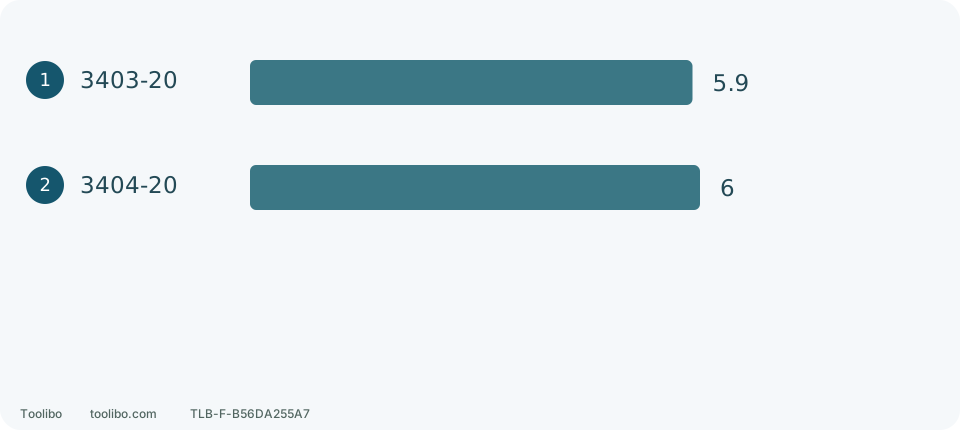
1 · 3403-20
5.9 in
2 · 3404-20
6 in
Bars share a zero baseline. Add actual bit projection, grip and battery envelope before judging access.
Put the shared specifications together
The M12 brushless 3403-20 is a drill/driver; 3404-20 adds hammer drilling. Both have a 1/2-inch metal chuck. These US capacities remain subject to the bit, material and operating instructions: fitting the shank is not permission to cut any diameter.
Swipe or scroll horizontally to see all columns.
| Item | 3403-20 | 3404-20 |
|---|---|---|
| Low/high no-load speed | 0–450/0–1,550 rpm | 0–450/0–1,550 rpm |
| Published torque | 400 in-lb | 400 in-lb |
| Length | 5.9 in | 6.0 in |
| Steel drilling | 1/2 in | 1/2 in |
| Wood flat/auger/hole saw | 1-1/4 / 1 / 2 in | 1-1/4 / 1 / 2 in |
| Masonry | No hammer capacity | 3/8 in |
| Low/high impact frequency | None | 0–6,750/0–22,500 per minute |
Impact figures follow English printed p3 of 58-14-3400d2. That page calls the table No Load BPM but defines the symbol as blows under load. Do not treat this as a verified equal-load efficiency comparison; match your applicable revision.
The 3404 does not gain a larger ordinary wood capacity or higher rotary speed in this table. Nor is 400 in-lb the value of each clutch setting or a furniture screw target.
About 2.5 mm of length, and two weight bases
The 0.1-inch length difference is about 2.5 mm. At a cabinet back it might matter, but exposed bit length, chuck diameter and hand clearance can matter more.
Manufacturer release specifications list both at 2.1 lb without battery. Current product descriptions say 2.5 and 2.6 lb without identifying the battery condition in those statements. Do not derive a definite bare-tool difference from the latter pair. Compare actual handling with the same battery and accessories.
Measure hole centre to obstruction, add actual bit projection and check straight access. Then assess the planned battery envelope and hand position. Before a physical fit check, release the trigger, wait for a complete stop and remove the battery. Keep it removed; do not run the tool inside a gap to test access.
Three jobs lead to different choices
Cabinet hinges, timber pilot holes and metal brackets use ordinary rotation on either tool. Without a real masonry job, the 3403 covers the same listed drilling ranges; suitable bits and a useful spare pack may deserve the budget instead.
For small installation holes in brick or block confirmed suitable for hammer drilling, the 3404 adds a function. A specified 1/4-inch anchor hole is below its 3/8-inch masonry capacity, but still requires the correct anchor instructions, substrate, bit and depth. Being below the maximum is not enough.
Frequent hard-concrete work or large/deep holes may call for a suitable rotary hammer rather than forcing a choice between these two. Unknown services, unidentified material or missing dust controls mean resolve those issues first, not exploratory drilling.
Compare matching packages
3403-20 and 3404-20 each list tool and belt clip, without battery or charger. Current US 3403-22 and 3404-22 each list one XC4.0 (48-11-2440), one CP2.0 (48-11-2420), charger 48-59-2401 and contractor bag. Two packs does not mean two 4Ah packs.
Existing M12 owners can compare the two -20 prices after checking usable compatible equipment. New buyers should compare the two -22 complete quotations. Different promotional capacities, counts or bags require their own written SKU list, not assumptions from a photograph.
Ask three questions: is there a suitable masonry job, does 2.5 mm genuinely change access, and what equipment already owned avoids duplicate purchases? Those answers are more useful than buying an extra mode simply because it exists.
Models referenced