
One charger, two separate tool platforms
48-59-1812 charges M12 and M18 packs. Each pack still belongs in its compatible tool family; there is no cross-platform tool connection.
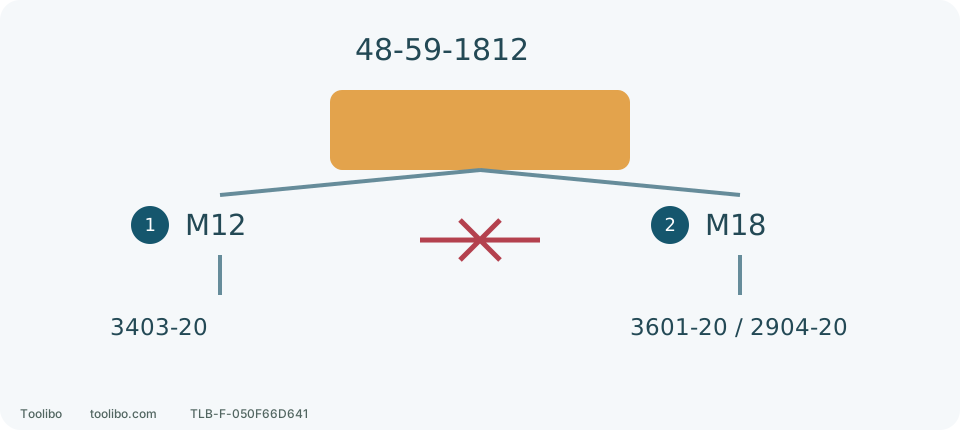
1 · M12
3403-20
2 · M18
3601-20 / 2904-20
48-59-1812 charges M12 and M18 packs. Each pack still belongs in its compatible tool family; there is no cross-platform tool connection.
Inventory before changing platforms
Do not approach, touch or remove a smoking, leaking or persistently abnormally hot battery to read labels. Keep away and seek local emergency guidance. Only inspect stable, safely approachable equipment after complete stop and power disconnection.
List full tool, battery and charger models in separate columns. “Milwaukee charger” is insufficient: an M12 charger need not support M18. Check pack condition and rotation needs, not just capacity; damaged or unidentified packs are not usable inventory.
M12 and M18 are different tool platforms. Neither pack family powers the other’s drills. The 48-59-1812 has charging connections for both, not permission for cross-platform tool supply. Do not force packs or use an adapter to defeat the mismatch.
Three inventories, three purchase routes
Swipe or scroll horizontally to see all columns.
| Existing equipment | Candidate route | What to add |
|---|---|---|
| M12 packs and suitable charger, furniture pilot holes | 3403-20 | Tool, bits and any useful spare |
| M18 packs and 48-59-1812, small cabinet holes | 3601-20 | Tool and missing accessories, not automatically another charger |
| Neither platform | Choose 3403-22, 3601-22CT or 2904-22 by job | Bits, protection and dust controls beyond the kit |
Existing M12 is not a reason to exceed the 3403’s listed capacity for repeated large wood holes. Compare adding an M18 system with hiring an appropriate tool. Conversely, an M18 owner doing a few small holes need not buy M12 merely for a general portability claim.
Do not infer size or capacity from voltage
3403-20 is 5.9 inches long, while M18 3601-20 is 5.7 inches, about 5.1 mm shorter. Battery bases differ, so the full configuration determines cabinet access.
Both list steel at 1/2 inch and wood flat/auger/hole saw at 1-1/4 / 1 / 2 inches. Their high no-load speeds are 1,550 and 1,700 rpm respectively, not proof of faster cutting in every job.
For genuinely larger wood holes, 2904 lists a 3-1/2-inch hole saw and 2-9/16-inch self-feed bit, plus hammer mode. Its trade-offs include 6.9-inch length, 3.3 lb without battery and side-handle clearance. Those are model capabilities, not qualities automatically shared by every M18 tool.
What starter kits provide
3403-22 has M12 XC4.0 plus CP2.0, 48-59-2401 and bag. 3601-22CT has two M18 CP2.0, 48-59-1812 and bag. 2904-22 has two M18 XC5.0, 48-59-1812, side handle and hard case.
If real future tools span both platforms, a dual charger may reduce desk equipment. Do not buy an unsuitable drill for an undefined future plan. List tools actually expected and their platform rather than comparing advertised system tool counts.
Record tool, pack, charger and required accessory costs separately. Deduct existing items only when suitable and reliable. Extra equipment that will stay unused is not automatically equivalent savings.
Check the actual job before paying
- State material, diameter, depth and bit type; compare specific model capacity, not torque alone.
- Measure clearance including bit projection, grip and battery envelope. Keep the pack removed for a physical fit check; do not power-test a gap.
- Check charger regional input voltage and frequency. A plug adapter does not convert supply conditions.
- Compare total tool-plus-missing-equipment cost before remaining with or adding a platform.
Masonry also requires a suitable mode, material and diameter, hidden-services checks and dust controls. Buying another platform cannot solve an unidentified wall or unsuitable working conditions.
Models referenced