
Listed softwood drilling capacities
Diameters in mm for 38 mm-thick softwood. Check the exact bit and operating conditions; chuck fit alone is insufficient.
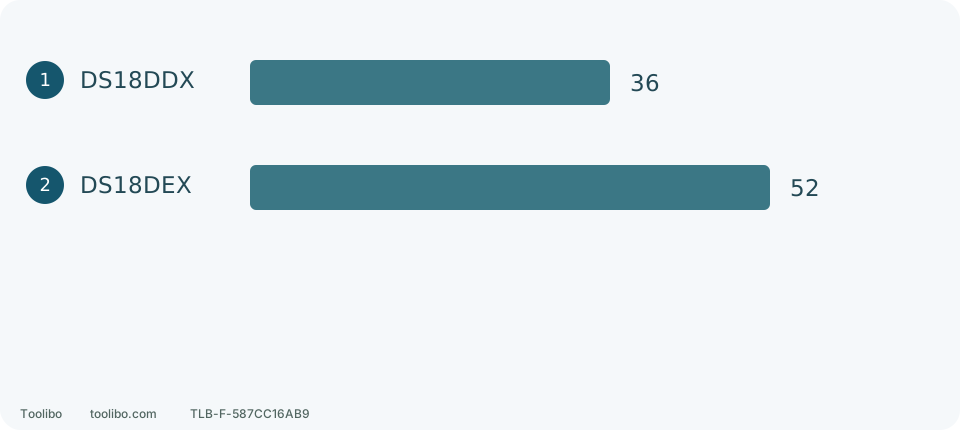
1 · DS18DDX
36 mm
2 · DS18DEX
52 mm
Diameters in mm for 38 mm-thick softwood. Check the exact bit and operating conditions; chuck fit alone is insufficient.
Compare like-for-like specifications
These US models both drive screws and drill by rotation, without hammer drilling. Sub-Compact does not make the DDX the shorter one: the published length difference is only 0.1 in, about 2.5 mm. Weight is the clearer distinction.
Swipe or scroll horizontally to see all columns.
| Item | DS18DDX | DS18DEX |
|---|---|---|
| Body length | 6.2 in | 6.1 in |
| Weight without battery | 1.9 lb | 2.6 lb |
| Weight with listed pack | 2.7 lb, 1.5Ah | 3.5 lb, BSL1820M 2Ah |
| No-load ranges | 0–440 / 0–1,700 RPM | 0–550 / 0–2,000 RPM |
| Maximum torque | 485 in-lb | 620 in-lb |
| Clutch positions | 20 + drilling | 22 + drilling |
| Softwood capacity | 36 mm | 52 mm |
| Mild-steel capacity | 13 mm | 13 mm |
| Wood screw | 6 × 75 mm | 10 × 100 mm |
| RFC | Not listed | Included |
Both wood figures are for the manual’s 38 mm thickness; steel is 1.6 mm thick. Other thicknesses, bit types and conditions need their own checks. The DEX manual prints 2 in (52 mm); this table retains its metric value rather than introducing a different conversion.
For light assembly, DDX’s weight advantage is direct
Bare-tool weight differs by about 318 g. With the respective listed packs the difference is about 363 g, but that includes different battery configurations, not an equal-pack test. Furniture hardware, small pilot holes and repeated picking up can make lower weight useful.
Release the trigger, wait for a complete stop and remove the battery. Keep it removed while checking the intended bit and extension, straight approach, hand clearance and withdrawal. Assess bottom clearance from the planned battery’s dimensions; do not refit it and run the tool into a narrow gap. Neither a 2.5 mm shorter DEX nor the DDX’s Sub-Compact name guarantees access.
Clutch numbers are not calibrated torque. On delicate wood, use the correct bit and start with a suitable low setting on matching scrap, check seating and damage, then adjust as instructed.
Larger wood holes give a concrete reason to check DEX
A 45 mm hole in softwood of the listed thickness exceeds the DDX’s 36 mm capacity but not the DEX’s 52 mm listing. That supports checking the DEX further, not automatically using any 45 mm hole saw, self-feed bit or wet timber. Confirm the exact accessory, low-speed requirement and workholding.
For a 6 mm metal hole, both have the same listed mild-steel limit. A 620 rather than 485 torque label does not require upgrading. Torque and no-load speed are not tests of actual hole speed, continuous temperature or service life.
DEX’s RFC can stop rotation when overload conditions are detected, but does not guarantee freedom from injury. A jam can still produce reaction torque. Secure the work and control your stance; do not deliberately jam a bit to test protection.
Compare actual kit items
The current US DDX listing includes two 1.5Ah packs, part 333353M, UC18YKSL charger, hard case and No. 2 Phillips bit. The accessory listing also calls 333353M BSL1815X, while the older manual says BSL1815. Record the delivered label rather than guessing a revision from an abbreviated name.
The current DEX listing includes two gauge-equipped BSL1820M 2Ah packs, 377797M, UC18YKSL, bag, bit and belt hook. A different configuration in the DEX manual lists one pack, so have the seller specify the order’s quantity in writing.
Existing owners should compare exact tool-only or seller-bundle costs. First buyers should include spares, charger input and bits. US charger input is 120V, 60Hz; a plug adapter alone does not establish local electrical suitability.
Eliminate by task rather than upgrading by name
For light assembly within capacity, start with DDX. For larger listed softwood holes or wood screws, verify DEX’s accessory and workholding conditions. A higher torque label alone does not justify replacing a drill that already works. If hammer action is actually required, neither is the answer.
Models referenced