
Wood capacity depends on the bit category
Paired bars compare self-feed and hole-saw capacities: 35 versus 51 mm, then 51 versus 51 mm.
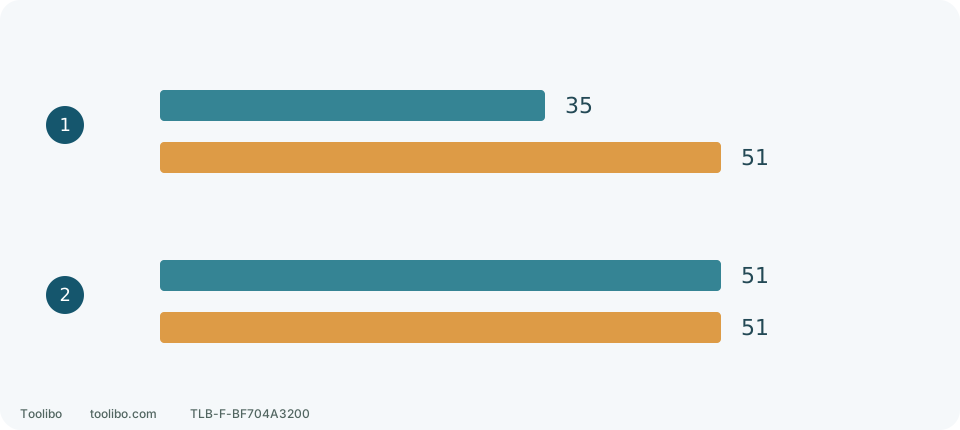
1 · Self-feed bit
35 mm versus 51 mm. Check this category for a 45 mm self-feed task.
2 · Hole saw
Both list 51 mm. A larger torque number does not increase every capacity.
Teal: XFD15. Gold: XFD16. Dimensions are mm; capacity is not a drilling-speed comparison.
Specifications that change the decision
This comparison covers US XFD15 and XFD16, not similar-looking regional models. A capacity applies to its named material and accessory type; it is not permission to use every bit of that diameter.
Swipe or scroll horizontally to see all columns.
| Item | XFD15 | XFD16 |
|---|---|---|
| Platform and modes | 18V LXT; drilling, driving | 18V LXT; drilling, driving |
| Chuck | 13 mm (1/2 inch) | 13 mm (1/2 inch) |
| Published body length | 150 mm (5-7/8 inches) | 174 mm (6-7/8 inches) |
| No-load speed, low/high | 0–500 / 0–1,700 rpm | 0–550 / 0–1,800 rpm |
| Steel drilling | 13 mm | 13 mm |
| Wood: auger / self-feed / hole saw | 36 / 35 / 51 mm | 38 / 51 / 51 mm |
| Wood screw specification | 6 × 75 mm | 10 × 90 mm |
| Numbered clutch positions | 20 | 21 |
| Published maximum torque | 350 in-lb | 970 in-lb |
The useful difference is the self-feed limit of 35 versus 51 mm and the different screw specification, not the ratio between torque figures. Both list 51 mm hole saws and 13 mm steel drilling. XFD16 does not therefore have a larger stated hole capacity in every category. Accessory instructions, suitable gearing and secure control still apply.
Cabinet installation: measure the complete setup
For small pilot holes and hardware inside cabinets, XFD15’s shorter body is worth considering if the required accessories fall within its range. The published metric lengths differ by 24 mm. That can matter between partitions, but the body dimension does not allow for the projecting bit, hands or withdrawal path.
- Measure from the hole along its drilling axis to the opposing obstruction.
- With power disconnected, fit the appropriate accessory and measure the actual assembly; check the intended battery’s outline too.
- Confirm straight alignment, a secure grip and a route to withdraw the bit. Do not solve a clearance problem by drilling badly off-axis.
- If neither tool can be controlled reliably, change the assembly sequence, reposition the workpiece or choose another suitable arrangement.
Shorter describes space, not proven balance or reduced fatigue. Battery, accessory and posture change the feel; assess the configuration you will actually use.
Larger woodworking bits: compare the right category
A known requirement for a 45 mm self-feed bit exceeds XFD15’s listed 35 mm capacity. XFD16’s 51 mm specification makes it a candidate for further checking. Confirm the bit, material, speed and work support, and follow the exact tool’s grip and side-handle requirements. A self-feed bit can pull into the material quickly; a rotating motor is not proof that forcing the cut is appropriate.
A 45 mm wood hole saw is different: both listed diameter limits cover it. Continue comparing access, workload, accessories and batteries instead of assuming XFD16 is mandatory. Higher maximum torque does not establish proportional speed, hole count, better screw seating or durability.
Driving screws: 21 positions are not a precision rating
Numbered clutch settings limit driving output; they do not make either drill a calibrated torque wrench. Start low for hardware installation, test in matching scrap and increase gradually until the screw seats without damaging the material. Connections requiring a specified tightening torque need the appropriate tool and procedure, not a conversion from a clutch number to N·m.
Drilling position differs from numbered clutch settings. Neither model has hammer drilling or is a dedicated impact driver. A masonry-shaped bit does not create hammer action. If the task needs it, reconsider the tool category rather than picking the larger torque number.
Compare the package you will buy
XFD15ZB and XFD16Z are bare-tool identities; XFD15SY1B and XFD16T are kits. The former kit description lists one 1.5 Ah battery, an LXT charger and bag. XFD16T lists two BL1850B 5.0 Ah packs, DC18RC and bag. Obtain the exact XFD15 kit battery and charger codes from the written offer and delivered labels; do not borrow codes from another model’s kit.
Weight also needs a configuration. The specification ranges with differing batteries or attachments are 1.3–1.6 kg and 1.8–2.5 kg respectively. Comparing endpoints is not a same-battery test. Existing LXT owners should price the bare tool plus genuinely missing equipment. First-time buyers should compare the different battery capacities, quantities and chargers as complete packages.
For confined work with modest accessories, check whether XFD15 does the job comfortably. For a known requirement outside its self-feed or wood-screw range, investigate XFD16. Without that requirement, a larger headline torque is not by itself a reason to sacrifice useful clearance.
Models referenced