
Plan grip space and supported contact
Side-view concepts are not scale drawings or powered operating positions. Check actual clearance and full applicable instructions before use.
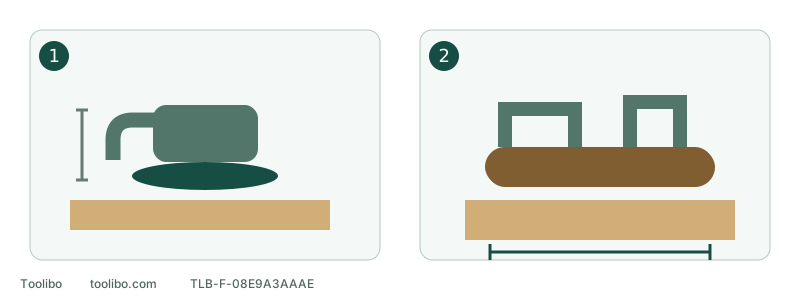
1. Disc system
Allow space for the adjustable front grip while preserving flat support.
2. Belt system
Plan room for both grips and the longer supported contact region.
Side-view concepts are not scale drawings or powered operating positions. Check actual clearance and full applicable instructions before use.
Answer four purchasing questions first
Are you removing shallow scratches or an identified thicker surface layer? Which edges, planes and thickness must remain? Can the tool be supported and gripped controllably in the actual space? Which machine do existing abrasives and extraction connections really fit?
These narrow the choice better than amperage, maximum motion number or brand alone. Both machines can over-sand. Calling a disc tool a finishing sander does not remove thin-layer risk; calling a belt fast does not make it a precision planer.
Compare both systems on the same dimensions
Swipe or scroll horizontally to see all columns.
| Dimension | BO5041 | 9403 |
|---|---|---|
| Abrasive system | Five-inch, eight-hole hook-and-loop discs | Continuous 4 × 24-inch belt |
| Adjustment | Variable 4,000–12,000 OPM | 1,640 ft/min belt speed; no variable-speed dial |
| Stage worth considering first | Scratch refinement and surface preparation near the intended shape | Defined heavier removal on known solid wood with allowance |
| Shape and space | Round pad cannot reach a square corner apex; adjustable front grip does not square the pad | Long contact region and body need support/control space; do not dig local lows with an edge |
| Current US listed net weight | 3.1 lb | 12.6 lb |
| Collection starting point | Bag, nozzle and model-specific port | Included repositionable bag; external route needs exact accessory confirmation |
| Consumable budgeting | Correct discs, applicable backing pad and collection connection | Complete belt size, condition/direction checks and collection arrangement |
OPM counts orbital movement; ft/min describes belt travel. Dividing them does not produce an efficiency multiplier. Stage recommendations are mechanism- and risk-based task judgments, not matched-condition performance tests.
Broad-surface refinement: when does BO5041 fit?
When the board already has the required shape and chiefly needs preceding scratches refined for finishing, BO5041’s discs and variable-speed system better match that stage. Confirm known material, secured work, suitable abrasive and collection, then select settings through the exact applicable instructions.
Its adjustable front grip can help arrange handling in limited space, but the pad remains round. Do not tilt or force it into the final point of a square cabinet corner. If hands and housing cannot be supported safely, use an appropriate manual or other established method.
Overall twist, significant thickness differences and loose joints need suitable woodworking preparation first. Moving a round pad randomly does not guarantee an accurate plane; finer paper does not automatically remove deep grooves or low spots.
Heavier solid-wood removal: when consider 9403?
Consider its continuous belt when material is known solid wood, support is adequate and removal target and retained thickness are defined. Mark what must remain, where shape will be checked and the condition at which finer work begins.
A belt does not eliminate prior flattening needs. Accurate planes or joint geometry may require suitable planing or another flattening method first. Buying 9403 also does not mean every project needs a coarse pass: later fine sanding cannot restore unnecessarily removed material.
Its much greater listed mass makes lifting, start/stop location and two-handed control important to plan. Weight is not a reason to add pressure, nor proof of stability in vertical or confined work. Do not invert-clamp a hand tool for small pieces without explicit exact-tool and mounting-system authorization.
Treat weight as selection information, not a comfort test
Current US pages list 3.1 lb for BO5041 and 12.6 lb for 9403. An earlier related 9403 manual says 13 lb. Confirm exact region/configuration rather than averaging or inventing a weight-reduction revision.
The values indicate different handling demands, not which produces less vibration or fatigue in your posture over an hour. Inspect actual grip space, support, cord and hose pull while safely stopped and isolated. Do not improvise load tests on unfamiliar tools or hazardous material.
Compare full costs, not one belt against one disc
List complete suitable abrasive specifications and grades before pricing. BO5041’s disc diameter is not its replacement-pad interface specification; 9403’s four-inch width omits loop length. Cheap incompatible consumables are not savings.
Include machine, suitable abrasives for each stage, exact extraction adapters and filtration. Disc and belt area, purpose and wear differ; package quantity alone cannot identify lower operating cost. Without comparable consumption and rework records, durability or efficiency advantages remain undetermined.
An included dust bag is not a complete answer to every dust scenario. Verify exact tool, interface and accessory for external extraction rather than guessing a universal diameter from a photograph. Do not transfer BO5041 connections to 9403.
Make the final exclusions before purchase
Unknown veneer allowance, unidentified old coating, unsecured work or instructions mismatching the body mean pausing sanding beyond selection. Match US BO5041 to its hook-and-loop disc system; backing-paper wording in a shared or foreign document does not authorize PSA conversion.
9403’s disconnected belt installation and powered designated-knob tracking are distinct procedures. Knowing belt size does not permit live installation or roller contact. Obtain complete applicable instructions for model, region and configuration before use.
The choice is straightforward: refinement favours the disc system suited to it; defined heavier removal brings the belt into consideration; without material, allowance and control conditions, neither should be forced into the task.
Makita discs or belts: different consumable checks
Match the complete abrasive and grip arrangement to the work. These specifications do not measure removal, fatigue or final finish.
BO5041Random-orbit sander
- Use five-inch eight-hole hook-and-loop discs; the listed 4⅞-inch pad is a separate dimension.
- Adjustable 4,000–12,000 OPM does not identify the best setting without the task and instructions.
- Switch off, wait for a complete stop and unplug before repositioning the front grip.
9403Belt sander
- Select the full 4 × 24-inch belt specification, not width alone or the shared manual’s 9921 row.
- Belt speed is 1,640 ft/min; linear travel is not comparable numerically with OPM.
- Install only while unplugged and match actual belt/tool direction arrows; tracking is a separate exact procedure.
Match the complete abrasive and grip arrangement to the work. These specifications do not measure removal, fatigue or final finish.
Models referenced