
Compare the whole charging route, not just the plug
Two separate schematic paths show an integrated-battery tool connected to its specified supply and a removable pack connected to its own charger, without interchangeable connectors.
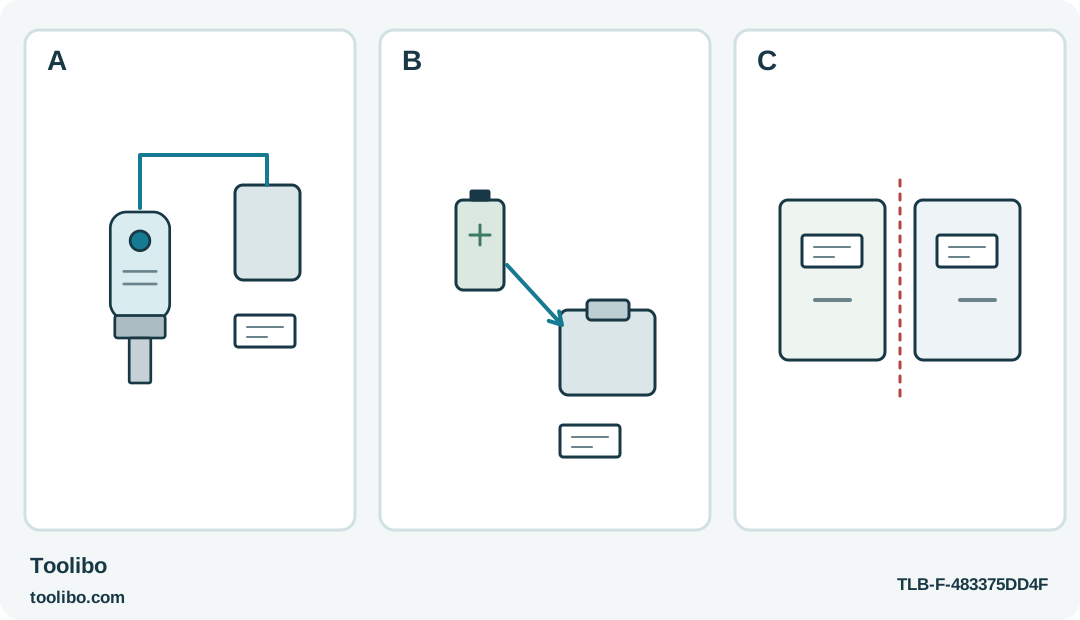
A · Integrated tool and supply
The integrated-battery tool and its specified supply form one identified charging routine.
B · Removable pack and charger
A removable pack uses its own specified charger; the drawing does not authorize cross-platform substitution.
C · Keep the system identified
Keep tool, pack and charging equipment identified and separated from incompatible systems.
The two paths illustrate different routines, not electrical wiring or cross-platform compatibility. Exact charging equipment remains model-specific.
Start with where the tool will live
For occasional household fastening, the charging arrangement can matter more than a headline motor specification. Think about where the driver will be stored, where it can be charged safely and whether the necessary charger and cable will stay with it. A tool that is repeatedly separated from its charging equipment is inconvenient even if its fastening controls suit the job.
An integrated battery stays inside the tool during normal use and charging. A removable battery is taken out and charged using its specified system. Neither arrangement is automatically better. The useful choice depends on your work pattern, compatible equipment and willingness to manage separate parts.
Keep the comparison focused on ordinary small fastening tasks. A removable battery does not turn a compact screwdriver into a substitute for a larger tool, and an integrated battery does not make it disposable when a charging problem appears. Internal service and end-of-life handling remain separate matters.
Compare complete systems, not connector pictures
The WX240L uses a USB-C charging connection with the supply requirements stated in its instructions. The SD561201 has its own specified charging arrangement and permitted power-source requirements. A familiar connector is not enough information to declare every phone charger suitable for either tool.
The DF012D uses its documented removable battery system. The Milwaukee 2101-20 uses M4, which must not be confused with Milwaukee M12. Matching the brand name or finding a connector that appears to line up is not a compatibility check.
For each candidate, write down three separate items: the device model, the permitted battery or power supply, and what the particular listing actually includes. A kit suffix may describe packaging rather than a different screwdriver. Do not count a bare tool and its charger bundle as two different fastening designs.
Match the charging pattern to the work
An integrated-battery driver keeps the tool and battery together, which can simplify storage for occasional use. The trade-off is that the tool itself must be available at the charging location. Do not plan to continue driving with a charging cable attached unless the exact manufacturer instructions explicitly permit it; the SD561201, for example, does not operate during charging.
A removable-battery arrangement separates charging from the tool. That can be convenient when a documented compatible spare is already available, but it adds a battery and charger to store and maintain. A spare is useful only when it is the correct, sound pack, not an improvised adapter or a battery borrowed from a different platform.
Do not plan a job around one universal charging time. The starting charge, battery condition and correct charging arrangement matter. Follow the exact tool’s initial-charge instructions and charging indicators, and allow time to charge before starting rather than assuming a short break will restore a depleted battery.
Plan a safe storage and charging place
- Choose a dry, suitable location within the temperature limits of the tool and charging system. Keep it away from water, heat sources and loose clutter.
- Keep the correct cable, supply or charger identifiable. Labeling a storage compartment with the tool model is better than relying on a cable’s color.
- Inspect the tool, cable and battery externally before charging. Damaged insulation, a distorted pack or a damaged port is a reason to stop, not to test another adapter.
- Follow the specified connection and completion procedure. Do not leave a cable attached as a permanent storage habit when the instructions say to disconnect it.
- Protect removable battery contacts from loose metal objects when stored or transported. Do not use a bag of mixed screws as a battery compartment.
A charging station should not force the cable to bend sharply or leave a tool balancing on an edge. These practical arrangements help keep equipment undamaged without changing its electrical design.
Keep battery convenience separate from fastening control
After comparing the charging systems, return to the task. Check bit retention, access to the screw, direction controls and any torque or clutch adjustment. A convenient charging cable cannot compensate for a driver that does not fit the work or gives poor control near a delicate fitting.
Likewise, do not assume a removable battery provides a performance advantage simply because it can be swapped. Compare only supported model-specific features under comparable conditions. This guide does not rank run time, battery longevity or maximum fastening power without evidence for those claims.
If two tools both meet the fastening need, choose the arrangement you can keep organized and use correctly. An occasional user may prefer fewer loose components; someone already using the exact compatible battery system may prefer a removable pack. Both are practical preferences, not universal rules.
Decide what you will do when charging fails
Before buying, check that the manufacturer provides the appropriate support route and documented replacement equipment for the model and region. If a tool later refuses to charge, inspect only the permitted external connections and indicators. Do not open the battery housing, bridge contacts or defeat a charging safeguard.
The right choice leaves you with a clear routine: correct equipment, a suitable charging place, a visible completion check and safe storage afterward. That routine is more valuable for household use than an attractive connector photograph or a battery-platform name that does not actually apply to the tool.
Battery format also says nothing about screw capacity. For the SD561201, the listed powered softwood application uses self-tapping screws no larger than ST3.5, while steel-plate use requires threaded mounting holes and machine screws no larger than M6. Unlisted screws are for manual, non-powered use. Do not select it for a different fastening just because its charging arrangement is convenient.
Models referenced