
Bosch GSR 12V-35 FC versus GSB 12V-35: access system or fixed-chuck combi decision map
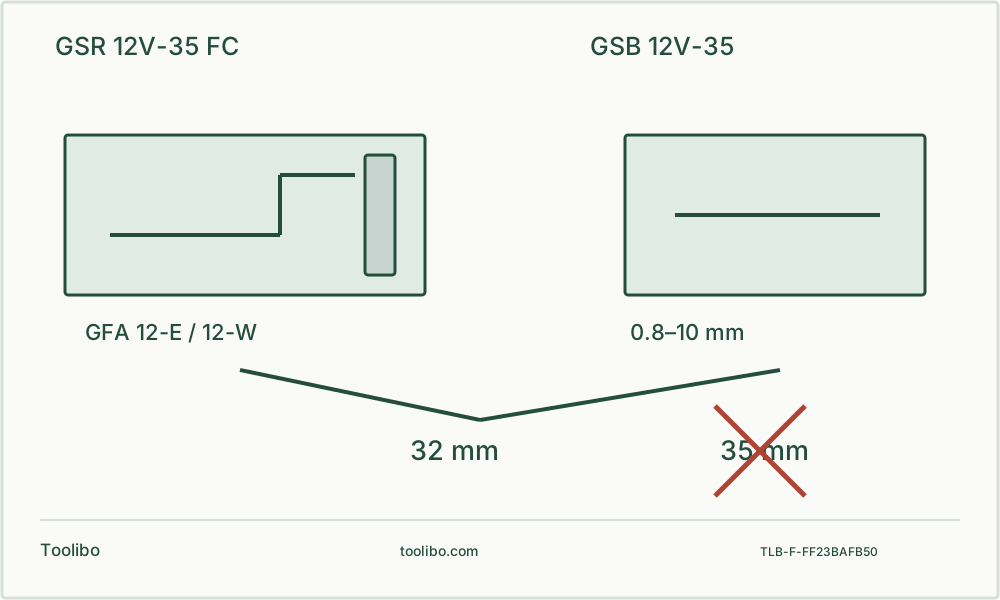
An offset cabinet access path for the FC is compared with the GSB straight chuck path; both connect to a shared 32 mm wood limit, excluding 35 mm.
GSR 12V-35 FC
- Order 06019H3003; tool family 3 601 JH3 0..; GFA 12-B, 12-X, 12-E and 12-W listed.
- 20 clutch positions plus drilling; 0–460 / 0–1750 rpm no-load ranges; no base-tool hammer selector.
GSB 12V-35
- Order 06019J9070; tool 3601JJ9000; use only the GSB column of the shared manual.
- Screwdriving, drilling and hammer drilling; 0–460 / 0–1750 rpm; 26,250 impacts per minute maximum.
Access
Inspect the real screw axis and room for the complete assembly.
Material
Assess the substrate separately from access.
Package
Match the order number, included heads and battery requirements.
Original two-branch decision diagram: a cabinet obstruction leads to offset or angle geometry; a separately identified material leads to mode selection. Both branches meet at the same 32 mm wood limit.
Begin with two tasks, not two torque labels
This comparison uses the UK GSR 12V-35 FC package 06019H3003 and GSB 12V-35 package 06019J9070. Both are Bosch Professional 12V tools, but the first is an interchangeable-head driver and the second has a fixed keyless chuck with a hammer-drilling function. The shared 35 Nm hard-torque headline does not answer whether you can approach a screw near a cabinet wall or whether the task needs an assessed masonry-drilling method.
Write down your two most frequent jobs before comparing packages. A visible wooden furniture joint and a wall fixing are not interchangeable tests. For furniture, include the head, bit, screw and your hands in the access envelope. For a wall, identify construction, services and dust controls before deciding any drill is suitable. This is documentation-based selection, not a measured speed or endurance contest.
Compare only matching fields
Swipe or scroll horizontally to see all columns.
| Decision | GSR 12V-35 FC | GSB 12V-35 |
|---|---|---|
| Standard output concept | Interchangeable FlexiClick heads | Fixed 0.8–10 mm chuck |
| Selected access equipment | GFA 12-B, 12-X, 12-E and 12-W listed for 06019H3003 | Do not assume those heads fit the GSB |
| Base-tool hammer selector | None | Present |
| Wood / steel capacity | 32 / 10 mm | 32 / 10 mm |
| No-load gear ranges | 0–460 / 0–1750 rpm | 0–460 / 0–1750 rpm |
The current FC manual also names a GFA 12-H rotary-hammer adapter. That is a separate system requiring its matched instructions; it must not be confused with the GFA 12-W angle head or assumed to be supplied in 06019H3003. The GSB’s impact row lists 26,250 per minute and 10 mm masonry capacity. Neither is evidence that one complete setup outperforms the other on an untested wall.
When the FC solves a real problem
An offset head can move the screw axis closer to an edge while the body remains clear. An angle head can change the approach direction. These are meaningful benefits only if the installed head locks correctly and you can still grip the tool and withdraw the bit. Check that a cabinet rail, drawer runner or adjacent panel does not block the battery or your supporting hand.
Rehearse with the battery removed. Locate the actual screw line, not just the empty space where the drill body fits. Count the heads and connecting interfaces you will need, then verify the exact supported combination. If a straight chuck already reaches every screw comfortably, extra attachments may add handling and storage without solving a problem. Do not buy solely because a drawing shows more configurations.
When the GSB is the simpler fit
For regular straight-ahead drilling and screwdriving, its fixed chuck avoids changing a front attachment. The built-in hammer setting may be relevant for a small, suitable, identified masonry task within the manufacturer’s instructions. It does not make the drill a structural-anchor specification, a service detector or a hazardous-dust control system.
If the main job is wood furniture, hammer mode adds a setting you must deliberately avoid for that work. If the main job involves repeated difficult masonry holes, assess whether different equipment is required rather than choosing by battery voltage alone. Neither small tool should be forced to stall to prove a purchasing decision correct.
Compare the package you will actually own
Check each selected order’s current packing list, battery identifiers and charger requirements. Do not compare one bare tool price with another battery kit, or assume a head pictured elsewhere is included. Battery-system identity is necessary but not enough for an imported charger: its actual input rating and local instructions still matter. No cross-brand or unrelated Bosch battery-platform adapter is authorized here.
Also plan where the removed heads and bits will go. A clean compartment makes it easier to inspect locking surfaces before assembly. The tool that fits your existing, verified battery system and your most common physical task can be a better choice than one with an unused feature, even when headline torque is the same.
A first-job acceptance checklist
Before drilling, match the full model and manual, remove power to fit the accessory and test on representative restrained scrap. Set the material-appropriate function, choose gear while stopped and trial the clutch for screws. Reject excessive play, insecure retention or an approach that twists your wrist and removes control.
Both tools list 32 mm wood capacity, so a 35 mm hinge cup is not approved simply by fitting its shank. A successful pilot hole is not proof that a larger cutter will be safe. Stop for binding, abnormal sound or repeated protective shutdowns; change the setup or tool rather than increasing force. The final choice should be supported by a suitable first-job setup, not a claim that one model is universally better.
Models referenced