
Rotation and two different impact directions
End views show smooth rotation and rotational impacts; a side view shows axial hammering along a drill bit.
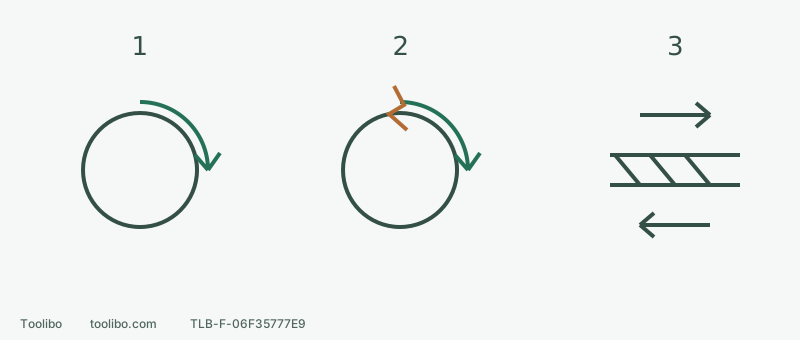
1 · Drill/driver
Continuous rotation for permitted holes and fastening.
2 · Impact driver
Rotational impacts around the axis require appropriate impact-rated accessories.
3 · Hammer drill
Axial blows are for specifically approved masonry work, not ordinary furniture fastening.
Mechanism directions only, not a power ranking or permission to interchange accessories.
Look at the action, not just the name
A drill/driver mainly supplies continuous rotation for permitted drilling and screwdriving. An impact driver adds rotational impacts around the axis while fastening. A hammer drill adds impacts along the bit axis for approved masonry drilling. These are not low, medium and high settings of one mechanism.
Driving a wood screw with an impact driver is different from drilling brick with a hammer drill. When sales names are confusing, identify the exact category, holder and permitted uses. A masonry bit does not add a missing hammer mechanism to an ordinary drill.
Three tasks, different advantages and costs
Swipe or scroll horizontally to see all columns.
| Actual task | What to consider first | Limits or additional costs |
|---|---|---|
| Furniture fittings and small screws | Controllable low-speed drill/driver with suitable clutch, or specified hand tools | Clutch needs appropriate trial adjustment, not a precision torque assumption; finish by hand if required |
| Ordinary wood or metal holes | Drill accepting the required bit and rated for the material | Correct bit, clamping and mode remain essential; larger chuck does not authorize larger holes |
| Repeated identical screws approved for powered driving | Impact driver as a dedicated fastening tool, reducing swaps from drill bit to driver bit | Correct impact-rated bits/sockets and fastener permission; another tool adds cost |
Consider first does not mean automatic approval. If furniture instructions prohibit powered tools, low speed is not an exception. Vehicle, structural or precisely torque-specified fasteners are not covered by an ordinary woodworking choice.
Does one furniture project need two tools?
Suppose you first drill locating holes in a separate wooden part that may be machined, then install ordinary fittings as the furniture instructions allow. List the drilling and driving accessories separately. Check whether one drill holds both correctly and has the required material and size capacity.
For a small quantity, accessory changes may not be the main problem. One suitable drill plus necessary hand tools can form the complete solution. Stop fully and remove the battery before changing accessories, even when trying to save time.
For many repeated operations, keep the drill for holes and assign an approved fastening step to an impact driver. This reduces holder changes; it does not prove each screw is faster or waive checks for overdriving, stripped recesses or damaged material. Installation requirements come before the convenience of a second tool.
Different holders mean different accessory costs
Common drills use three-jaw chucks for approved round or suitable hex shanks within their range. Many impact drivers use 1/4-inch hex quick-change holders. Milwaukee 3453-20 is one specific example; its 4-Mode Drive Control is a feature of that model, not every impact driver.
Hex shape answers only part of the question. Check dimensions, retention groove, locking requirements and operating rating. An ordinary bit or socket is not suitable for rotational impact merely because it inserts. Drill bits also need explicit impact suitability and tool permission. A chuck adapter does not automatically turn an impact driver into a suitable fine-drilling machine.
Include missing impact-rated accessories, permitted sockets, battery, charger and storage in the cost comparison. Reusing what you own depends on ratings and compatibility, not simply all of it being hexagonal.
Sound does not tell you the correct tightening torque
Impact noise means the mechanism is working, not that a specified installation torque has been reached. Clutch slip also does not establish equal precise clamping force on every screw. Stop for slipping, damaged recesses, obvious wobble or crushed material; do not simply switch to a stronger tool and force it.
Follow installation instructions and, where allowed, establish settings on suitable matching scrap before touching a finished surface. Without suitable trial conditions, do not guess on the finished item. Use the eye, hearing and other protection required for the tool and work; sounding quieter is not a substitute for that assessment.
Describe the final choice as a division of work: which tool makes which holes, which fastens, what remains manual and what materials or fasteners are outside the plan. That is more useful than buying whatever looks more powerful.