
Same reach, different packing
Compact internal three-piece wand storage beside upright external wand storage, with equal hose and cord routes.
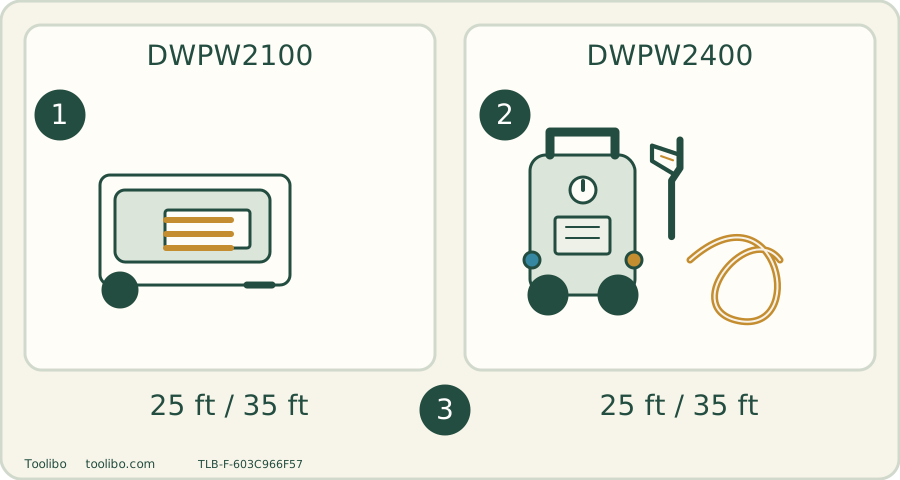
DWPW2100
- 2100 PSI maximum pressure.
- 25 ft hose and 35 ft cord. Verified package: 15°, 40°, soap and turbo tips. Three-piece wand stores internally; operation requires feet and wheels on the ground.
DWPW2400
- 2400 PSI maximum pressure; product footnote uses the 15° nozzle condition.
- 25 ft hose, 35 ft cord, 10-inch pneumatic wheels; 15°, 25°, 40°, soap and turbo tips.
DWPW2100
Internal three-piece wand storage; separate operating position.
DWPW2400
Upright frame and pneumatic wheels; external accessory storage.
Shared reach
Both documented kits: 25 ft hose and 35 ft cord.
Storage orientation does not define operating orientation; the 2100 operates feet-and-wheels down.
The numbers that genuinely match
This comparison covers US DWPW2100 and DWPW2400 corded models. Both manuals specify 120 V AC, 60 Hz, 13 A, a minimum 15 A source, cold-tap inlet pressure 20–100 PSI, a 25 ft high-pressure hose and 35 ft electrical cord. These shared requirements are useful: neither documented configuration solves a reach problem simply by changing the number on its label.
DWPW2100 lists 2100 PSI maximum and 1.2 GPM rated flow. DWPW2400 lists 2400 PSI maximum and 1.1 GPM rated flow; its product footnote uses the 15° nozzle condition. The 2400’s higher maximum pressure does not also give it the larger listed rated flow. Without a controlled matched task test, this is not a percentage-cleaning-speed comparison.
Different storage designs
DWPW2100 uses a compact cage with carrying positions, a telescoping transport handle and an internal compartment. The wand separates into three pieces for that compartment. This helps organize a compact storage arrangement, but adds a deliberate unpacking and assembly step before each use.
The 2100 manual allows horizontal or vertical storage after emptying. Operation is different: it must sit right-side up with feet and wheels on the ground. Do not choose a vertical storage spot and assume it can run there without repositioning.
DWPW2400 has an upright frame with a handle and external hose/wand storage. Its 10-inch pneumatic wheels suit rolling transport, but their condition is another item to inspect. A wheel-supported layout is not immunity from tipping, punctures or awkward stairs. Neither guide establishes a verified carrying-weight advantage, so test the physical route rather than relying on a made-up weight comparison.
Same hose length, so draw the route first
Picture a car parked beside a wall. The machine may sit near the tap, but the hose needs to pass around the vehicle rather than through it. Both supplied hoses are 25 ft, about 7.6 m. If one route needs more than that plus connection slack, neither standard package automatically fixes it.
Move either washer only after shutting down, isolating and releasing trapped pressure. Use the appropriate cage or frame handle, not the hose. A longer accessory hose is a separate compatibility decision: pressure rating, connector geometry, seals and exact product approval all matter. Equal brand and hose length do not prove interchangeable parts.
Compare tip sets and detergent handling
The verified DWPW2100 package lists 15°, 40°, soap and turbo tips. Its manual’s common-tip table also shows 25°, but that is not proof of inclusion. The DWPW2400 product lists 15°, 25°, 40°, soap and turbo. If a 25° pattern is specifically important to your work, verify the box rather than assuming both include it.
Both have soap tanks. Use the correct low-pressure soap tip and suitable detergent; follow the chemical’s dilution and dwell directions. A tank is not permission to put bleach or arbitrary solvents through the machine. Switching tips requires power off, unplugging, water shutoff and pressure release—not merely letting go of the trigger.
For mixed garden furniture and paving, the right surface treatment matters more than owning the most aggressive nozzle. Test a small hidden patch, keep the spray moving and stop if coating lifts or joints erode. Choose a non-pressure method where the material cannot tolerate the jet.
A worked storage-and-task decision
If the washer must fit a shallow shelf or enclosed vehicle space, the 2100’s packed shape and internal wand compartment may be the useful feature. Check the actual dimensions of the space and allow for drainage before closing the compartment; compact does not mean safe to pack while wet or pressurized.
If your route is mostly level and you want an upright frame with externally accessible parts, the 2400 layout may suit the routine better. Its extra 25° tip broadens the verified included selection, but it does not change the need for safe material testing or establish a cleaning-time saving.
Choose neither until unresolved constraints are fixed: unsuitable outlet, poor water supply, unsafe hose route or lack of a suitable storage temperature. Both matched safety sections specify storage not below 4°C. A shed that reaches 1°C is above freezing but does not satisfy that stated limit.
What ownership still requires
For either model, inspect hoses and electrical protection, purge air with the motor off, and verify nozzle retention before starting. At shutdown, turn off, unplug, close water, release pressure and drain the accessories before packing. Repeated protection trips, damaged pressure hose or persistent abnormal pump operation require stopping and service.
The compact cage and upright frame solve different handling problems. Let that difference, verified kit contents and the actual task guide the choice; maximum PSI alone cannot decide which is easier or more useful in your home.
Models referenced