
Head length is only part of the required clearance
Two simplified head-length bars face an obstruction; dashed extensions represent a fitted bit.
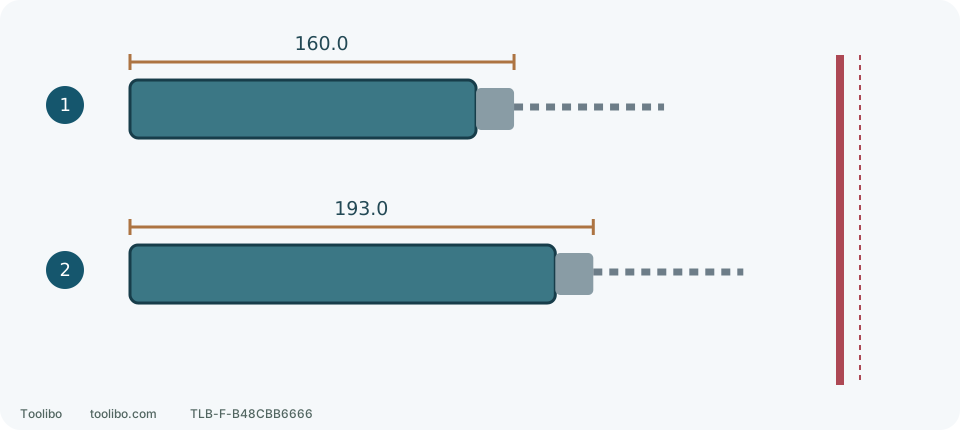
1 · GSR18V-400
160.0 mm
2 · GSB18V-975C
193.0 mm
Head dimensions are in mm. Add the real protruding bit and room for feed; silhouettes are not product drawings.
Compare mode and size together
These are US versions. Furniture assembly, wood pilot holes and suitable metal drilling use ordinary modes; hammer action is not an essential upgrade for these jobs.
Swipe or scroll horizontally to see all columns.
| Item | GSR18V-400 | GSB18V-975C |
|---|---|---|
| Modes | Driving, rotary drilling | Driving, rotary and hammer drilling |
| Chuck | 1/2 in, all-metal | 1/2 in, all-metal |
| Head length | 6.3 in, about 160 mm | 7.6 in, about 193 mm |
| Two no-load ranges | 0–500 /0–1,900 rpm | 0–480 /0–2,100 rpm |
| Additional controls | Conventional drill/drive setup | Separate mode selector, 25 clutch settings, KickBack Control |
| Selected package | 400B12: BAT612 2 Ah, charger, bag | 975CN: battery/charger excluded |
| Buying priority | Batteries, chuck, clearance | Actual hammer task, auxiliary grip, complete contents |
A half-inch chuck specifies shank accommodation, not a half-inch hole in every material. No-load rpm is not a drilling-speed ranking. Screen for the job before looking for the largest advertised torque number.
Ordinary woodwork: the 400’s shorter head is useful
The listed head is about 33 mm shorter. Between cabinet panels or near obstructions, that may matter more than another mode. Add the fitted bit’s protruding length and feed/withdrawal room to head length, then check battery and hand space.
For example, drilling pilot holes and fitting screws into a clamped wooden shelf does not involve masonry. Choose the suitable bit and driver tip, confirm tool capacity, then compare which setup can approach the holes properly. If the 400 meets those needs, adding hammer mode does not complete an otherwise missing part of the job. If even the 400 cannot fit squarely, choose equipment suited to the space rather than drilling at an angle.
Give hammer mode a specific job
“Occasional wall drilling” needs detail: substrate, hole diameter/depth, fixing, number of holes and a bit approved for percussion. Surface finishes, hollow blocks and solid masonry do not share one universal setting. Resolve unknown material and concealed services before work; do not make exploratory holes.
The975C’s added mode matters only when the exact tool version, accessory and task agree. Frequent concrete work, large holes or specified SDS bits require a tool selected for those demands, not simply one labelled hammer drill.
Its separate selector preserves the clutch setting when switching driving and drilling. That can suit repeated changes of operation. Clutch numbers are not fixed N·m values: begin low on scrap or an inconspicuous area and adjust for the fastener.
Electronics do not replace handling
KickBack Control has activation conditions; the 03/2021 manual describes a maximum-tool-speed condition. Never violate bit/material speed requirements to seek that protection, and do not deliberately jam a bit to test it. Follow side-handle requirements, secure the work and maintain a grip prepared for a stall reaction.
Confirm the 975CN actually supplies the side handle: its features mention it, but the listed contents name only tool and belt clip. Obtain required accessories before working. GCY42 is optional; do not count an unpurchased module’s functions as equipment already fitted.
Price the complete setup
400B12 lists a BAT612 2 Ah, charger and bag; 975CN excludes battery and charger. Existing compatible18V owners can subtract equipment they do not need to buy. New owners must add power equipment and required accessories before comparing totals. Check charger model, compatibility and local input supply.
The975CN page gives3.4 lb and 3.5 lb tool-weight figures, so no precise weight difference is calculated here. For prolonged handling, consider the actual battery and handle rather than subtracting unmatched figures. Without a hammer task, prioritize space and existing equipment; with a suitable task, allow for the 975C’s longer body and complete setup.
Models referenced