
Head length is only part of the required clearance
Two simplified head-length bars face an obstruction; dashed extensions represent a fitted bit.
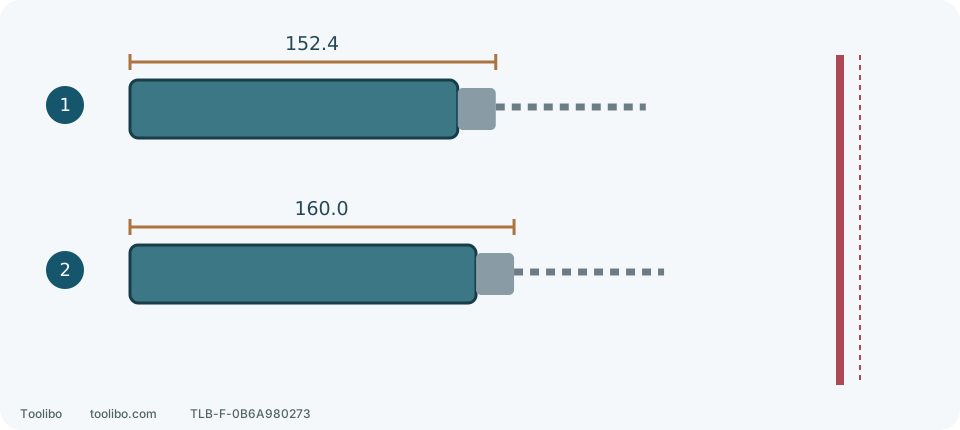
1 · GSR12V-300
152.4 mm
2 · GSR18V-400
160.0 mm
Head dimensions are in mm. Add the real protruding bit and room for feed; silhouettes are not product drawings.
Differences worth paying for
These are US versions. Both suit appropriate furniture assembly and rotary drilling; the larger voltage number is not a reason to buy the 400 for every job.
Swipe or scroll horizontally to see all columns.
| Item | GSR12V-300 | GSR18V-400 |
|---|---|---|
| Battery family | 12V Max | 18V |
| Chuck | 3/8 in, about 10 mm | 1/2 in, about 13 mm, all-metal |
| Head length | 6.0 in, 152.4 mm | 6.3 in, about 160 mm |
| Two no-load ranges | 0–460 / 0–1,750 rpm | 0–500 / 0–1,900 rpm |
| Modes | Driving and rotary drilling | Driving and rotary drilling |
| Selected package | GSR12V-300N excludes battery/charger | GSR18V-400B12 includes BAT612 2 Ah, charger and bag |
The 300’s 1.6 lb is explicitly tool-only. The 400 specification lists 1.95 lb, but without a clearly matched setup these figures are not used to calculate a working-weight difference. Include your actual battery, bit and grip when judging the assembled tool.
Check the accessories first
For small-shank twist bits and driver tips within the 300’s approved limits, a larger chuck may add nothing to that job. An already selected, suitable accessory with a shank beyond the smaller chuck’s range gives the 400 a concrete purpose.
A fitting shank does not approve the cutter. A large hole saw may have a reduced shank; that does not make it suitable for any small drill. Check material, cutting diameter, accessory type and operating requirements. Neither tool has hammer mode, so a task requiring it needs different candidates.
Will 7.6 mm solve the cabinet problem?
The listed heads differ by about 7.6 mm. Measure from the hole surface to the obstruction, add the fitted bit’s protruding length to head length, and allow for alignment, feed and withdrawal. A shorter head does not help enough if the bit still cannot approach squarely.
Check battery and hand space too. A simple cardboard envelope or permitted handling of a display tool can reveal a battery hitting a panel or an awkward wrist position. This is a clearance check, not a reason to power an unknown tool or test-drill a wall with unverified construction and services.
Three buyer situations
Existing Bosch 12V Max owner: confirm exact battery and charger compatibility. If jobs and accessories fit, adding the 300N tool is straightforward. Moving to the 400 may require a new 18V power setup and should solve an actual need.
Existing Bosch 18V owner: the 400 may fit your equipment more directly. Confirm the pack model, then compare the offered bare tool with B12. An extra BAT612 matters when battery rotation is useful, not just because the box says kit.
First purchase: quote two complete setups. Add a suitable 12V battery and charger to 300N. The 400B12 lists both, but confirm its exact charger and input rating, plus job accessories. Include taxes and delivery rather than comparing a bare-tool price with a complete kit.
Keep a short buying record
Write down three jobs, required shanks, confirmed tool capacities, clearance, existing batteries and missing equipment. If the 300 meets them and fits better, voltage alone does not justify another platform. If the larger chuck or existing 18V system solves a real need, the 400 has a practical advantage. Higher no-load rpm alone does not establish faster work, better runtime or longer life.
Models referenced