
Separate purchase, consumables and uncertainty
A stacked hypothetical budget120+15+24+25=184 is paired with a bag-use change to 208, then a feedback loop replaces assumptions with observed usage.
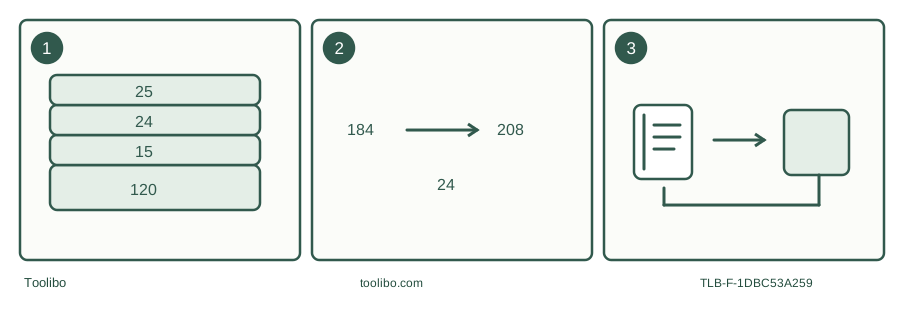
Complete
Include missing essentials before comparing.
Scenario
Show how uncertain consumable use changes cost.
Review
Update assumptions after real permitted jobs.
Amounts are illustrative cost units; the spare-filter row is a budget allowance, not a replacement interval.
Begin with the configuration you actually need
The price on the machine is only the starting point. List what is included and what your approved task still requires: correct filters, collection bags where specified, a suitable wet arrangement, necessary nozzles and supported adapters. For a cordless bare tool, include the compatible battery and charger rather than assuming your existing pack is sufficient.
Separate necessities from conveniences. A missing required filter is essential; a storage accessory may be optional. Do not make an incomplete machine appear economical by postponing a component needed for safe normal use. Conversely, do not load every optional attachment into the comparison if it does not serve a real planned job.
Identify consumables by part number and local supply
Record the exact model, region and consumable code. A family name or nominal drum size alone can be insufficient when filters change across generations. Check the manufacturer’s current parts information, pack quantity and approved material/application. An inexpensive bag advertised for a similar size is not automatically a suitable replacement.
Look beyond whether a product is listed once. Can you obtain it from a reliable local source, and is the pack size sensible for your use? Keep shipping and taxes in the same currency as the machine comparison. Do not turn an overseas price into a local ownership claim without accounting for actual availability and costs.
Use a budget table with visible assumptions
A useful first-year table has separate rows for the machine package, missing essentials, planned consumables and optional items. Label estimated replacement frequency rather than presenting it as a manufacturer schedule.
Swipe or scroll horizontally to see all columns.
| Hypothetical item | Assumption | Illustrative cost units |
|---|---|---|
| Complete machine package | One purchase | 120 |
| Approved adapter needed for the task | One purchase | 15 |
| Correct bags | Two packs at 12 each | 24 |
| Spare approved filter | One provision at 25 | 25 |
| Total first-year allowance | Excludes energy and optional items | 184 |
These are invented arithmetic amounts, not prices for a named machine or a recommendation to replace one filter every year. If the filter remains serviceable and the manual permits appropriate maintenance, the provision might not be spent. If contamination, damage or heavy use requires earlier replacement, the allowance may be too low.
Stress-test the uncertain rows
Change the bag assumption from two packs to four. In the example, the total becomes208 rather than 184 cost units. This shows how usage assumptions affect the result without claiming every household will consume that quantity. Make the same kind of explicit scenario for a necessary replacement hose or battery, but do not fabricate a failure probability.
Keep unrelated figures separate. The number of bags used does not establish filtration quality, and a washable-filter label does not mean unlimited reuse. Follow the matched cleaning and replacement criteria. A damaged seal or unsuitable filter is not a budget item to defer until the next convenient shopping trip.
Account for the practical costs that are easy to miss
A larger container may reduce emptying interruptions in one setting but create carrying and storage difficulties in another. A hard-to-obtain bag can delay a job. Sharing one battery across several tools can interrupt the workflow. These are practical considerations, not financial figures unless you have a defensible way to value them.
Also consider the return and service route before purchase. Keep the receipt, regional identity and consumable record together. If a necessary part becomes unavailable, do not improvise an unsafe substitute to protect the original purchase cost. The right decision may be professional advice or a different supported machine.
Review the plan after real use
After the first few permitted jobs, replace assumptions with your own observations: how often the bag needed attention, what maintenance was actually required, and which accessory you truly used. Record why a part was replaced rather than only the date. This makes the next budget more useful without pretending that a small household sample predicts everyone else’s running cost.
The cheapest suitable system may not have the cheapest machine label, but it also need not be the one with the largest accessory bundle. Compare complete, supported configurations for the same work. Filtration and material restrictions remain fixed requirements, not variables to remove when trying to lower the total.