
Choose the task before the machine
A decision path separates dry debris, water, fabric washing and tool dust before checking access and consumables.
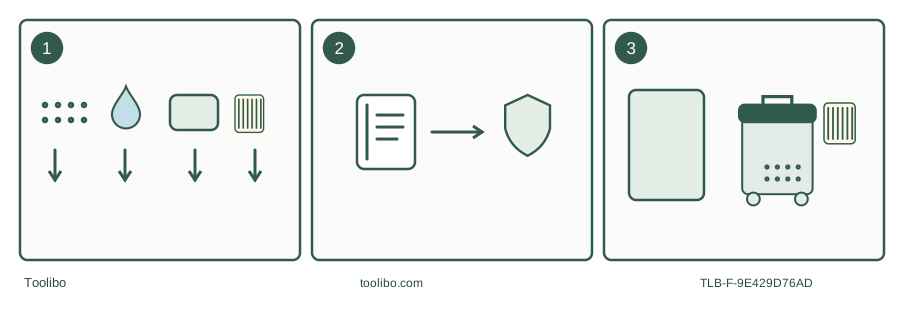
Task
Identify the material and cleaning method.
Route
Check storage, carrying and emptying.
Package
Price the correct complete configuration.
Four cleaning needs lead to different checks; a large motor cannot resolve an unsuitable application.
Describe three real jobs before opening a comparison
Write down the three jobs you actually expect to do, rather than everything a product photograph suggests. A useful entry is “remove ordinary loose debris from the car footwell once a week”, not “clean the car”. The first describes material and frequency; the second could include washing seats, collecting broken glass or recovering an unidentified liquid, each requiring a different decision.
For each job, record whether the material is known, dry or wet, roughly how much there is, where you can place the machine, and where you can empty it. Put an unresolved material in a separate column. Do not turn uncertainty into permission by buying a more powerful machine. A modest machine approved for the task is a better shortlist entry than a large one whose instructions exclude it.
Decide which kind of cleaner solves that job
A bucket-style wet/dry vacuum collects material through a hose into a container. That does not make it a powered floor washer, an upholstery spray extractor or a certified hazardous-dust system. Similar search names can hide different operating methods.
Swipe or scroll horizontally to see all columns.
| Main need | First thing to check | Do not assume |
|---|---|---|
| Known, permitted loose dry debris | Suitable filter, collection arrangement and nozzle | Every powder is ordinary household dirt |
| A small known water spill | Approved wet configuration and usable wet capacity | The whole advertised tank volume is available |
| Washing a stained fabric seat | Whether a spray/extraction process is required | Suction alone washes the fabric |
| Dust produced by a power tool | Material hazard and complete extraction-system suitability | A hose that fits proves adequate dust control |
Bosch’s UniversalVac 15/AdvancedVac 20 manual, for example, scopes use to non-hazardous materials and non-flammable liquids in private use. This is a useful reminder to read intended use before matching a nozzle; it is not a promise that the same boundary describes every other model.
Walk the carrying and emptying route
Measure the storage space with the hose and attachments included. Check the narrow doorway, stairs and threshold between storage, task and emptying point. A large drum can mean fewer emptying interruptions on one floor but a more awkward object to carry upstairs. The relevant comparison is the loaded arrangement you can safely handle, not only the bare-machine weight.
Ask where you will set down the detached head during authorised emptying. Is there a dry, stable place? Can you reach the latches without lifting the whole unit? Is a suitable drain present and usable at your chosen disposal point? A drain is a convenience feature, not permission to discharge contaminated contents anywhere.
Compare the complete working package
Make two columns: included and still needed. Enter the correct dry filter, approved wet arrangement, bags, hose, floor nozzle, crevice tool and any genuinely required adapter. For a cordless model add the compatible battery and charger if absent. A bare-tool price and a complete corded package are not like-for-like prices.
Next, check local availability of the consumables by exact part number. A bargain that lacks a compatible replacement filter is not ready for normal ownership. Do not compensate with a visually similar cartridge or a homemade seal. Save the regional model code and manual revision together so future purchases use the same identity.
Make the final choice with a small decision record
Compare no more than a few suitable candidates. Give each an answer for task permission, wet capacity if needed, carrying practicality, hose/nozzle reach, consumable availability and complete purchase cost. Mark unknowns as unknowns, not average scores. Resolve a failed essential requirement before debating minor conveniences.
A household that mainly cleans a car may rationally choose a smaller, easy-to-carry arrangement. A ground-floor workshop may favour a larger container and organised attachments. Neither choice proves stronger suction or better dust safety. The finished buying brief should explain why the selected configuration fits your work, and which jobs remain outside its scope.