
Three volumes, one carrying limit
A 20 L tank outline contains separate10 L and 12 L example markers; beside it an 8 L water load adds about8 kg and a 6 L planned-load route repeats three times for an 18 L hypothetical spill.
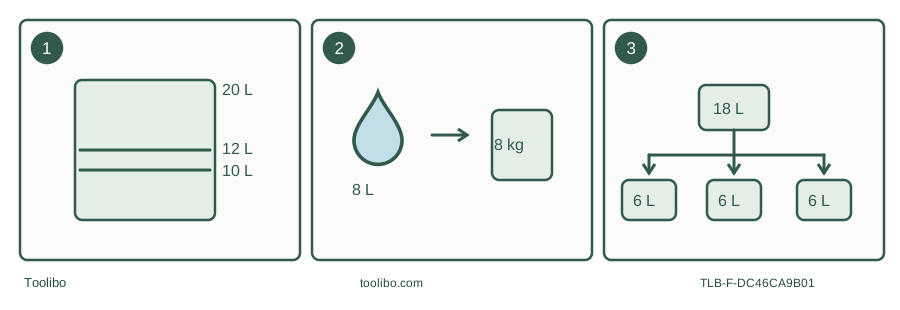
Volume
Read gross and usable figures separately.
Weight
Water adds approximately1kg per litre.
Route
Plan safe loads and emptying before collection.
WD4-family figures illustrate why nominal volume, wet collection and a manageable load are different.
Find out which capacity the box is advertising
A container has physical space, but not all of that space is available for every task. Internal parts, the collection arrangement and the machine’s liquid-stop behaviour affect the usable volume. A headline tank size is therefore not a promise that you can recover that exact quantity of water in one uninterrupted pass.
Look for separate entries such as tank content, dry collection, filter-bag capacity and water absorption. If only the first is published, mark the wet capacity unknown. Do not estimate it by measuring the outside of the bucket or subtracting an arbitrary percentage. Nor should you defeat the float or tilt the machine to squeeze in the last litre.
Read a real example without generalising it
The English WD4/WD4S/KWD4-family manual 59510240 gives a 20 L tank, but water absorption of 12 L with the handle and 10 L with the floor nozzle. These are the configurations in that manual, not universal limits for every product sold under a similar name.
The important lesson is not that every 20 L machine takes 10 or 12 L. It is that the collection setup matters, and the manufacturer may distinguish nominal size from usable liquid quantity. Check the exact regional appliance and supplied accessory before applying any number.
Swipe or scroll horizontally to see all columns.
| Number in a listing | What to record beside it |
|---|---|
| Nominal tank volume | Whether it is gross container volume |
| Wet collection capacity | Accessory/setup and any stated operating conditions |
| Bag capacity | Exact bag and whether the figure describes usable collection |
| Empty machine weight | Whether hose, accessories and battery are included |
Translate a water quantity into a handling problem
For everyday planning, a litre of water adds approximately a kilogram to the load. Eight litres therefore adds about 8 kg before accounting for the container, machine parts and accessories you are moving. This is a rough water-mass relationship, not a lifting recommendation and not a conversion for every liquid or mixture.
Use a deliberately modest planned load if that is what you can handle safely. The machine’s collection limit is an upper operating constraint, not a target you must reach. A smaller load emptied more often can be the sensible choice when a threshold, step or awkward doorway lies on the route.
Do not assume the carrying handle is approved for lifting the loaded arrangement in your chosen way. Check the manual, keep the appliance stable, and arrange help or another suitable method when necessary. A trolley also needs a practical route and secure, manufacturer-approved use; wheels do not make a heavy load safe on stairs.
Work through a hypothetical cleanup plan
Suppose there are an estimated 18 L of known, permitted clean water after the source has been stopped and electrical hazards have been resolved. You choose to plan no more than 6 L per load for handling reasons, even though the matched machine permits more. The arithmetic suggests at least three loads. Uncertain spill quantity, residual water and earlier stop behaviour may require more.
Before starting, identify the disposal point and how to reach it without carrying water over electrical connections or clean living areas. Decide where the safely disconnected head can rest if the approved emptying method requires its removal. Keep that surface dry and protected. The plan is not complete if the machine can pick up the water but you cannot empty it safely.
Understand what the full-container signal means
In the cited WD4 family, the float closes the suction opening and the machine changes sound; the instructions require immediate shutdown and emptying. That is not permission to leave the motor running while you finish another task. Other machines can have different controls, so learn the exact signal before collecting liquid.
Stop sooner for unusual discharge, instability, foam or a condition the manual does not permit. After emptying, restore the correct configuration before resuming. If storage and handling repeatedly make the task awkward, reconsider the machine size or collection method rather than treating the largest advertised drum as automatically the best purchase.