
Fit the right bag
Three panels compare a model/part match, collar sealing around the inlet, and an unfolded bag clear of the lid seam.
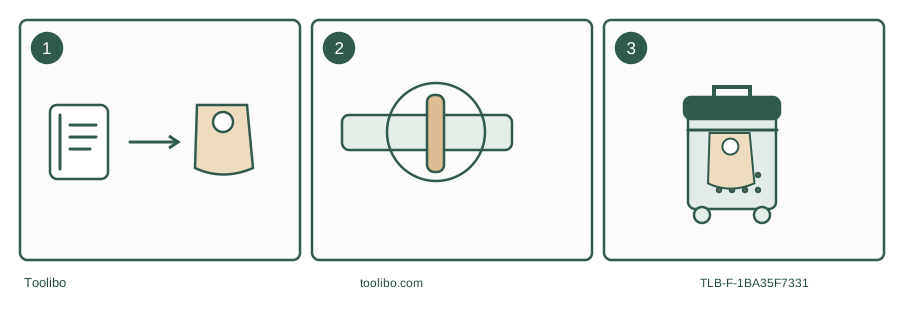
Match
Verify model, bag and dry job.
Seal
Fit the collar onto its intended inlet.
Clear
Unfold the bag and keep it out of the lid seam.
Model-specific decision path; isolate power before opening or changing the collection system.
Start with the job and the exact model
A collection bag makes permitted dry debris easier to remove, but “fits a 20 litre vacuum” is not enough information. Identify the complete model and regional version, then check the manufacturer’s compatible bag listing and any later part-number change. Kärcher WD 4 manual 59510240 specifically advises checking current filter and bag part numbers. Do not buy solely by a photograph of a similar yellow or stainless-steel tank.
This guide covers ordinary dry household debris within the vacuum’s approved use. A high-efficiency or HEPA-labelled consumable does not establish whole-machine certification for hazardous dust. Silica, asbestos, lead contamination, hot ash and combustible dust are outside this routine. Likewise, a bag cannot make an ordinary vacuum suitable for flammable liquids or vapours.
Decide whether this particular bag belongs in the machine
Check three separate facts: the bag fits this model, the bag is appropriate for the permitted dry material, and the manual calls for or allows that bag alongside the main filter. Do not substitute a household paper sack or adapt the collar with tape. A bag that appears to fit but cannot remain sealed at the inlet may simply collect some debris while the rest bypasses it.
The documented WD 4 installation unfolds the bag and presses it firmly onto the internal connection. Shop-Vac manual 87559-79 covers several series and inlet arrangements, including a removable deflector. That version needs the actual collar notches and deflector arrangement followed. These examples show why one installation photograph cannot cover every bucket vacuum.
Swipe or scroll horizontally to see all columns.
| Compatibility question | Evidence to find | Reason to pause |
|---|---|---|
| Correct model? | Manufacturer model/part cross-reference | Only a generic tank-volume claim |
| Correct collar? | Matching inlet and retention method | Loose, stretched or modified opening |
| Correct mode? | Dry-use marking and manual instruction | Water job with a dry-only bag |
| Correct filter system? | Main filter still present as required | Bag used as a substitute for it |
Install while fully disconnected
Switch off and unplug before opening the tank. Remove old routine contents and inspect the inlet and sealing surface. If the previous bag is full, handle its collar rather than tugging on a heavy paper wall. Keep the waste receptacle nearby and minimize ordinary dust release. Do not squeeze a used bag to reclaim volume; that can damage its seams or send collected material back out.
Unfold the new bag, seat the collar by the prescribed action and arrange the bag inside the tank without trapping it against the lid. Leave the internal filter and protection components in their intended positions. On a design with a removable deflector, follow that exact model’s sequence and restore the deflector where required; never discard it as spare packaging.
Check the fit before closing the head
Look around the collar for an even fit. Confirm that the material is not torn and the bag can expand rather than being tightly folded below an accessory. Remove loose nozzles or packaging from the collection space. Seat the motor head and engage every required latch without using extra force to crush a protruding bag edge.
Do not deliberately fill a new bag to test its maximum capacity. The WD 4 manual warns that overfull bags can be damaged and that fill behaviour changes with the collected material. A loss of pickup is a reason to stop and inspect, not proof that the motor needs more power. Keep one verified spare with its part label for the next change.
Change modes and dispose deliberately
Before wet collection, stop and consult the wet-mode instructions. For the documented WD 4, the bag must be removed while the flat pleated filter remains installed. A dry-only bag should not stay in the tank simply because the planned spill seems small. Other specially labelled collection systems require their own compatibility evidence; do not generalize from them.
After the dry job, replace the bag when its condition or the manual requires it. Dispose of known ordinary contents according to local arrangements, without claiming that the bag makes all waste suitable for household disposal. If unexpected oily residue, unfamiliar powder or a hazardous item appears, stop the ordinary workflow and identify the material. Correct bag selection helps collection; it cannot correct an unsuitable task.