
Read the label before comparing the number
A comparator tag stays attached to the quieter claim; soundpressure and soundpower occupy separate lanes; tool and vacuum are shown as two job sources without arithmetic addition.
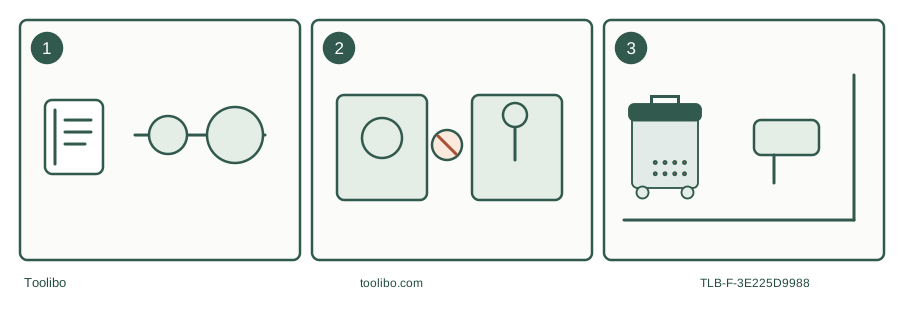
Reference
Keep the comparison model and method.
Metric
Separate sound pressure and sound power.
Job
Consider all sources and duration.
Quieter is a bounded comparison, not a universal statement about the complete job.
Start with the comparator in the small print
A claim such as quieter needs an answer to “quieter than what?” The reference may be an earlier model, one internal test setup or a particular competing product. If the comparator and conditions are missing, the claim cannot establish that the machine is quieter than every alternative on your shortlist.
Alton’s Stealthsonic page, for example, links its50% quieter statement to internal testing against DXV12P. That identifies a comparison rather than a universal result. Preserve the attribution when discussing it, and do not turn a brand’s internal claim into a Toolibo measurement. A different tank size, hose, operating mode or regional variant needs its own supporting information.
Do not treat decibels like litres or kilograms
The decibel scale is logarithmic. A percentage used in a perceived-loudness marketing claim is not a direction to halve the printed dB number. Nor does a small-looking numerical difference automatically tell you how comfortable a machine will sound in your room.
Published figures may describe sound pressure at a measurement position or sound power emitted by the source. These are not interchangeable labels. Record the metric, weighting, standard or method, uncertainty if supplied, operating condition and measurement distance where relevant. A figure without its label is an incomplete comparison.
Swipe or scroll horizontally to see all columns.
| Information to keep | Why it matters |
|---|---|
| Exact model and operating mode | Another configuration may have another result |
| Sound pressure or sound power | Different quantities cannot be placed in one ranking |
| Method, distance and uncertainty where stated | Test arrangements affect the interpretation |
| Reference machine for a comparative claim | Quieter is relative, not a universal category |
Assess the job, not just the vacuum by itself
A vacuum used beside a power tool is one sound source in a larger activity. The tool, material, room reflections and duration all matter. Buying a quieter vacuum may reduce one source of disruption without making the complete task quiet or removing the need for precautions required by the equipment instructions.
Do not add two dB figures with ordinary arithmetic, and do not subtract a marketing percentage from a tool’s noise level. If a formal exposure assessment is required, it needs an appropriate method for the actual activity. A household buying guide cannot certify that result from brochure numbers.
Make practical improvements that do not alter the machine
Plan noisy work for an appropriate time and keep other people away from the working area. Place the vacuum on a stable permitted surface, give hoses enough slack and avoid unnecessary contact that produces rattling. Securely fit approved attachments and correct a blockage through the normal isolated maintenance procedure rather than running through an abnormal sound.
Do not wrap the motor head in blankets, obstruct cooling openings, build an unapproved enclosure or move the machine into an unsuitable wet or outdoor location just to make it sound quieter. Similarly, an excessively long hose is not a free noise solution: compatibility, handling and working performance still matter. A separate room can introduce access and supervision problems and should not be assumed suitable.
Compare convenience honestly before paying a premium
Make a shortlist only from models already suitable for the material and collection task. Where sound data genuinely match, note the difference alongside hose reach, usable capacity, consumables and complete cost. If the sound data do not match, say that a reliable numerical ranking is unavailable.
A permitted demonstration in a similar setting can help you notice tonal annoyance or rattles, but a phone recording or casual app reading is not a controlled comparison across models. Do not reproduce an abnormal high-pitched condition by blocking suction. If a normally used machine develops a new sound, treat it as a condition to investigate safely, not simply a characteristic of a loud model. The goal is a less disruptive suitable system, not a reassuring adjective on the box.