
Budget the session before the battery
A 35 minute hypothetical job separates18 minutes of suction into three6 minute blocks; a second panel pairs runtime with mode/battery; a third compares complete carry packages.
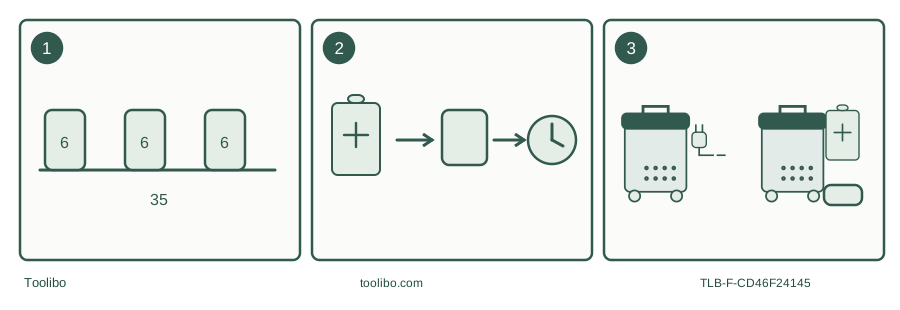
Time
Add actual suction intervals.
Configuration
Keep battery and mode with every runtime claim.
Package
Include the carried and purchased equipment.
Runtime needs a battery and mode; the example job timing is illustrative, not a product test.
Separate elapsed job time from motor-on time
A 40-minute cleanup may include moving seats, sorting loose objects, changing a nozzle and emptying a container. The vacuum might run for much less than 40 minutes, or nearly all of it. Write a simple sequence of work and estimate the time that actually requires suction. That is a more useful starting point for a cordless purchase than the total time you spend in the garage.
For an occasional five-minute pickup, avoiding a cord can be valuable. For repeated floor cleaning in one place, access to a suitable mains supply may matter more than portability. These are workflow examples, not promises that every cordless machine suits the first job or every corded machine suits the second.
Compare the exact battery, mode and advertised condition
A runtime number is incomplete without its battery and mode. Makita’s US GCV14Z listing, for example, advertises over three hours on Low and up to 35 minutes on High using an 8.0 Ah BL4080F battery. The large difference on the same machine shows why a single headline runtime is a poor buying shorthand.
Those are manufacturer figures, not Toolibo tests or a guarantee for your debris, filter state and working pattern. Do not scale them directly to another battery by dividing amp-hours. Nominal energy, battery compatibility, operating mode and load all belong in the interpretation. A battery already used with a drill may be compatible yet still leave an inconvenient work-and-recharge pattern.
Build a session budget before a purchase budget
List the planned suction intervals and add them. For example, three hypothetical six-minute stages total18 minutes of motor-on time, even if the full job lasts35 minutes. Then ask whether the documented setup offers a practical margin rather than matching that estimate exactly. Unknown or highly variable conditions should remain uncertainty, not an invented percentage deduction.
Swipe or scroll horizontally to see all columns.
| Session question | Corded consideration | Cordless consideration |
|---|---|---|
| Where is the work? | Safe, suitable supply and cable route | Battery access and machine placement |
| How long does suction run? | No battery-change pause, but follow operating limits | Exact battery/mode runtime and recharge plan |
| What must be carried? | Machine, hose and cable | Machine, hose, fitted battery and spares |
| What is included? | Plug/voltage version and necessary attachments | Tool, compatible battery, charger and attachments |
A second battery is not automatically a complete answer: the charger and available supply must support the planned rotation, and charging conditions must be suitable. Do not count on charging a hot or unsuitable battery faster than its instructions permit.
Check the whole package and route
Compare ready-to-use prices, not a cordless bare tool against a complete corded vacuum. Include any battery that is actually needed, the correct charger, essential filter arrangement and attachments. Also consider whether sharing a battery will interrupt another tool that you want to use during the same job.
For carrying, compare the configuration you will really lift. A smaller body with a large battery and stored accessories can feel different from the brochure’s bare weight. For corded use, plan the cable route so it does not become a trip hazard or cross the collection area. Do not improvise an extension setup when the matched manual or site conditions do not support it.
Make a choice without assigning a universal winner
Cordless can be a good fit for short, dispersed jobs when the approved battery setup and accessories are already practical. Corded can be attractive for longer sessions near a suitable supply. A model that supports both should still be checked for what is included and how each mode is specified; the label hybrid is not enough.
Keep material and environment restrictions separate from power source. Removing the mains cord does not authorise rain exposure, sewage recovery or hazardous dust collection. If the main task is outside the machine’s scope, change the machine category or work method first. The best power-source choice is the one that makes an already suitable cleaning process easier to complete.