
Protection and conformity are different jobs
Left: the scoped ETS 125 pad–single protector–net stack. Right: a separate soft-interface concept, not another layer to add to that stack. Shapes are not fitting templates.
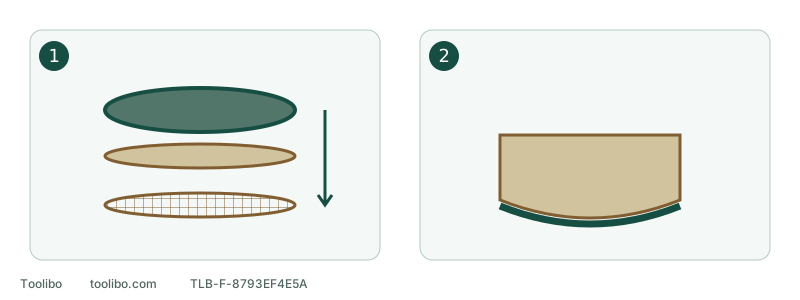
1. One protective layer
492280 supports one 203344 protector and 203296 net in the example.
2. Soft contour support
492271 serves fine contour sanding; do not insert it into the left stack without complete approval.
Left: the scoped ETS 125 pad–single protector–net stack. Right: a separate soft-interface concept, not another layer to add to that stack. Shapes are not fitting templates.
Separate the three jobs
Swipe or scroll horizontally to see all columns.
| Accessory | Purpose | What it does not establish |
|---|---|---|
| Net abrasive | Passes dust through its open structure toward extraction | Freedom from extraction or respiratory protection |
| Thin protector | Replaceable protection between net and main pad | Repair of distorted, delaminated or failed pads |
| Soft interface | Conformity for suitable contours and fine sanding | A universal upgrade for flattening and crisp edges |
Decide whether you need pad protection or contour conformity. Adding both layers “for safety” changes support without establishing an approved assembly. A flat job does not automatically need a soft interface.
A specific 125 mm combination
This is a Festool ETS 125 system, not every five-inch sander:
- Main pad ST D125-M4-W, 492280: 125 mm, M4 connection, listed for ETS 125 and specified related machines.
- Protector PP D125/2, 203344: 125 mm, 2 mm thick, protects the pad with net abrasive. Two in a packet does not mean installing two together.
- Granat Net D125 P120, 203296: 125 mm P120 net. P120 identifies this product, not a compulsory starting grade.
From machine to work: main pad, one protector, net. Festool lists wood among Granat Net applications and advises a protector with orbital/random-orbit sanders. Material, surface, finishing target and dust controls still need to suit the job; changing abrasive does not clear unknown old paint.
ETS 125 and ETS EC 125 are not interchangeable pad identities. A broader protector compatibility list does not extend 492280 mounting compatibility to every machine on it.
Inspect the main pad first
Switch off, wait for all movement to stop, then isolate power before handling accessories. Check brittle foam, collapse, delamination and attachment grip. Replace damaged pads correctly; do not cover them.
This example adds external layers to a correctly secured pad. For pad replacement, use the actual tool procedure. M4 alone does not establish screw length or tightening torque.
Fit and inspect with power isolated
- Remove loose contamination by the permitted method; reject trapped grit, folds and damage.
- Center one correct protector and match its extraction paths to the main pad. Keep edges flat, not curled or unsupported.
- Center the net. It needs no individual hole indexing like punched paper, but lower layers must not block extraction.
- Inspect edges for bulges, separation, wrong backing or debris. Check attachment gently; do not run a loose disc to flatten it.
- After the static checks, suitable extraction, identified material and secure support are ready, confirm the switch is OFF before restoring power; then follow the tool’s start/stop instructions on matching scrap. Stop for loosening, abnormal vibration or unexplained heat; do not compensate with pressure.
The sample checks attachment and finish, not unknown-material safety. Escaping dust still needs correction even with open mesh.
When is a soft interface useful?
Festool IP D120-15, 492271, is 15 mm soft foam for contours and fine sanding. It sits between abrasive and main pad for conformity, not as another name for a thin protector.
A suitable gentle curve may justify an approved interface. Flattening a stepped board joint, preserving an edge or reaching a narrow profile needs another support decision, perhaps shaped hand sanding or another process. Do not add 492271 to the example above without explicit approval for the complete multilayer assembly.
If you own another brand
Use the shopping and inspection method, not these part numbers. PCL406 and 2648-20 have their own accessory restrictions; five-inch diameter is not cross-brand approval. Without a verified combination, retain the known suitable abrasive. Do not cut holes, trim pads or hide pad damage under extra layers.
Models referenced