
Record three full model numbers
Read labels only on stable equipment that is safe to approach. Do not approach, touch or remove a battery to read its label if equipment is smoking, leaking or persistently abnormally hot; address personal safety and obtain appropriate help first.
Write DCW210, DCB205 and DCB107, not “yellow 20 V battery” or “large 5 Ah pack”. Colour, capacity and rail shape cannot replace identification, especially in second-hand or mixed kits.
DEWALT’s 20V MAX description has an 18 V nominal relationship. That explains its labelling, not compatibility with another brand’s 18 V system. Sliding into rails does not establish electrical, control or protection compatibility.
Work through a documented combination
Swipe or scroll horizontally to see all columns.
| Relationship | What this example establishes | Remaining check |
|---|---|---|
| Pack to tool | US DCW210P1 includes the tool and DCB205 | Actual identity, applicability and condition |
| Charger to pack | The same kit includes DCB107 with DCB205 | Exact charging instructions and sound condition |
| Charger to supply | The North American chart places DCB107 under 120 V chargers | Actual charger nameplate and available supply |
An appropriate intact DCB205/DCB107 setup can therefore support a checked bare-tool purchase. An unidentified “20 V” pack cannot. This is not approval for adapters or modified packs.
Read charging minutes, not runtime
The end chart in N648180, Sep18, places 240 at the DCB205 row/DCB107 column. Its unit is charging minutes and times are approximate. It does not promise four hours of sanding or an exact charge duration in every condition.
X means incompatible with that charger, not untested permission to experiment. This dated table explains its listed combinations, not every later product; new model numbers need current applicable instructions.
Inventory before buying
List existing exact pack/charger models and actual kit contents. DCW210B excludes both battery and charger. Another suffix may change quantity or capacity, so read the included-items list.
Consider whether existing packs are occupied elsewhere and whether charging arrangements suit the job. Ah alone cannot predict a board’s runtime; material, grade, pressure and process change demand.
Keep checks external
For a normal undamaged pack, switch the tool OFF before the documented insertion and retention check. If it will not seat normally, do not alter rails, tape it in or use a cross-system adapter. Remove the battery as required before accessory changes or inspection.
Do not test a cracked, deformed, leaking, abnormally hot or severely impacted pack on the tool or another charger. No terminal bridging, cell replacement or powered probing. Keep away from immediate danger and use the appropriate service route.
Resolve unlisted combinations precisely
Give support the tool model/version, full battery model, charger model/input label and region. Ask about all three relationships. “Both are 20 V” is not a complete answer.
Once power compatibility is settled, abrasive, material, workholding and dust controls still apply. A powered motor does not make an unknown coating suitable for sanding.
Check two separate compatibility links
The arrows indicate checks, not permission to fit any battery that looks similar.
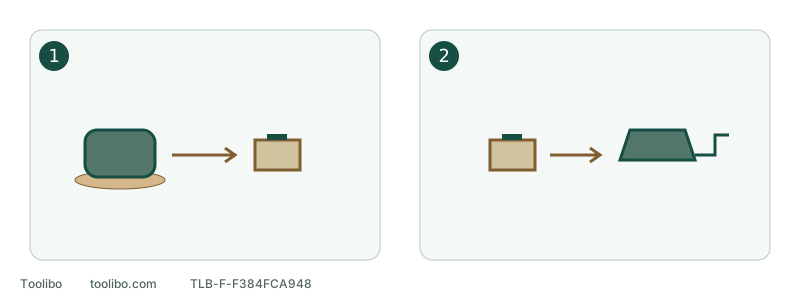
1. Tool and battery
Match the exact tool to an approved battery model.
2. Battery and charger
Check the exact pair in the charger table; a charging time is not tool runtime.
The arrows indicate checks, not permission to fit any battery that looks similar.
Models referenced