
Compare the same tool class
DWE6423 and DCW210 are both five-inch random-orbit examples. This isolates the supply decision instead of confusing it with a change to a belt or pointed pad.
Either needs suitable material, pad support, abrasive and dust control. Unknown coatings, uncertain veneer allowance and loose structure need assessment, not a switch to batteries.
Compare five practical differences
Swipe or scroll horizontally to see all columns.
| Question | Corded arrangement | Cordless arrangement |
|---|---|---|
| Fixed bench | No battery rotation once suitable supply is arranged | Available packs and charging still required |
| Moving locations | Reassess cable route and distance | No tool supply lead; battery and possibly hose remain |
| Existing equipment | Suitable supply and any compliant extension | Existing compatible packs help; voltage similarity does not |
| Interruptions | No depleted-pack stop, but abrasive/dust care remains | Changes, charging and shared packs affect scheduling |
| Complete cost | Tool plus required supply/extraction | Tool plus missing battery, charger and extraction |
Neither column proves lower weight or faster cutting. Compare ready-to-work mass, including battery, and hose pull; do not compare one bare body with another fully equipped tool.
Lay out cable and hose together
With the tool OFF and disconnected, check the intended travel over secured work for tugging, snagging and walking-route conflicts. This setup check does not require running or sanding an unknown material.
For corded, match the actual nameplate and choose extensions from the exact current/total-length instructions. Correct routes that expose the cable to abrasive, tension or wet areas.
For cordless, an external extractor still brings a hose and may need mains power itself. Removing one tool lead can be a small benefit at an already arranged bench, but a useful convenience when moving frequently with an established battery system.
Do not rank unlike electrical numbers
DWE6423 is listed at 3 A; DCW210 uses 20V MAX with 18 V nominal. Comparing 20 and 3 is not a power-performance comparison. Both list 8,000–12,000 OPM, which does not prove equal loaded removal, vibration or finish.
Compare documented settings and arrangements, not unsupported “twice as fast” or all-day runtime claims. Material, grade, pressure and removal target affect battery demand.
Apply the choice to your work
For occasional solid-wood boards at a supplied bench with suitable extraction and no battery inventory, consider corded first and budget for the correct abrasive and dust system.
For frequent changes of location with sound compatible packs and charging already available, cordless can reduce lead management. Check pack availability and dust controls at each location. No outlet is not permission to ignore extraction.
Check the order and condition
DCW210B excludes battery and charger; compare complete packages. Confirm abrasive and connection fit, sound cables or packs and reliable controls.
For accessory changes and care, stop and isolate appropriately: unplug corded tools or remove cordless batteries when safe. Unsafe damaged or hot components require their own handling precautions. Power choice changes workflow, not maintenance or material boundaries.
Removing the cable does not remove the hose
The thin line is power and the thick line is extraction; the cordless arrangement still needs hose routing.
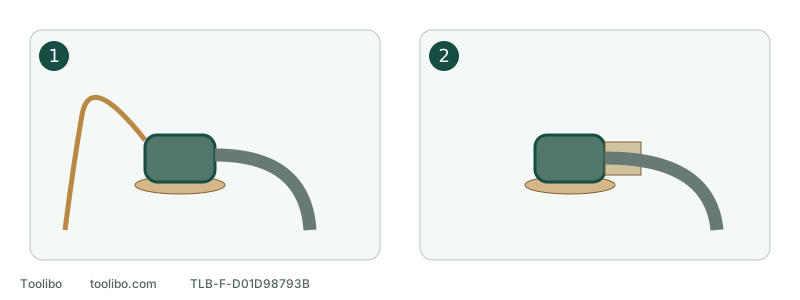
1. Corded arrangement
Manage both paths without pulling the tool off its supported surface.
2. Cordless arrangement
Plan battery availability and the remaining extraction connection.
The thin line is power and the thick line is extraction; the cordless arrangement still needs hose routing.
Models referenced