
Three switch stages, unchanged sound waves and a visible selector
Three switch stages, unchanged sound waves and a visible selector.
A
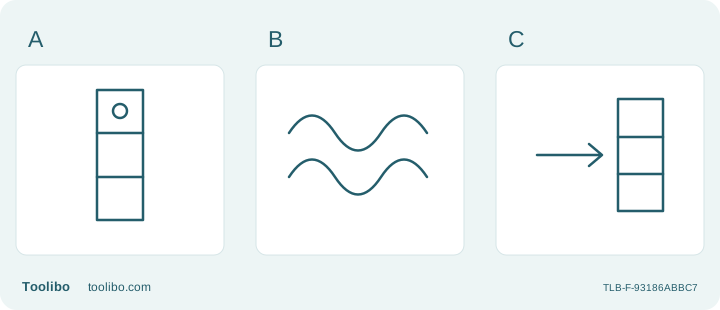
A switch movement changes the selected stage.
B
The repeated waveforms show the normal unchanged fan sound.
C
Read the physical control without directing the outlet at yourself.
UniversalHeat 600 can change heat stage without changing fan speed or sound; read the switch instead of testing the outlet with skin.
Separate the sound from the selected stage
On the German Bosch UniversalHeat 600, an unchanged motor sound after moving the switch is not by itself evidence that the switch failed. The applicable manual specifically explains that fan speed and operating sound do not change when moving from the low-temperature stage to the hotter stages. The operator therefore needs a different cue for the heat decision: the actual switch position and its model-specific meaning.
This is especially important when borrowing a tool. Someone accustomed to a device whose motor changes pitch with each position may wait for a sound that this model is not intended to produce. Repeatedly moving the switch to obtain that sound can select an unintended hotter stage.
Confirm that the observation belongs to this model
Read UniversalHeat 600 on the tool and match the regional identification. This guide concerns the German 06032A6100 listing and the shared Bosch operating document. The EasyHeat 500 appears in that document too, but its controls should not be used to interpret the UniversalHeat switch. A shared manual cover does not make the two tools identical.
With power disconnected and the tool cold, locate the switch and read its marked positions against the UniversalHeat instructions. If the markings are damaged, the switch does not match the drawing or the model cannot be established, resolve that problem before operating. Memory of a similar green Bosch housing is not adequate identification.
Make the stage check a visible action
Before directing air at an approved sample, deliberately check the selected stage. Do not rely on the sound at startup or on what the previous operator said they used. Treat a stage change as a change to the material process even if the motor sounds exactly as it did before. The hot-air capability has changed whether or not an audible cue accompanies it.
Plan this visual check while arranging the task, rather than rotating a running tool toward your face to inspect it. Keep the outlet directed into the clear work area and the inlet unobstructed. If reading the control would require an awkward movement near the sample, stop and reposition safely instead of guessing.
Do not turn your hand into a thermometer
A hand held near the outlet cannot reliably distinguish an intended stage change from a problem, and exposes skin to hot air and hot metal. Neither touching the nozzle nor trying to feel a difference in the air is an appropriate diagnostic step. An unchanged sound is already explained by the manual; it does not require a burn-risk demonstration.
Similarly, an unsuitable household object should not become a convenient indicator of whether the air is hotter. Use only a known material and a process approved by its supplier and the tool instructions. A scrap that curls or discolors proves damage to that scrap, not correct tool calibration. This guide provides no temperature, distance or timing experiment for measuring output.
Distinguish an expected cue from an unresolved symptom
Unchanged sound alone fits the documented behavior. A damaged switch, interrupted motor operation, physical damage or an unexplained loss of function is a different observation. Describe exactly what occurred rather than grouping everything under “the stages sound the same.” If the controls cannot be confidently matched to the instructions, stop using the tool and seek manufacturer support.
An approved sample failing to respond also does not automatically prove a heater fault. Material identity, fitted attachment, access and the selected stage must all be appropriate. Review those factors only after stopping and allowing safe cooling. Do not escalate through hotter stages merely to force a visible response from a material whose suitability has not been established.
Leave a useful note for the next operator
A handover note can be brief but precise: identify the model, name the last selected stage and explain that fan sound is not the stage indicator. Keep this separate from any material-specific trial record. The same acoustic behavior can accompany different heating choices, so “use it until it sounds right” is an unusable instruction.
For repeated work, preserve the complete accepted arrangement and recheck it after interruptions. If the tool has been borrowed, moved or handled by someone else, treat the current switch state as unknown until checked. The practical lesson is not that sound never matters; a new abnormal noise still deserves attention. It is that the normal unchanged sound documented for this model should not replace a direct reading of its controls.
Models referenced