
EasyHeat 500 / UniversalHeat 600 controls
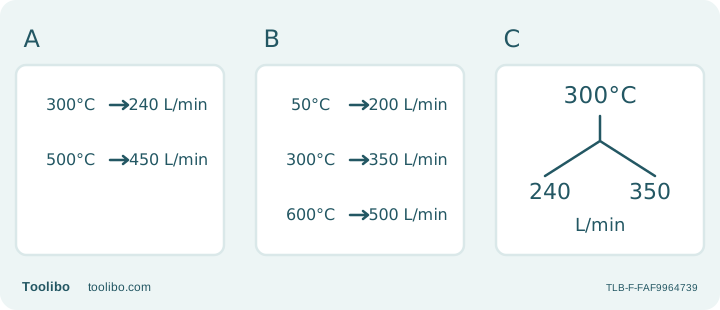
Two paired setting lists and a branch comparing airflow at the same outlet temperature.
A
A pairs EasyHeat 500’s two stages: 300°C with 240 L/min, and 500°C with 450 L/min.
B
B pairs UniversalHeat 600’s three stages: 50°C/200 L/min, 300°C/350 L/min and 600°C/500 L/min.
C
C compares the shared 300°C choice: EasyHeat supplies 240 L/min, UniversalHeat 350 L/min. These are German 230 V tool ratings, not material temperatures.
Different airflow at equal outlet temperature.
Start with the process you need to control
The German EasyHeat 500 and UniversalHeat 600 are related corded heat guns, but do not offer the same switch positions. EasyHeat has two linked heat and airflow settings. UniversalHeat adds a lower-temperature stage and a third choice. Neither permits independent selection of any desired temperature and airflow combination.
Compare the material’s permitted process first. Write down whether it requires gentle airflow, a temperature range, a particular nozzle or a cooling support. Then check whether either tool meets the complete requirement. A higher maximum is irrelevant when the material needs a condition below the simpler tool’s minimum stage.
Separate three different conveniences
Two stages can simplify decisions during a straightforward permitted task. An extra stage provides another documented condition. UniversalHeat’s removable shield changes access but exposes more hot metal. These are different properties, not combined proof that one tool is always safer or easier to use.
For household work on an open bench, keep the shield fitted. If reaching the object requires entering a hidden cavity or approaching combustible material, neither model solves that underlying access problem. Rearrange or reject the work. The existence of a removable part is not permission to attempt an unsuitable location.
Compare the package you would actually receive
The checked basic order numbers are 06032A6000 and 06032A6100. The UniversalHeat page also offers another accessory package. Do not compare a basic name or price with a photograph of a different package. Confirm the exact number, included accessories, local electrical version and instructions before deciding what additional equipment is needed.
Every attachment must be approved for the model and task. Even a nozzle producing the desired airflow pattern does not establish that the workpiece tolerates heat. Budgeting for a nozzle and demonstrating material suitability are independent checks. Neither should be treated as a substitute for the other when assembling a usable setup.
Make a realistic household decision
If you already have a material with a documented hot-air process that fits a fixed stage, a representative sample is still necessary. Inspect the cooled result, including the underside and adjacent finish. If you need the additional low-temperature stage, that is a concrete reason to consider UniversalHeat rather than a general claim of superiority.
If neither tool provides the necessary control, or the object cannot be isolated safely, choose another process. This comparison does not rank speed, service life or value, or establish price and availability. Both require a cooling area and supervision. Another switch position does not remove those responsibilities.
Compare the whole operating routine
Sketch both proposed arrangements on paper: cold inventory, first sample, interruption, nozzle change and storage. This makes the features less abstract. If you alternate approved materials, check whether the required conditions exist without awkward compromises. If you only occasionally use one size of approved sleeve, determine whether the additional stage would actually be useful.
The bench can decide the issue before specifications do. Both tools need room for the air path and cooling, as well as the correct local supply. A small housing does not make a crowded shelf a suitable bench, and extra features cannot compensate for unknown material behind the target.
When replacing a tool, do not presume that old nozzles are compatible. Check approved fit and condition separately. A fair comparison considers two complete usable arrangements, not a bare tool against another with accessories already available. Keep price and availability outside the conclusion until the exact regional packages have been confirmed.
Read the verified operating values
The decisive mapping is EasyHeat 500: 300°C/240 L/min or 500°C/450 L/min; UniversalHeat 600: 50°C/200 L/min, 300°C/350 L/min or 600°C/500 L/min. Even their shared 300°C choice has different airflow. UniversalHeat adds a 50°C cooling stage and a higher top stage, not independent heat and airflow selection. These German 230 V outlet ratings use 20°C ambient conditions and ±10% temperature measurement accuracy; they are not material treatment instructions.
Models referenced