
Starting clearance, a recovered gap and a rejected split sleeve
Starting clearance, a recovered gap and a rejected split sleeve.
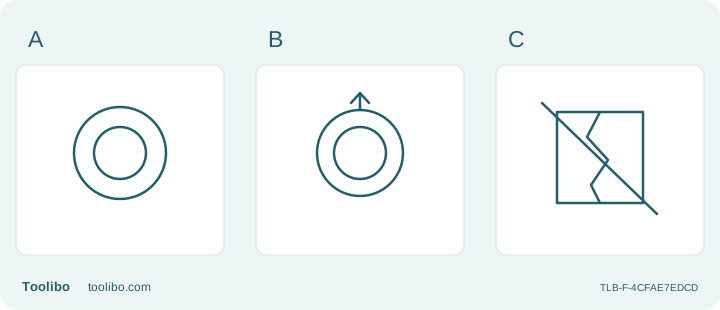
A
The starting opening must pass the installation route.
B
A remaining cooled gap needs size and access review, not assumed extra heat.
C
A split or distorted sleeve is a rejected sample.
A sleeve must pass over the installation route and meet its specified recovered fit; extra heat cannot correct an incompatible size.
Begin with the sleeve rather than the gun
A sleeve that remains loose is not necessarily asking for more heat. Its starting size, specified recovered size and intended application may simply be wrong for the object. This guide concerns manufacturer-approved hot-air shrinking on a known, detached, non-electrical and nonstructural item. It does not establish insulation performance, waterproofing, strain relief or suitability for a safety-related handle. The Makita HG6031V and HG6530V documents include sleeve shrinking, but that tool capability does not approve any particular sleeve and object combination.
Keep the sleeve packaging. Identify its material, dimensional information and permitted recovery process before cutting it. A loose sleeve from an unmarked assortment cannot supply the information needed for a defensible fit decision.
Check both installation clearance and recovered fit
Consider the whole route the unheated sleeve must travel. A raised end or shoulder may require a larger starting opening than the central section where the sleeve will finish. Compare that requirement with the supplier’s stated recovered size. Passing over the shoulder and gripping the middle are separate conditions; a sleeve that satisfies only one is not suitable. Do not assume stretching, splitting or extra heating will repair that mismatch.
For a nonround object, a single width measurement is particularly misleading. Corners and recesses influence how the sleeve contacts the surface. Ask the sleeve supplier whether the intended shape is appropriate rather than converting a round-product size label into an unsupported guarantee of complete contact.
Include length and position in the cold check
Read the supplier’s information about longitudinal change instead of assuming the sleeve stays the same length. Establish which part of the detached object needs coverage and which features must remain exposed. A sleeve initially centered over a feature can finish short or migrate during recovery. Cold placement should therefore be judged against the supplier’s finished dimensions, not merely the appearance before heating.
Use a representative sacrificial object or sample with the same relevant shape and material. Rehearse support and access without power. If a clamp, end stop or supporting surface hides the side that needs inspection, improve the arrangement before heating. Holding a small item in a hand is not a substitute for proper support.
Separate an unsuitable size from uneven exposure
After a supplier-approved trial and complete cooling, inspect the entire circumference. A generally uniform but loose sleeve suggests a different question from one that fits on one side while remaining visibly unchanged on the other. In the first case, revisit the specified recovered size and whether recovery was completed within the allowed process. In the second, examine access, support and the air path before deciding whether any further trial is justified.
Neither appearance proves a diagnosis by itself. Record the observations without calling the tool defective or the sleeve fully recovered. Wrinkling, splitting, discoloration or an altered underlying surface make the sample unacceptable. More heat is not an appropriate way to conceal damage or overcome an incompatible material.
Change one justified condition on a fresh sample
If the sleeve size is wrong, choose a properly documented size and repeat the cold checks. If the setup obstructed the air path, correct that setup while everything is disconnected and cool, then use a fresh equivalent sample. Changing sleeve size, nozzle and tool setting together makes the result hard to interpret. The purpose of a trial is to establish a repeatable permitted process, not to find how much damage the materials survive.
Record airflow as well as temperature control. HG6031V dial behavior depends on airflow position; HG6530V’s display concerns the tool’s airflow rather than temperature throughout the sleeve and object. A familiar dial position or screen reading cannot certify that a different nozzle or support arrangement produces the same result.
Accept only the function actually demonstrated
Define success before testing: correct coverage, supplier-specified recovered fit, no visible damage and no unintended change to the object after cooling. Retain the accepted sample and its packaging information with the setup note. If the supplier requires checks beyond appearance, those checks remain necessary. A tidy surface alone establishes neither durable adhesion nor any protective rating.
When no sleeve can both pass over the required feature and recover to the intended fit, stop looking for a hotter setting. A different sleeve design or a non-heating method may be needed. Likewise, if the object lacks approval for the sleeve’s recovery process, finding an apparently successful sample does not remove that uncertainty. The useful result of diagnosis can be rejecting the combination before damaging the finished object.
Models referenced