
Wallpaper strips and usable drops
Original schematic: Wall width determines whole strip positions. Roll length must yield complete usable drops. Pattern and trimming can change the cutting plan. Not to scale.
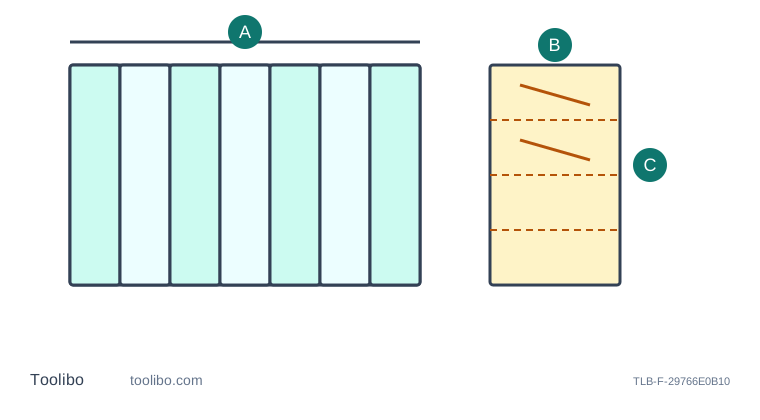
A
Wall width determines whole strip positions
B
Roll length must yield complete usable drops
C
Pattern and trimming can change the cutting plan
Conceptual geometry only, not to scale. The diagram does not establish installation clearances or reproduce a manufacturer control layout.
Establish the strip layout before measuring the wall
Wallpaper is usually supplied as a narrow roll, but installed as full-height drops. Dividing the wall area by the printed roll area can therefore underestimate the purchase. A strip left too short for the wall is not equivalent to the same area in a usable full-length drop. Pattern matching, trimming and the position of openings further change what can be cut from a roll. Begin with the chosen wallpaper’s actual width, usable roll length and pattern instructions, rather than a generic waste percentage.
Measure the intended papered width along a clear wall plane and check height at several positions. A sloping ceiling or uneven floor may require different drop lengths. Use a direct tape for short returns or places where the laser cannot establish the intended endpoints. Keep people out of the beam path, and never aim at eyes or optical instruments. A laser provides dimensions; it does not determine a safe fixing location or certify the wall’s condition.
Convert a width into a whole number of strips
Consider an illustrative wall 3.60 m wide and wallpaper 0.53 m wide. Six full widths cover 3.18 m, so at least seven strip positions are needed across that width. The seventh position may need only a narrow exposed portion, but it normally still consumes a piece cut from the roll. This arithmetic is an example, not a measured room or a recommendation for a particular product.
Before treating seven as the final count, consider the starting edge and any pattern-centering requirement. Centering a motif over a fireplace can produce partial strips at both outside edges. A return around a corner may require its own treatment rather than sharing the last sliver of the preceding wall. Discuss the hanging layout with the installer or follow the wallpaper manufacturer’s instructions. Do not assume that making the leftover strip mathematically narrower always produces a workable installation.
Check how many complete drops each roll can supply
Suppose the wall height is 2.40 m and the chosen illustrative cutting plan adds 0.10 m total for trimming. Each nominal drop is then 2.50 m. A hypothetical 10 m usable roll would yield four such lengths before allowing for pattern alignment, damaged ends or other restrictions. The 0.10 m is not a universal allowance: use the actual product and installer’s requirements.
A repeating pattern can change this division. For a straight match, the cutting length may need to advance to a suitable whole repeat. For an offset match, adjacent strips may require alternating starting positions. Read the actual repeat and match instructions before rounding the roll count. A roll with enough total metres can still provide fewer complete matching drops than a simple division suggests. Keep a small cutting sketch showing which full drops come from each roll, instead of relying only on a total wall area.
Handle openings and purchasing without hiding assumptions
A door or window reduces the area actually covered, but does not necessarily save an entire full drop. A strip crossing a window position may still need matching pieces above and below it, and the pattern relationship can prevent using an arbitrary offcut. Mark opening edges against the proposed strip layout. Only count an offcut as reusable when its length, width, pattern and intended position make that reuse plausible.
Check each wall separately if its height or pattern alignment differs. Add short returns, chimney sides and other papered faces explicitly; do not count the hidden wall behind a projecting chimney breast as an exposed face. Keep the original dimensions available when the product changes, because a different roll width or repeat can change the answer even though the room has not changed.
Before ordering, ask the supplier about matching batch numbers, return restrictions and the amount recommended for the actual hanging plan. Keep the geometric calculation separate from any reserve roll purchased for mistakes or future repairs. If the installer will make the final quantity decision, hand over the wall dimensions, strip layout and unresolved details together. That is more useful than a single confident roll count that conceals its assumptions.
Models referenced