
Wall rectangles and openings stay separate
A wall elevation contains a window and door, with a separate narrow coloured wall zone.
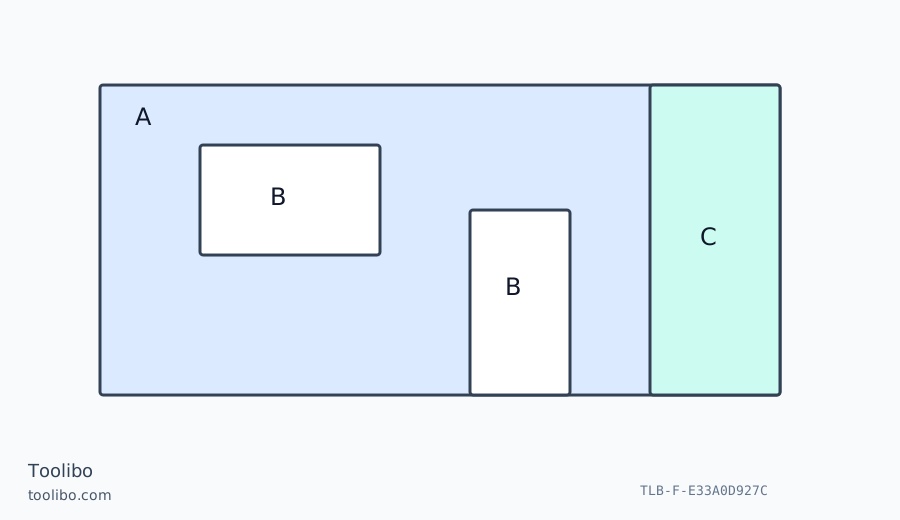
A
Start with the wall boundary.
B
List openings as separate measured shapes.
C
Keep a differently painted region in its own total.
Subtract openings once and keep different colours or coating systems separate from the geometric total.
Match the basic TLM99 before selecting area
This guide concerns the basic TLM99 identified as STHT1-77138 in the historical Asia catalogue. Its matched instructions cover direct distance, area and volume. Select the function needed for the task and follow the display prompts for each input. A calculated area is not the latest wall length and must not be recorded as one. Similar TLM99s or TLM99si names do not justify importing wireless features or copying their button sequences.
Before estimating paint, decide which surface is being painted. A full wall rectangle and the exposed wall around a fitted cupboard are different quantities. Sketch the wall and its major openings before starting the area function. Measure width and height against stable opaque surfaces, keeping people out of the beam path. The meter supplies dimensions; you still define the boundaries of the work.
Keep a small calculation ledger
Beside the wall name, record each input and then the resulting area. If subtracting a doorway, enter it as a separate rectangle with its own dimensions. This makes an unexpected total traceable. Do not subtract the same door twice merely because it appears on both a room sketch and a shopping worksheet. Keep the raw wall measurements even after producing a net area.
For a room that is not rectangular, calculate individual wall surfaces rather than multiplying an assumed perimeter by one convenient height. Sloping ceilings and stepped returns need different geometry. For a narrow piece of trim, a direct tape may be more useful than arranging an artificial laser target. The choice of measuring method should follow the boundary you need, not a wish to use the area button for every surface.
Turn geometry into a purchase estimate carefully
Area is only one input to a paint order. Check the selected paint’s stated coverage, the planned number of coats and the required surface preparation separately. The instrument cannot determine whether a porous wall will absorb more paint. Retain the unrounded area calculation, then choose a purchase quantity using the actual container sizes and the product guidance.
Inspect the meter externally and stop if it repeatedly gives inconsistent results over an otherwise reproducible span. Do not open the housing or invent a correction. Never aim the laser at eyes or optical instruments. This is a decorating estimate, not a structural assessment, a hidden-service detector or evidence that a proposed drilling position is safe. Keep those installation decisions separate from the area calculation.
Build the paint worksheet one surface at a time
Consider a room with a large window and two doors. First list its wall rectangles, then the openings. Decide which openings to subtract for the actual decorating plan. Edge work and available pack sizes can mean that a small opening does not reduce the practical purchase quantity. That is a purchasing decision, however, and should not be concealed inside an inaccurate geometric total.
Write down each wall’s width and height before calculating its area. Where the ceiling slopes, divide the surface into shapes that can be described and checked. Do not treat a convenient full-height rectangle as equivalent to the sloping region. A chimney breast has a front face and side returns. Omitting those returns, or counting the covered wall behind the projection, changes the estimate in different directions.
Keep totals separate for different colours or coating systems. One whole-room area cannot tell you how much ceiling paint and wall paint to buy. Record the coat count and the coverage for each chosen product. If the surface is new plaster or has extensive repairs, ask the supplier how preparation affects application and coverage; do not expect the meter to account for it.
Before ordering, check the arithmetic from the original inputs. A misplaced decimal or the same length entered twice can still produce a plausible total. Keeping the inputs lets you correct arithmetic without repeating the entire survey. It also helps when changing paint after measuring: the geometry remains, but coverage and pack sizes may change. The TLM99 reduces repetitive measurement work; it does not choose a product-specific order quantity.
If a colour changes partway across a wall, measure and name each painted region rather than assigning the entire wall area to both colours. Keep decorative borders and trim separate when their coating or coverage differs. This preserves a clear route from the measured surface to the specific tins on the shopping list.
Models referenced