
Equal diagonals do not prove a rectangle
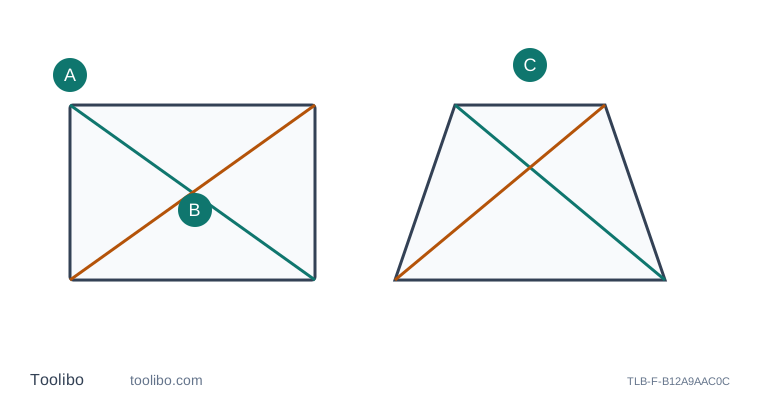
Original schematic: Define four endpoints in one plane. Compare both diagonal paths. A nonrectangular trapezoid can also have equal diagonals. Not to scale.
A
Define four endpoints in one plane
B
Compare both diagonal paths
C
A nonrectangular trapezoid can also have equal diagonals
Conceptual geometry only, not to scale. The diagram does not establish installation clearances or reproduce a manufacturer control layout.
Define the corners before comparing the numbers
A diagonal connects two specified corners. If the starting reference sits against skirting while the target lands above it, the line may not connect the corners drawn on your plan. Start by identifying four points in the same intended measurement plane and labelling them around the room. If trim or a rounded finish prevents access to a point, record that limitation instead of quietly substituting another point.
A folding endpiece can help establish a starting contact on a model designed for it, but its reference must be selected or detected as that exact model requires. Leica’s D2 v1 and Stanley’s reviewed TLM165 do not justify one universal endpiece procedure. Follow the matched instructions. Keep the beam away from people and optical instruments, and do not force an endpiece against a rounded or obstructed corner.
Understand what the rectangle example does show
For an ideal rectangle with sides 3 m and 4 m, the diagonal is 5 m because 3 squared plus 4 squared equals 5 squared. Its opposite diagonal is also 5 m. This is an illustrative mathematical relationship, not a claim that a particular room or instrument has been tested. The calculation assumes a right angle between the two sides.
If two measured diagonals differ, something about the assumed rectangle, the selected endpoints or the measurement setup needs investigation. The difference does not identify the cause by itself. One wall may be skewed, one target may have missed the intended corner, or the two measurements may have been taken at different heights. Inspect the geometry and reproduce the setup before deciding that a wall must be altered or that the meter is faulty.
Recognise why equal diagonals are not enough
Equal diagonals do not, by themselves, prove that a four-sided shape is rectangular. An isosceles trapezoid can also have equal diagonals while its opposite parallel sides have different lengths. Therefore, matching two diagonal readings is insufficient evidence that a fitted rectangular component will sit correctly within an opening. The side lengths, corner relationships and local wall profiles still matter.
Similarly, one diagonal that agrees with a calculation based on two nominal dimensions does not describe every part of the opening. A wall can bow between corners, or trim can project into the space halfway up. A rigid object occupies width, height and depth, not just one line across a plan. Check the clear dimensions at the planes relevant to the object and use the installer’s method for any required angle or profile verification.
Use diagonals as a diagnostic, not a fabrication approval
A useful comparison records both diagonal endpoints and the height of the measurement plane. Repeat each diagonal after lifting and replacing the meter. If a difference is stable, inspect whether the four selected points really form the shape you intended to compare. Use direct measurements or appropriate layout tools to investigate the sides and angles rather than averaging the two diagonals into a reassuring single number.
For a furniture-planning sketch, the result may simply tell you that the room should not be drawn as a perfect rectangle. Preserve that finding in the plan. For a countertop, fitted cabinet or structural opening, obtain the responsible professional’s final survey. Their tolerances, templates and installation allowances are separate from this household comparison. Do not present a pair of equal readings as a certificate of squareness or a guarantee of fit.
If the instrument cannot reach a corner cleanly, change to a method that can establish the required points rather than inventing an endpiece correction. If the readings remain inconsistent under the specified conditions, follow the manufacturer’s checking or service route and do not open the instrument. The value of a diagonal check is that it can reveal a question worth investigating. Its limitation is that a few line lengths cannot fully describe the shape or safety of a real building opening.
Models referenced