
A transferred value keeps its room endpoints
A room outline with a measured wall is linked to a phone-shaped record containing three separate entries.
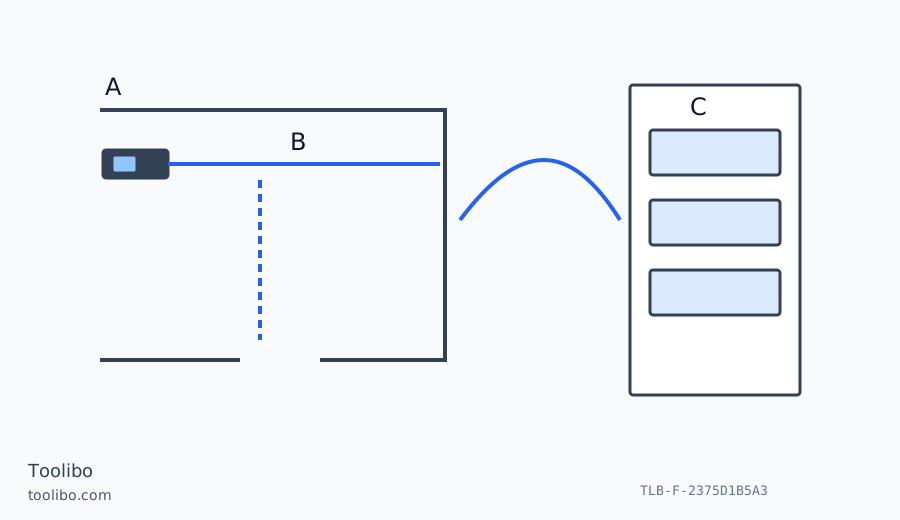
A
Choose the physical reference before measuring.
B
Keep the measured span attached to the room plan.
C
Open the saved record and check the destination entry.
The transfer path carries a number; the room, endpoints, height and receiving field still need checking.
Choose the reference before the connection
The GB GLM 50-27 C, order number 0601072T00, is the red-laser model; do not treat the CG name as interchangeable. Its checked instructions offer rear, front and tripod-thread references. Select the one that physically meets the starting point before recording a room. A connected phone cannot detect that you rested the wrong part of the housing against the wall.
The reference choice is in the basic settings; the measuring functions are selected through the functions menu. Use the instrument’s built-in help for the chosen function rather than improvising a button sequence from another GLM. Begin with a simple distance that you can independently verify. Record it on paper as well as in the receiving application. Check the unit and destination field after transfer. Bluetooth transfers a value; the room, wall and purpose remain your responsibility. Avoid building a whole plan before discovering that new readings overwrite the same field.
Give the digital plan a physical anchor
Name the room and draw a fixed starting corner. Add measurements clockwise, marking interruptions such as doorways and projecting cupboards. Where an app invites a photograph, use one that clearly shows the measured surfaces without private household material. A number attached to the wrong side of a photograph is less useful than a plain labelled sketch.
If the connection fails, stop trying to solve two problems at once. Confirm that the meter still measures normally, then use a written record while checking the current app and device compatibility. Do not assume the app’s present operating-system requirements from the age of the meter.
Review before relying on the drawing
Compare several transferred values with the display and your notes, especially after changing units or reference settings. Preserve raw distances separately from calculated areas. A triangle or wall-area function is useful only when its geometric assumptions match the room.
Do not open the housing to troubleshoot wireless problems or defeat safety features. Keep the beam away from eyes, people and optical instruments, and turn it off between setups. Label the saved plan with its purpose so a room-planning sketch is not mistaken for final installation dimensions.
Build a room file that another person can audit
Consider a small renovation in which you need to send room dimensions to a designer. Create one record per room rather than a single unstructured list for the whole home. Give the starting corner a name that is unambiguous in both the sketch and the room, such as the corner beside the entrance. A label like “left wall” becomes ambiguous when the reader faces the opposite direction.
For each transferred value, retain the two endpoints and the measurement height. Note whether you measured above skirting, between skirting faces or to a cabinet face. These details are particularly important when a photograph makes a wall look flat but furniture conceals a projection. Keep photographs as context, not as a substitute for identifying the measurement plane.
Before leaving the room, open the saved record rather than merely assuming that transfer succeeded. Compare an early reading, a middle reading and the final reading with your written backup. Check whether the software displays a rounded value or has changed the unit. If the application calculates an area, preserve the lengths that generated it. A designer may need to distinguish an actual measured width from a dimension inferred by software.
When a measurement is corrected, mark which value replaces the earlier one and why. Do not leave two unexplained alternatives in different photographs. If you cannot establish the right endpoint, label that dimension as unresolved and arrange a suitable direct measurement. This makes the record useful without presenting uncertain data as finished design information. The benefit of a connected meter is a cleaner transfer process, not permission to skip this review.
Models referenced