
RYOBI PBLJS01: verify blade seating before the first cut · Diagram
A blade sits in a clamp beside a guide roller; a separate battery symbol indicates isolation.
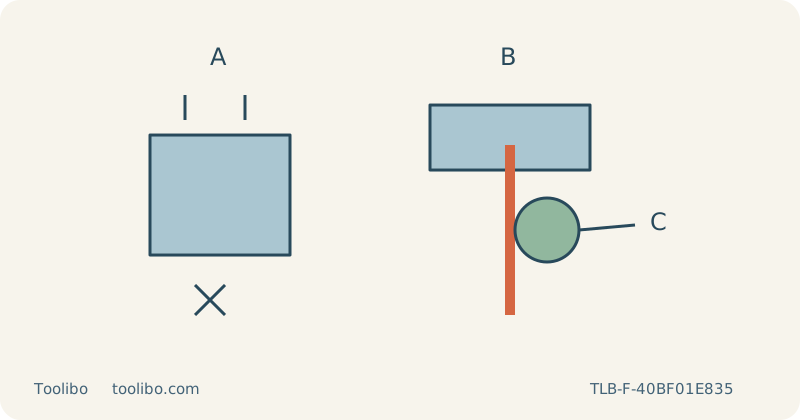
A
Remove the battery
B
Seat the T-shank fully
C
Check roller alignment
A blade sits in a clamp beside a guide roller; a separate battery symbol indicates isolation.
Identify the holder before fitting a familiar blade
The US RYOBI PBLJS01 machine is sold in a tool-only listing identified as PBLJS01B. The checked operator’s manual specifies T-shank blades. A mixed blade packet from another saw is not automatically compatible, even if one blade seems to enter the holder. Confirm the shank and the accessory’s intended wood application before moving the release lever or connecting the battery.
This guide uses blade retention as the first decision in preparing a loose wood sample. It does not treat the scrap as permission to test a doubtful clamp under power. A correct blade must seat fully and remain securely held while the battery is removed. If that cannot be established with the normal procedure, the cutting task stops until the tool has been inspected or serviced.
Follow the complete seating sequence
Switch off, remove the battery and allow the old blade to cool. Move the blade-clamp lever in the direction shown by the manual and hold it at the prescribed resistance point. Do not extend its travel with a tool. Remove the old blade carefully, keeping your fingers away from its teeth and checking for broken pieces that could remain in the holder.
Insert the suitable T-shank blade as far as possible into the slot, with the teeth in the cutting direction. Some insertion resistance may be encountered, but that does not justify hammering or prying. Centre the back of the blade in the groove of the blade-support roller, then release the lever. Check that the blade is completely seated and securely clamped. An off-centre blade back should be corrected with the battery removed, not by running the tool against wood.
Keep the controls separate from the clamp decision
The PBLJS01 has a switch trigger, a lock-on button and a separate speed control. The product listing describes the speed control as a dial, while the checked manual describes a lever above the trigger. Identify the actual control on the nameplated machine rather than relying on one generic illustration. The retention procedure does not require starting the motor or engaging lock-on.
Rehearse the normal stop and lock-on release sequence with the battery removed. For a first short sample, leave lock-on unused. Select an appropriate speed and orbital setting for the wood and blade. A high speed setting does not compensate for poor seating, and a low setting does not make it safe to observe the holder closely while it operates.
Build a sample that does not load the blade sideways
Secure the base at zero bevel and confirm that the guard is intact. Clamp matching, uncoated wood on a stable bench, independently supporting the waste so it cannot fall or pinch the cut. Check beneath the whole route for the full moving blade stroke. A blade long enough for the board can also be long enough to strike a support that was overlooked below it.
Arrange eye and hearing protection, suitable respiratory protection, compatible dust control and ventilation. Keep the hose clear of the base route and the stopping control. With the base supported and the blade initially clear of the wood, start and establish the chosen speed before feeding. Maintain flat base contact, modest forward feed and no sideways levering. Stop if the blade twists, the base lifts or the tool labours.
Read the result without mistaking completion for secure retention
Switch off and wait for the blade to stop fully before withdrawing it or setting the saw down. Remove the battery before inspecting or adjusting anything. Check the blade’s seating again and examine the cut face, not just the pencil line. A completed sample does not prove the setup was good if the blade is bent, the lower edge wandered or the clamp now feels uncertain.
For repeat work, record the blade identity and inspect it between tasks with power isolated. Do not pull on a hot blade, lubricate the clamp with an improvised product or modify a shank to cure a recurring problem. If a correctly matched blade repeatedly loosens or the lever no longer returns normally, take the saw out of use and obtain service advice. Replacing consumable blades is ordinary preparation; compensating for a defective retention mechanism is not.
Models referenced