
Narrow, flared and curved outlet paths
Narrow, flared and curved outlet paths.
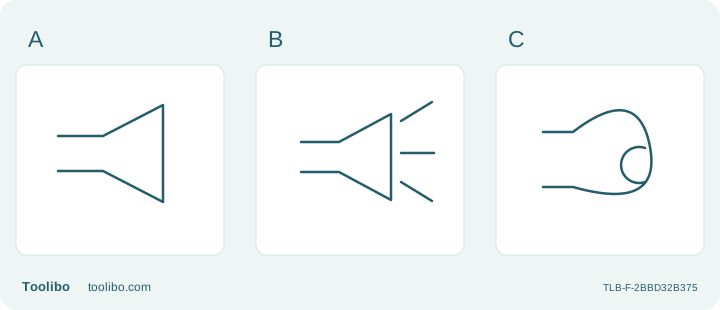
A
A narrowing outlet concentrates the air path.
B
A flared outlet exposes a broader region.
C
A curved outlet redirects air but does not create a cold barrier.
Concentrated, broad and curved air paths expose different areas; nozzle compatibility and a representative trial still govern the choice.
Start with the working area rather than the accessory count
A nozzle changes where the air goes. That makes it a process choice, not simply an upgrade included in a larger kit. Before choosing one, identify the part of a known, detached, non-electrical object that requires heating and the adjacent areas that must remain unchanged. The material process must already be approved by the relevant suppliers. A better shaped outlet cannot make an unsuitable adhesive, unknown coating or heat-sensitive base acceptable.
Draw the desired heated region on a sketch rather than marking the actual object with an unverified coating. Include the reverse side, nearby edges and support points. This small planning step makes it easier to see whether the air needs to cover a broad area or remain localized. It also exposes situations where no accessible airflow path avoids an unsuitable neighboring material.
Understand what concentrating the air changes
A reduction or concentrator nozzle directs airflow toward a smaller region. The Makita HG6530V manual describes the reduction nozzle as concentrating heat over a small area; the Wagner FURNO 300 accessory descriptions distinguish a concentrated pattern from a long, narrow one. These descriptions identify intended airflow geometry, not a measured footprint on every workpiece.
Concentration can make a small target easier to address, but it also makes careless dwelling more consequential. Do not assume a narrow outlet is automatically gentler because it heats less area. It may require a different permitted process from the bare outlet. If the target is smaller than you can reliably follow with a moving air stream, stop and reconsider the method rather than relying on an improvised shield or unusually close nozzle position.
Distinguish wide coverage from guaranteed uniformity
A wide-slot or flare attachment spreads the air differently from a concentrator. That may suit a permitted process with a broader working region, but a long outlet does not prove the entire object receives equal heat. Edges, curves and changes in thickness can still respond differently. A broad pattern also exposes more of the surroundings, including supports and parts that were easy to avoid with the narrower pattern.
Evaluate coverage on a representative sample with the same construction. Inspect both the center and boundaries after cooling. A satisfactory center with damaged edges is a failed trial, not a reason to ignore the edges on the actual item. If completing the required area would repeatedly overlap already treated sections, account for that in the supplier-approved process rather than inventing a new heating schedule.
Treat curved and protective attachments as specific tools
A curved deflector changes the path around a workpiece, while a protective attachment redirects part of the stream away from a neighboring region. Neither creates a cool barrier around everything outside the intended target. Heat can still travel through the object, and the metal attachment itself becomes hot. Consider its physical clearance as well as the visible direction of the outlet.
Use such an attachment only for the documented application and with materials approved for that process. An illustration of a nozzle near glass is not permission to experiment on an unknown glass object. This guide does not extend accessory examples to pipe work, installed windows, electrical assemblies or hidden spaces. If the actual job falls outside the detached material process already approved, select another method rather than borrowing a suggestive picture.
Match the accessory to the exact tool
The US HG6530VK package is associated with the HG6530V body and its manual. A shared Makita manual also covers HG6531C controls, which do not become available because a nozzle fits. Similarly, an accessory shown for the US FURNO 300 should be verified against that model rather than selected solely by brand color or an apparently similar collar.
Check the manufacturer-approved compatibility and inspect the cold accessory for distortion, blockage and a sound mounting interface. A loose fitting can fall off; an unsuitable or obstructed nozzle can interfere with airflow. Do not crimp, tape or pack the connection to make a questionable accessory usable. If the actual package differs from a photograph, verify its contents before planning a process that depends on a particular nozzle.
Requalify the process after a nozzle change
Keep the nozzle identity with the trial record. Changing from a bare outlet to a concentrator is a meaningful change even if the display or switch position stays the same. Repeat the relevant sample check within the material supplier’s permitted conditions and inspect the cooled result before proceeding. The display describes the tool’s operating information, not a map of the object’s temperature.
Choose the attachment that allows the approved task to be performed with a clear air path, stable control and an acceptable cooled result. More nozzles do not establish better performance, and this comparison is not a hands-on ranking. If no compatible attachment provides a workable pattern without exposing unsuitable material, that is a useful conclusion: the heat gun is not the right method for this particular object.
Models referenced