
Separate work and cooling zones
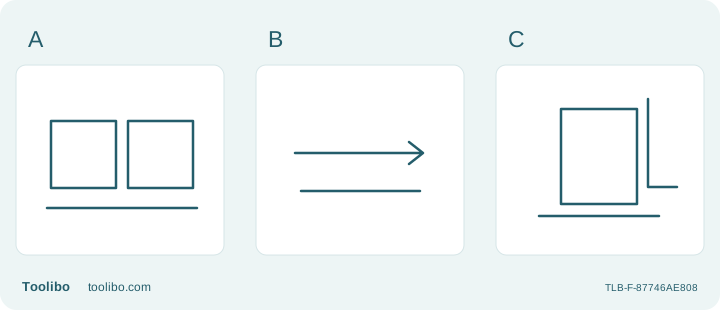
A supported sample, an upright tool and a cable routed between clear zones.
A
Separate the work area from the cooling area before starting.
B
Rehearse the unobstructed air path without power.
C
Keep the parked tool and cable protected from accidental pulling.
Keep the parked tool and cable protected from accidental pulling.
Begin with the air path beyond the workpiece
The working area is not only the place where the object sits. Follow the path of hot air after it reaches the object. A wall, cloth, cable or the opposite side of an open container may receive heat without being the intended target. If you cannot see and control that path, rearrange the bench before switching on. A clear foreground does not prove the space behind the sample is suitable.
Use a dry, stable, noncombustible surface suitable for the approved process. Remove combustible items and keep the tool away from solvents, fuel and aerosols. General room ventilation does not make an unknown material safe. First identify the material and the manufacturer’s permission; reject unknown coatings and concealed assemblies rather than trying to compensate with a different setting.
Support the sample without putting fingers in the stream
A small object should not require your fingers in the hot-air path. Prepare an appropriate fixture or support while everything is cold, then rehearse the movement with the gun unplugged. The sample must remain stable without blocking airflow or forcing your hand across the hot nozzle. Check the movement needed to reach the far side as well as the easiest front face.
The support should allow the finished sample to cool without being moved. If achieving the intended heating effect means immediately catching an object as it falls, the arrangement is incomplete. Redesign the support instead of depending on fast reactions or a glove as the main control. Think through the result before beginning, not after the sample becomes too hot to reposition safely.
Reserve another place for the tool itself
The cooling zone should be separate from the sample and use the stable resting arrangement specified by the manufacturer. Keep the hot outlet clear of objects and out of reach. Do not assume a case, hook, soft mat or cardboard box is suitable because it happens to be convenient. The correct resting orientation comes from the actual tool’s instructions.
Keep the cable away from heat and walking routes. Allow enough movement without loose loops that can catch and pull over a supported gun. Check this before connecting the supply, including the movement required to stop and put the tool down. A carefully supported tool can still fall if its cable crosses a moving chair or the edge of a busy passage.
Decide how to handle an interruption
Plan what you will do if someone enters or you need to leave the bench. Stop heating and follow the model-specific shutdown and cooling procedure; do not leave a powered gun aimed at the work. A documented powered cooling mode still requires supervision and does not mean the nozzle can be touched. Another person’s arrival is a reason to control the situation, not to hurry a hot tool into storage.
Once both sample and tool are cold, inspect the support and nearby surfaces for unintended heat effects. Clean only as the manual allows, with the power disconnected. Store accessories only when cold and dry. The diagram illustrates separation of areas, not a certified clearance distance, a fire barrier or universal permission for stationary operation. Do not improvise a resting or stationary-use arrangement the manufacturer does not permit.
Look at the bench from someone else’s position
Before connecting power, step back and consider how someone entering would see the arrangement. Can they recognize the area that must remain clear? Could a bag, sleeve or chair pull the cable? Could a child reach the gun from the other side? If separation depends only on your memory, improve the physical layout before beginning.
Keep the outlet clear and avoid an arrangement that requires crossing a hot sample to unplug the tool. The plug should remain accessible without dismantling the work area. Do not use improvised extension wiring or overloaded power strips to make an inconvenient location usable. The electrical instructions for the actual tool remain the relevant requirements.
Check protection without using it to excuse the layout
Use the protection specified for the tool and the approved process, including suitable eye protection. Clothing and gloves must not compromise control or cover the inlet. Protective equipment supplements a controlled arrangement; it does not make an unknown coating or a material producing harmful fumes acceptable.
A successful bench plan allows you to support the sample, control the visible air path, stop heating, disconnect when appropriate and leave both hot items protected while they cool. If that sequence cannot be achieved in the available space, stop during planning and choose another arrangement or process. Do not discover the missing cooling zone while already holding a hot gun.
Models referenced